Golang Channels (chan) in 5 Minutes
Go channels for beginners, in five minutes, on a real Go program: why one send into a channel crashes with 'all goroutines are asleep - deadlock!', what an unbuffered channel really is (a hand-off, not a mailbox), what a buffer of three slots changes, and why a range over a channel deadlocks after the last value until the sender calls close.
Not a mailbox
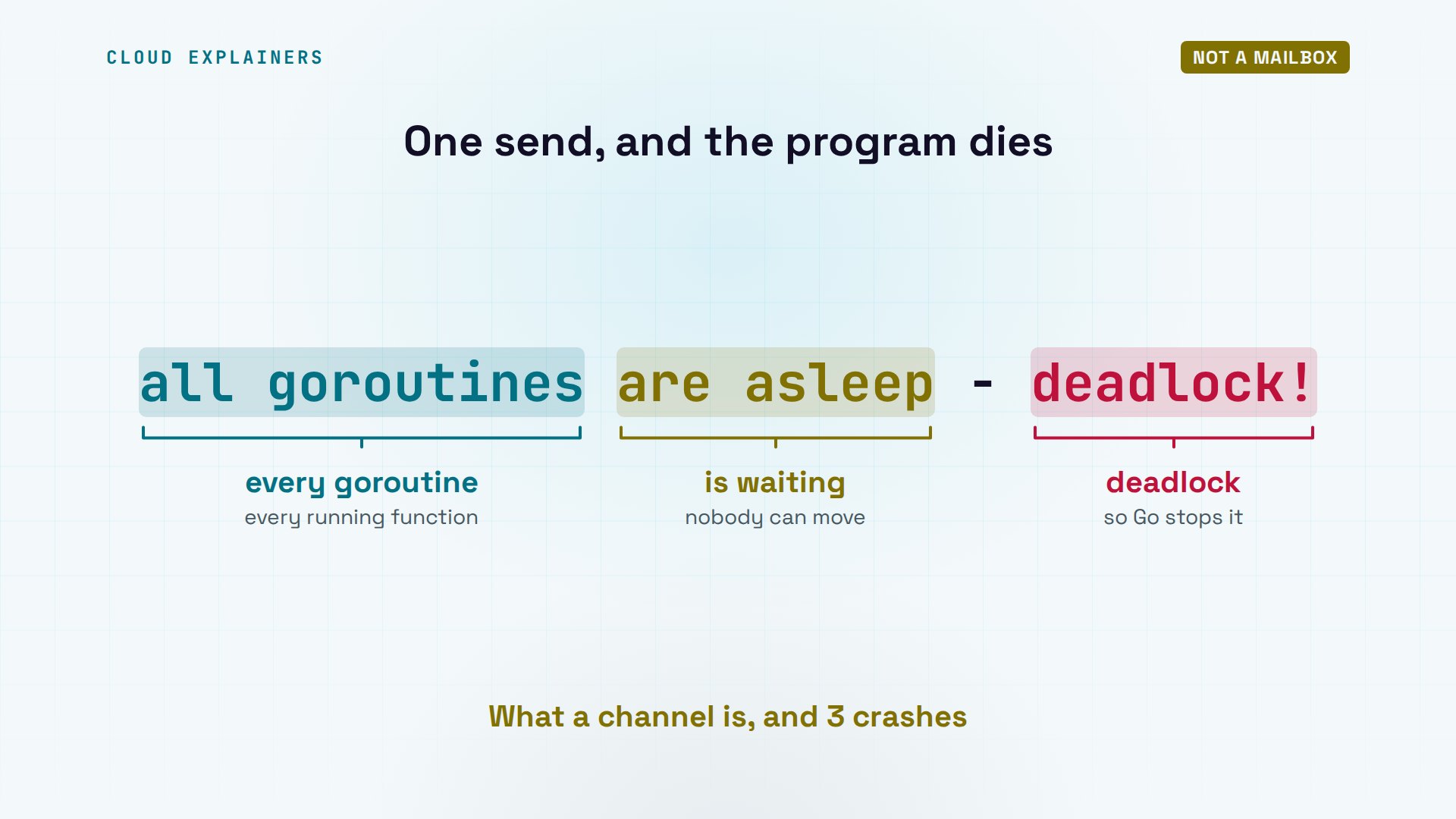
Your Go program crashed: all goroutines are asleep, deadlock. All it did was send into a channel. In five minutes: what a channel is, and three crashes beginners hit.
Most beginners picture a channel as a mailbox: drop a value in, pick it up later. Sue thought so too: her program loads the hay truck for Rich's horses.
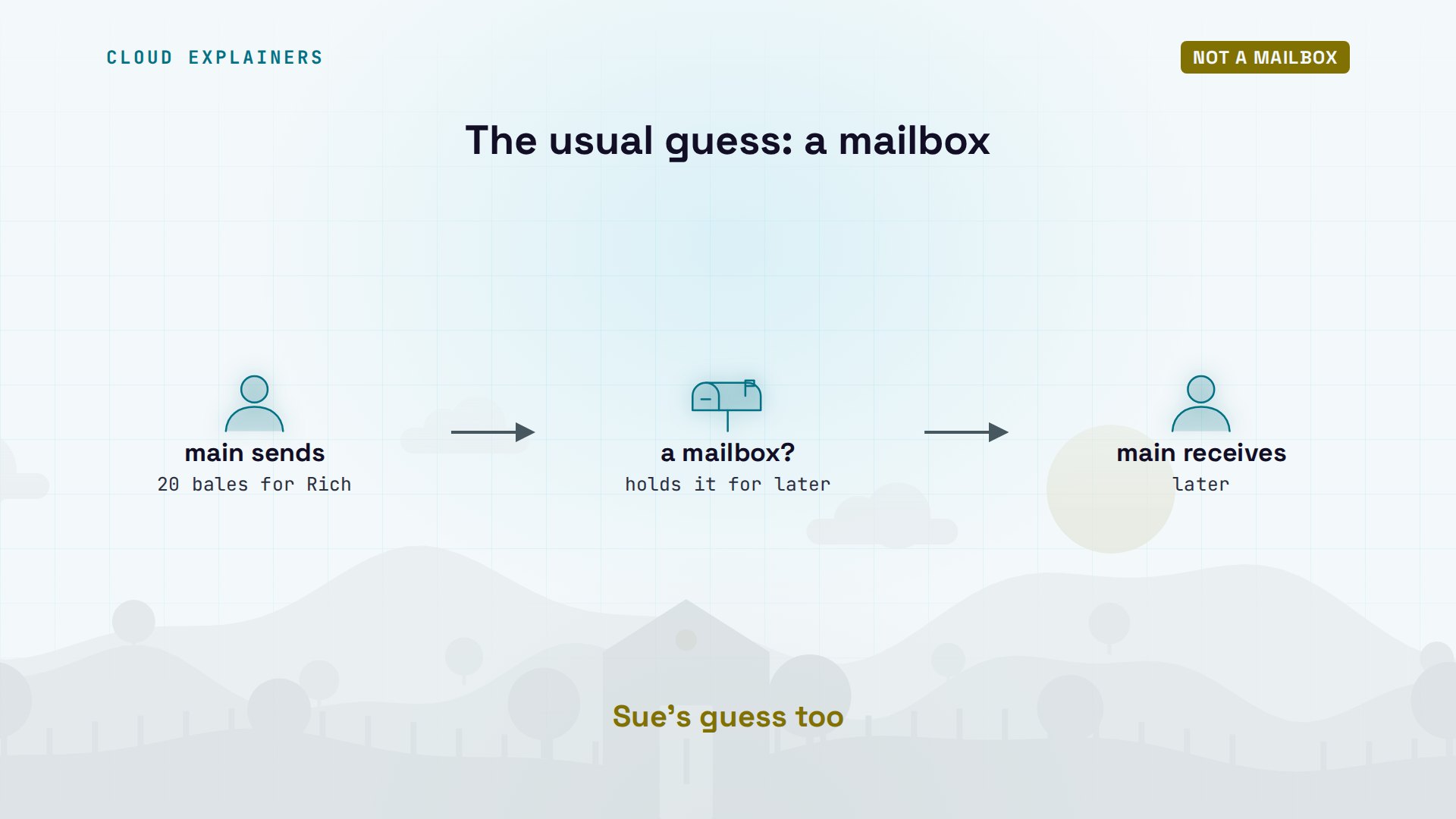
Her program makes a channel, sends an order with an arrow pointing into orders, then takes it out with an arrow pointing out. Same crash. And it's not the last one.
sed -n '6,8p' main.goorders := make(chan string) orders <- "20 bales for Rich" fmt.Println("loading:", <-orders)
go run .fatal error: all goroutines are asleep - deadlock!

goroutine 1 [chan send]:
main.main()
    /home/sue/hay/main.go:7 +0x38
exit status 2
A hand-off
So what is a channel? Not a box, but a hand-off. A send waits until someone receives, and a receive waits until someone sends. Main sent, and then waited for someone to receive. But the only receiver was main itself, on the very next line, so nobody ever came. So Sue moves the send into a small function, and starts it with the word go. That makes it a goroutine: a function running alongside main. Now one side sends, the other receives, and the order gets through.
sed -n '6,10p' main.goorders := make(chan string) go func() { orders <- "20 bales for Rich" }() fmt.Println("loading:", <-orders)
go run .loading: 20 bales for Rich
Rich and his horses are waiting on twenty bales. And Sue's real program sends four orders before the driver shows up. A hand-off can't hold them: they need somewhere to wait.
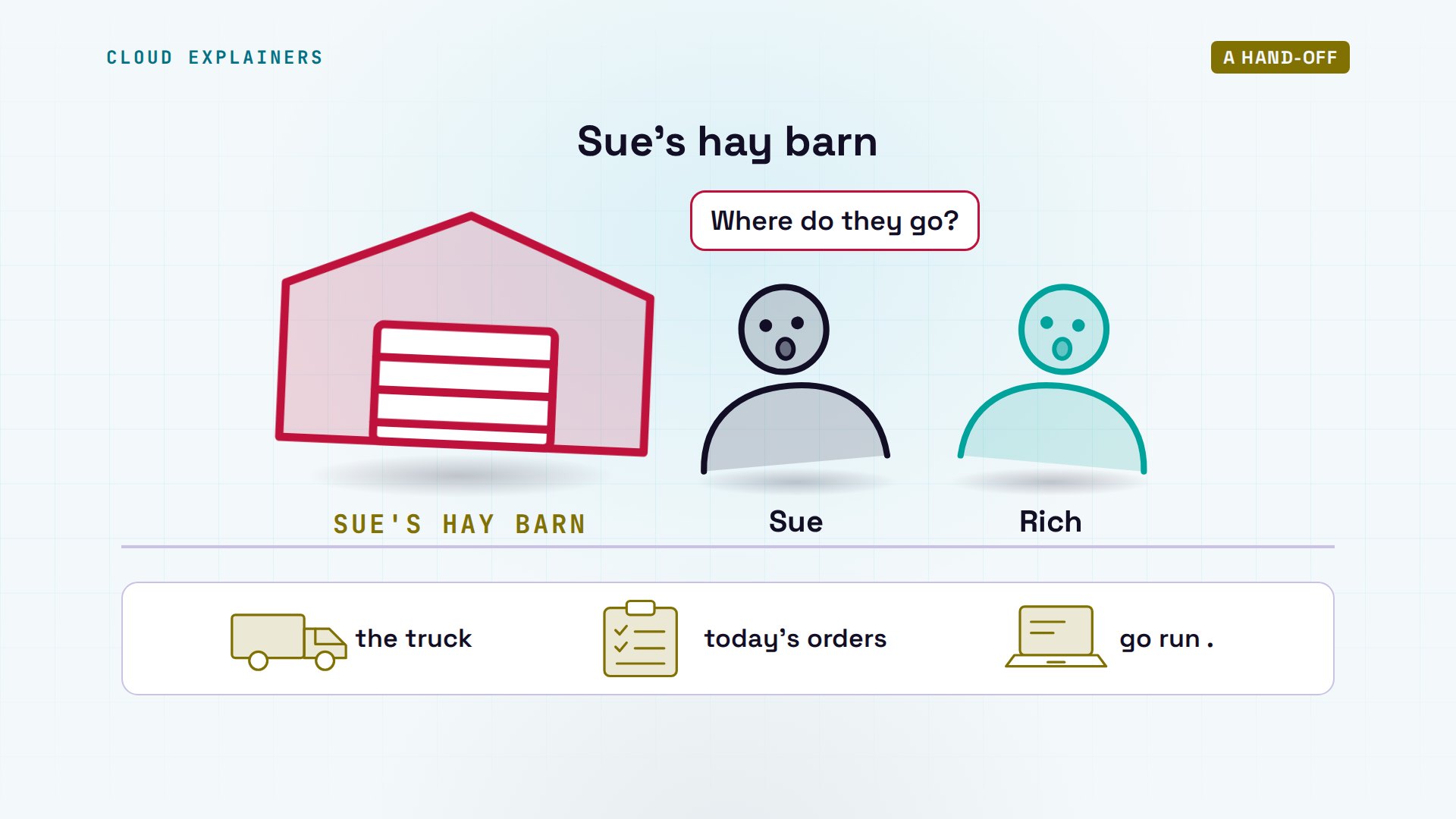
Think of passing a bale by hand, from Sue in the loft to the driver. She can't let go until he takes it: an unbuffered channel.
Put a cart between them, and she can drop in three bales before he takes one. That cart is called a buffer.
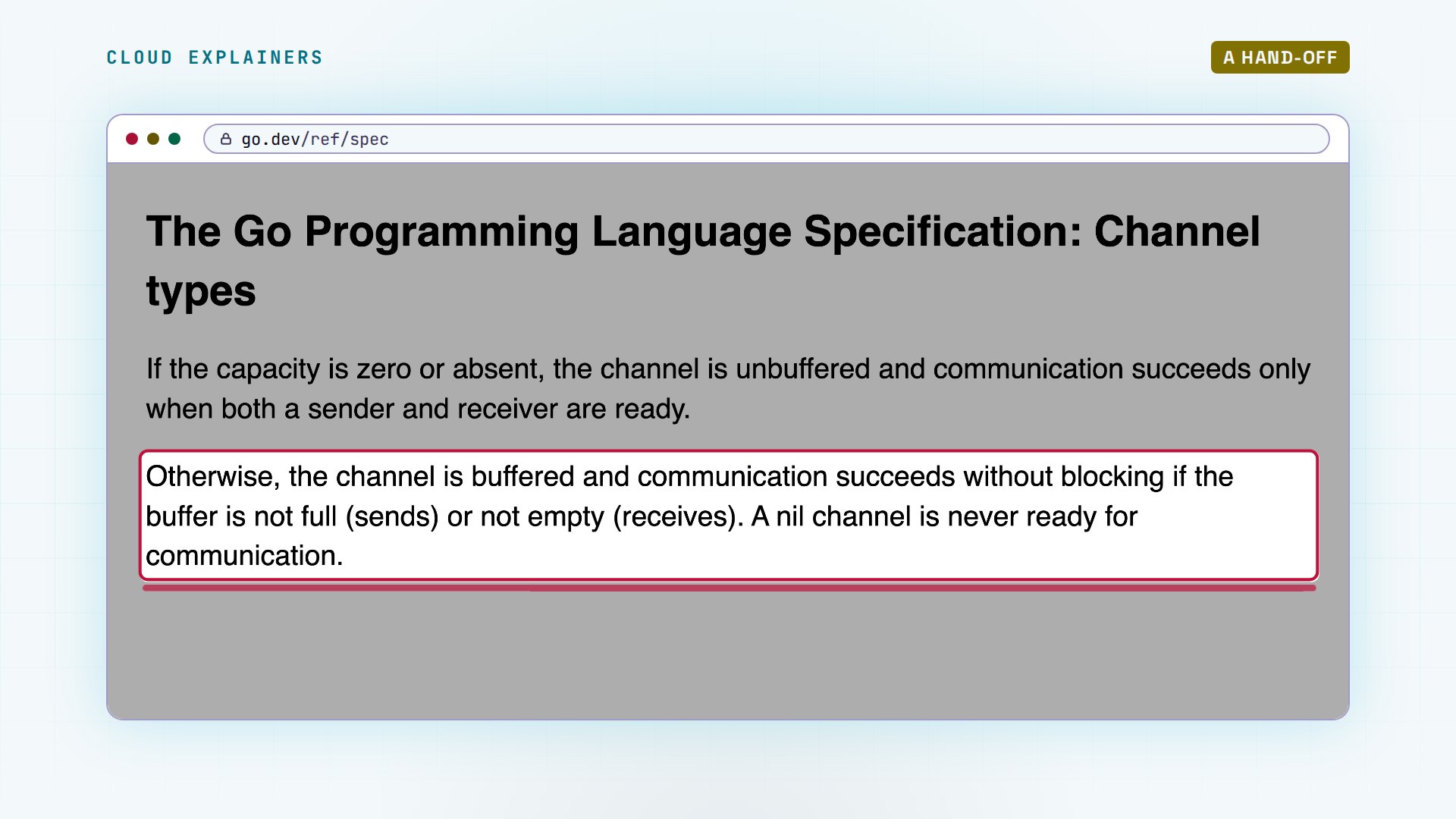
Go's specification says the same: with no buffer, both sides must be ready. With a buffer, a send only waits when it's full.
A cart with slots
Sue has four orders, and the driver isn't there yet to take them. Can a channel hold them? You create a channel with make, and Sue's first one had no number, so no slots. Put a number after chan string, here three, and the channel gets a buffer with three slots. Now she can send three orders with nobody receiving yet. The len function counts the orders waiting, and cap counts how many fit: three of three.
sed -n '6,11p' main.goorders := make(chan string, 3) orders <- "20 bales for Rich" orders <- "12 bales for Oak Stables" orders <- "8 bales for the riding school" fmt.Println("on the cart:", len(orders), "of", cap(orders)) fmt.Println("loading:", <-orders)
go run .on the cart: 3 of 3
loading: 20 bales for Rich
Then a fourth order comes in: thirty bales for Maple Farm. The cart is full, and nobody is unloading. Guess first: does Go drop an order, or wait? It waits, forever. Same crash, and look at the line under it: goroutine one is stuck on a chan send.
sed -n '10,11p' main.gofmt.Println("on the cart:", len(orders), "of", cap(orders)) orders <- "30 bales for Maple Farm"
go run .on the cart: 3 of 3
fatal error: all goroutines are asleep - deadlock!

goroutine 1 [chan send]:
main.main()
    /home/sue/hay/main.go:11 +0x108
exit status 2
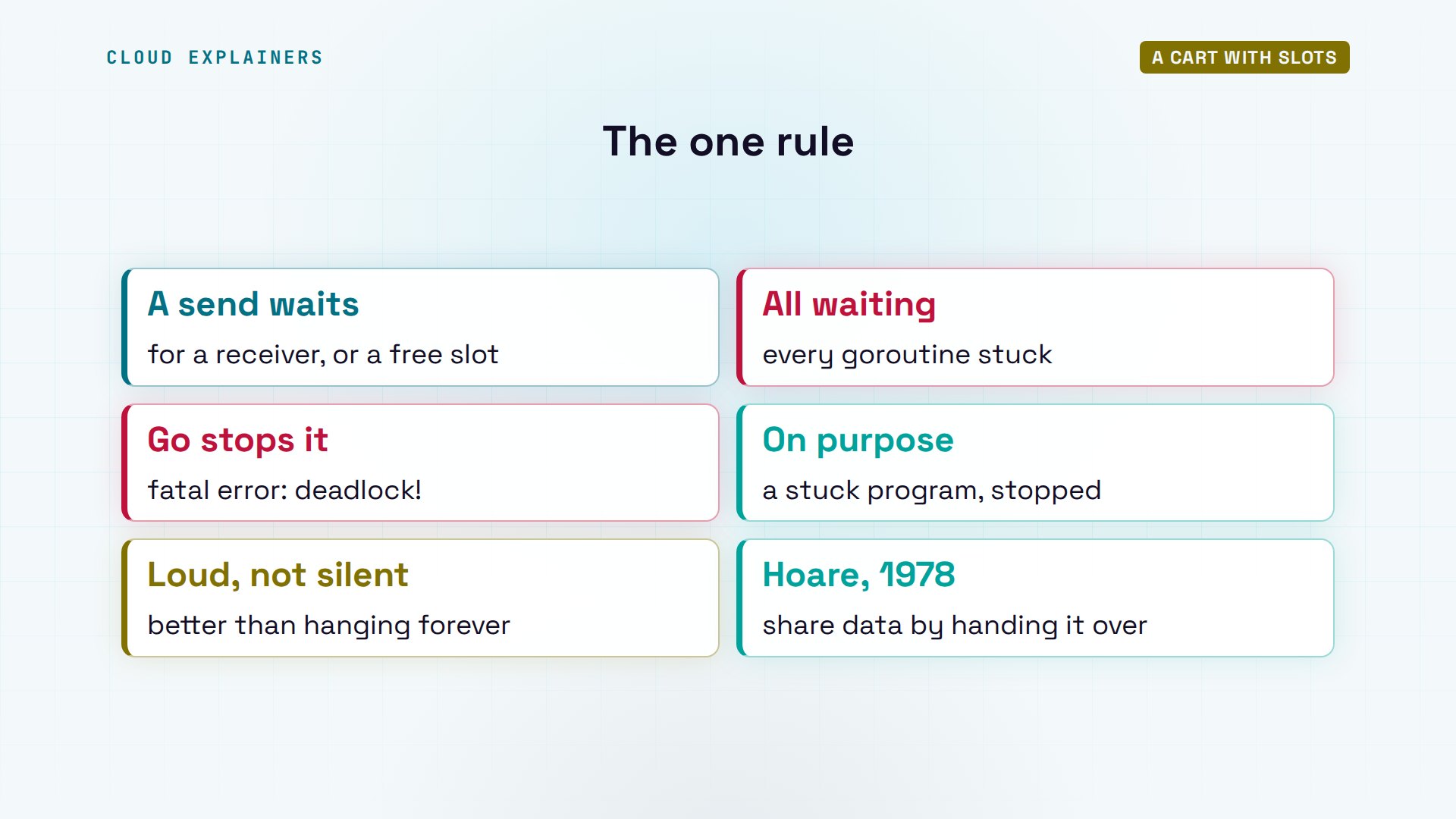
The rule behind these crashes: a send needs a receiver, or a free slot. When every goroutine is waiting, Go stops the program. That's on purpose: a program that stops loudly beats one that hangs silently. The idea goes back to a 1978 paper by Tony Hoare.
Saying you're done
A full cart needs someone unloading it. So Sue moves the sending into a loader goroutine, and main takes each order off the channel with a for loop using range. All four get delivered, and then: deadlock, this time stuck on a chan receive. And a bigger cart won't fix this one.
sed -n '6,15p' main.goorders := make(chan string) go func() { for _, o := range todaysOrders { orders <- o } }() for o := range orders { fmt.Println("delivered:", o) } fmt.Println("all orders delivered")
go run .delivered: 20 bales for Rich
delivered: 12 bales for Oak Stables
delivered: 8 bales for the riding school
delivered: 30 bales for Maple Farm
fatal error: all goroutines are asleep - deadlock!

goroutine 1 [chan receive]:
main.main()
    /home/sue/hay/main.go:12 +0xe0
exit status 2
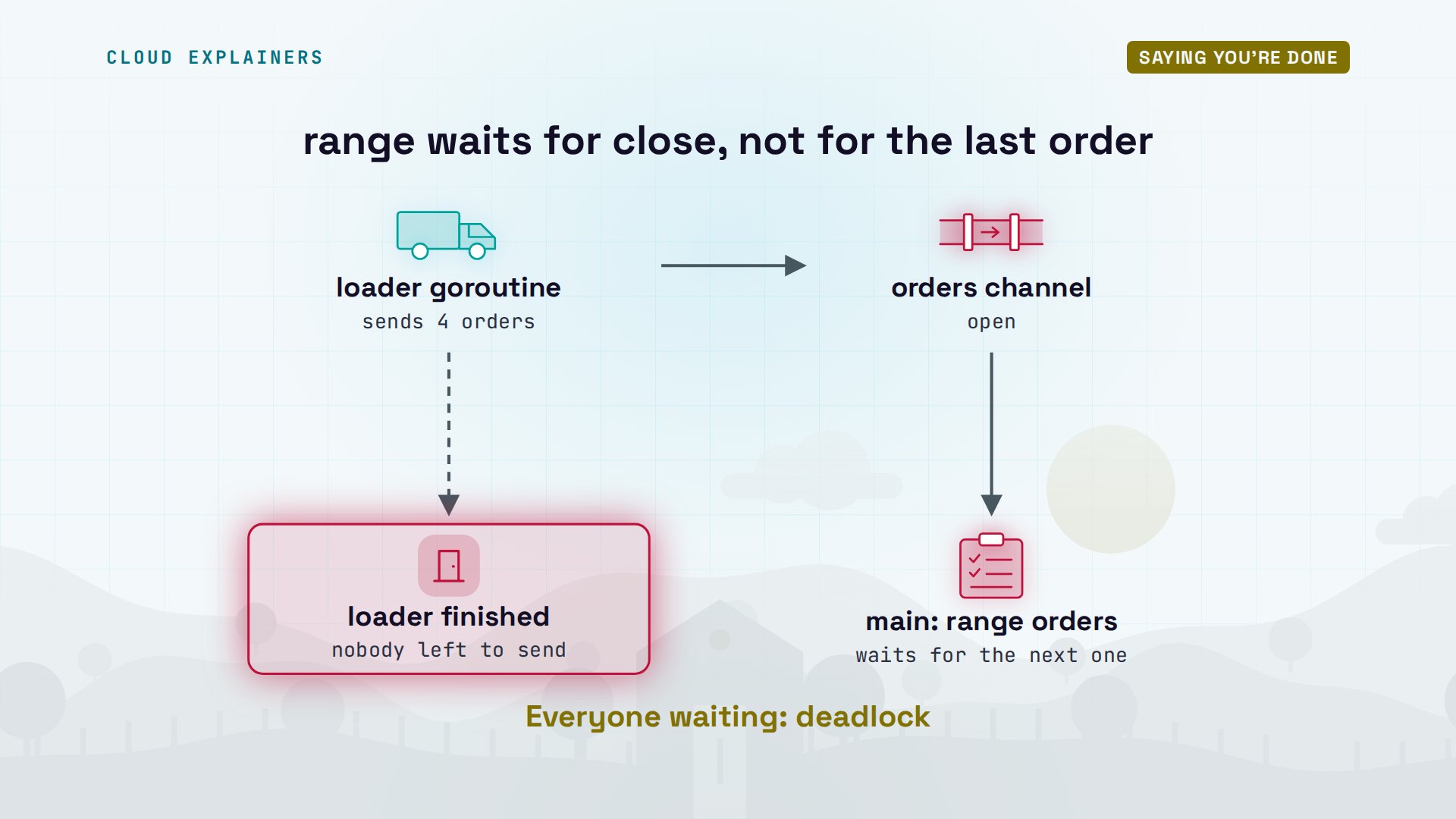
Why? A range over a channel keeps receiving until the channel is closed. The loader finished its four sends and returned, but nobody told main there were no more. So main waits for a fifth, every goroutine is asleep, and Go stops.
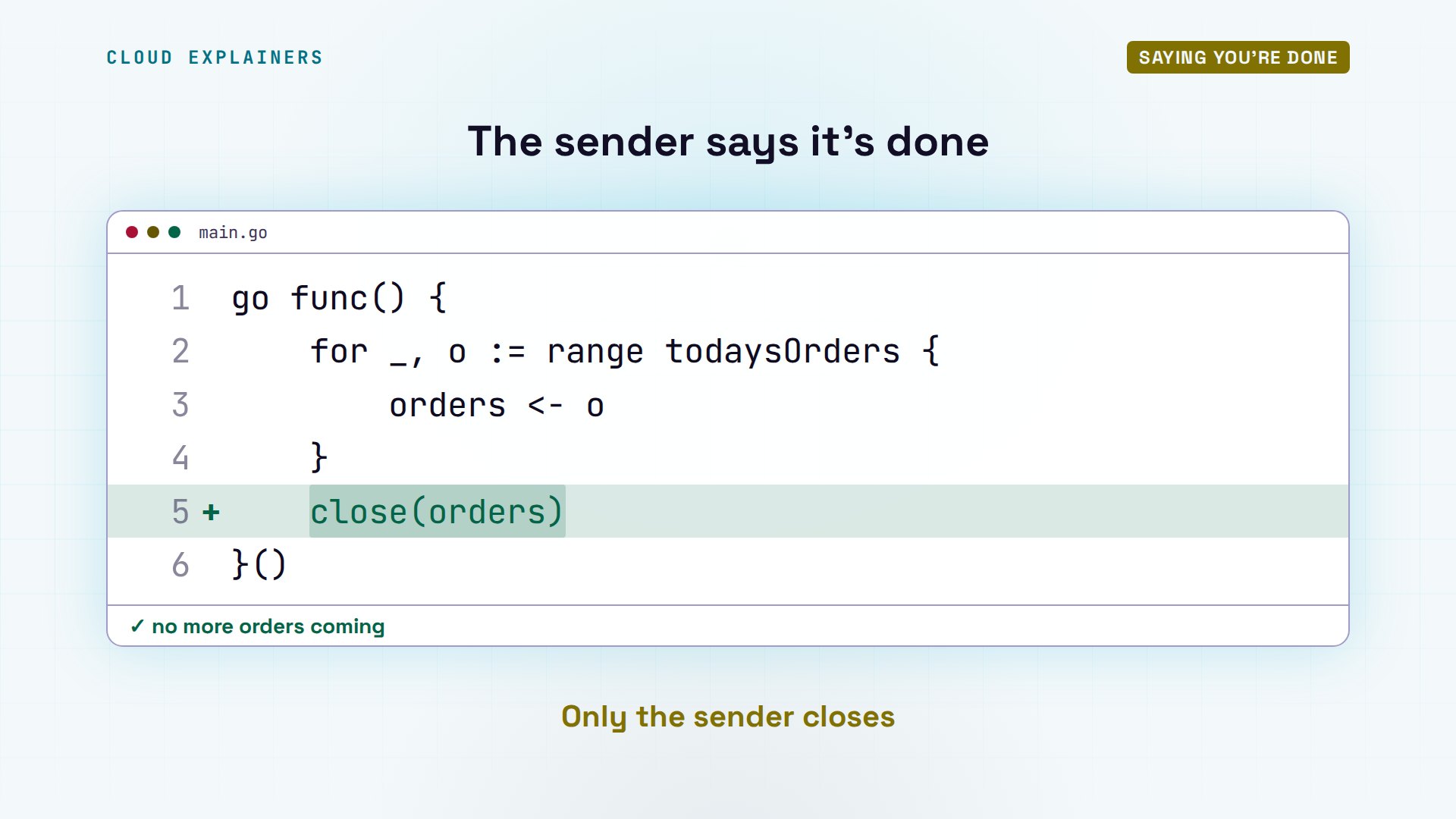
Sue adds one line after her loader's loop: a call to close, with orders inside. Only the sender closes.
Run it again. Four deliveries, then it prints: all orders delivered. And the program ends on its own. One more detail: receiving from a closed channel never waits. Receive into two variables, o and ok, and ok tells you if the channel is still open. On a closed channel, o is an empty string, and ok is false.
sed -n '7,12p' main.gogo func() { for _, o := range todaysOrders { orders <- o } close(orders) }()
go run .delivered: 20 bales for Rich
delivered: 12 bales for Oak Stables
delivered: 8 bales for the riding school
delivered: 30 bales for Maple Farm
all orders delivered
after close: "", ok = false
sed -n '17,18p' main.goo, ok := <-orders fmt.Printf("after close: %q, ok = %v\n", o, ok)
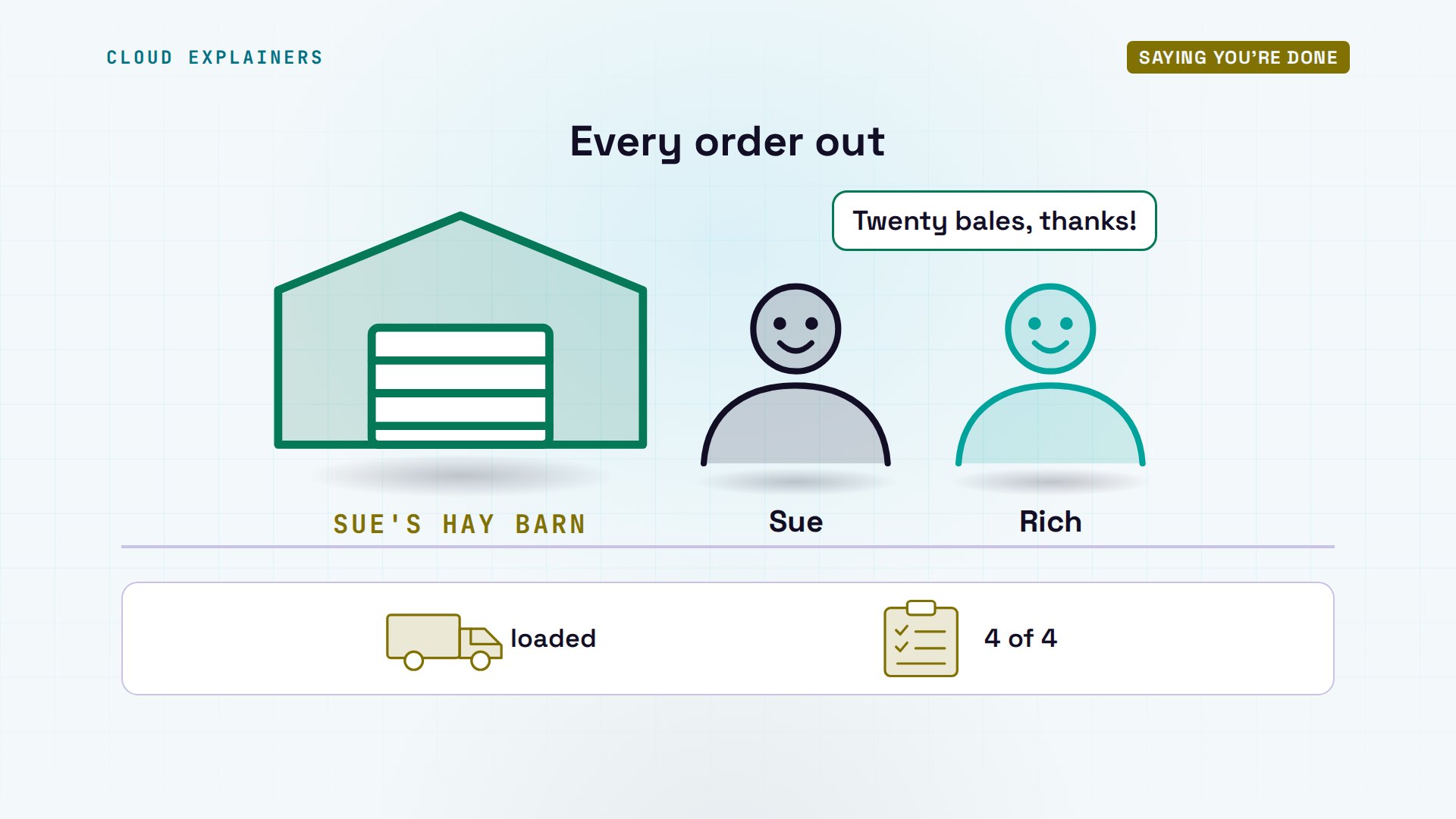
Next morning, the program runs to the end. The truck is loaded, and Rich gets his twenty bales.
Recap
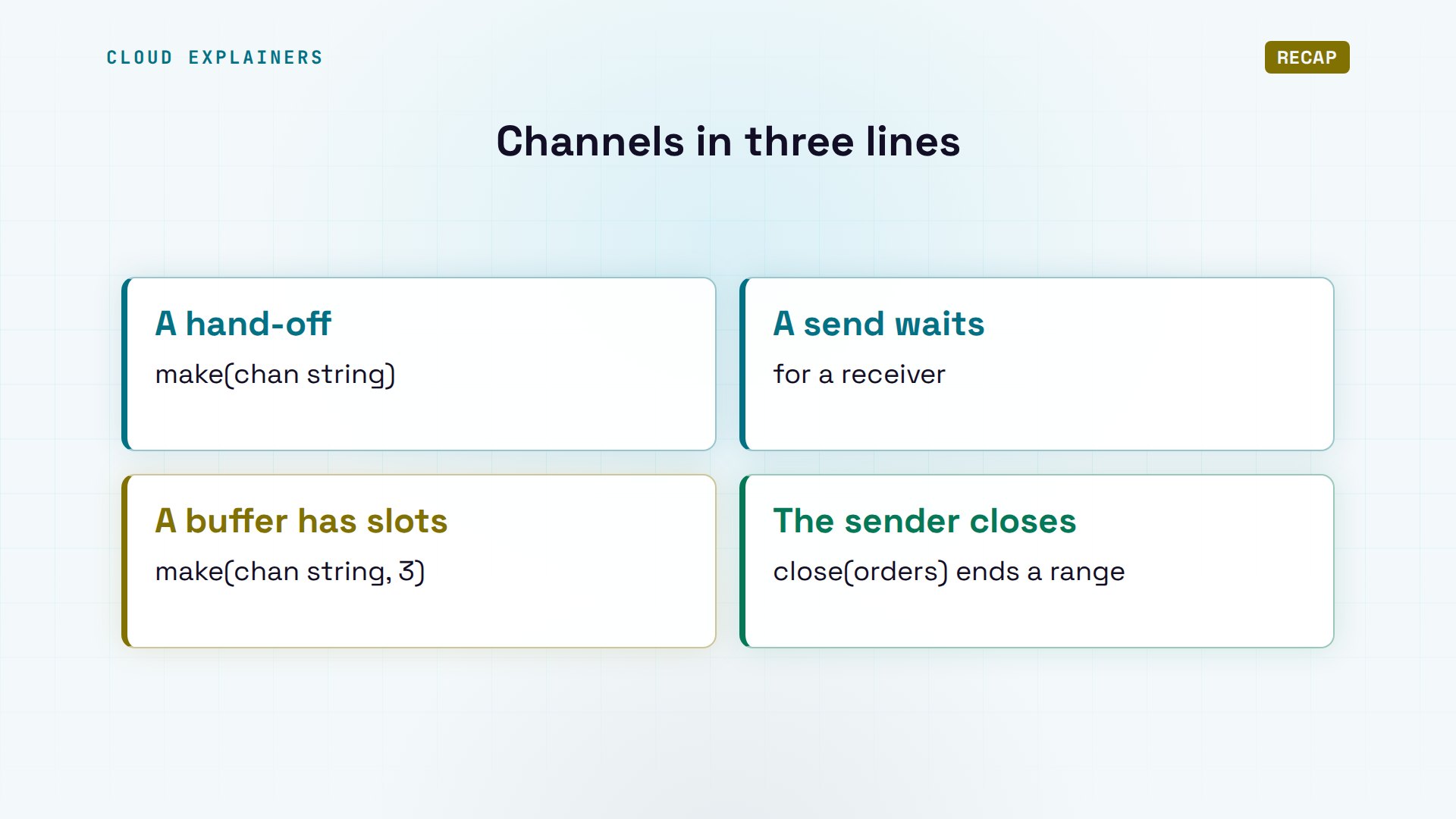
So: a channel is a hand-off, not a mailbox. A send waits for a receiver or a free slot in the buffer. And the sender closes the channel, so a range knows when to stop.
If channels finally make sense, a like helps YouTube show this to more beginners, and subscribing brings the next Go idiom: type assertions.
The lab files and every command are linked in the description. Thanks for watching Cloud Explainers.
Sources
Demos: one container on our own Mac standing in for a laptop; the hay business and its orders are made up. Every command, output and number was real. Watch the full video on YouTube.
More videos
Amazon Bedrock vs OpenRouter: Which One Should You Use?
Tailscale: Full Tutorial for Beginners
How RAG Works

Every Git Setting to Change on Day One

WSL vs a Linux Virtual Machine: Which One Should You Use?
Every PostgreSQL Setting to Change After You Install It
What Happens When You Install Docker on Ubuntu
How to Fix Python 'Address Already in Use' Errors
Golang Interfaces and Mocks in 5 Minutes
How to Fix Git 'Detached HEAD' State
Linux Firewall with ufw: Full Tutorial for Beginners
Golang defer Statements in 5 Minutes
How to Fix OAuth 'invalid_grant' Errors

The SQL Roadmap for Beginners
Golang make() for Slices and Maps in 5 Minutes
How to Fix Network 'No Route to Host' Errors on Linux
How to Fix Linux 'Too Many Open Files' Errors
Every Django Concept a Beginner Needs to Know
SSH on Linux: Full Tutorial for Beginners

Golang for range Loops in 5 Minutes
SQL Databases: SQLite vs PostgreSQL
The Django Roadmap for Beginners
Golang Structs in 5 Minutes
Redis: Full Tutorial for Beginners
Golang context.Context in 5 Minutes
How to Fix MySQL Database Error 1045: Access Denied for User
Golang Method Receivers in 5 Minutes
How to Fix Python SSL: CERTIFICATE_VERIFY_FAILED Errors
How to Fix Django Static Files Not Loading in Production
OpenRouter vs Direct API Keys: Which One Should You Use?
Golang if err != nil Checks in 5 Minutes

How to Fix Golang 'go.mod File Not Found' Errors

MCP Servers: Full Tutorial for Beginners
Golang Error Return Values in 5 Minutes
How to Fix Python ModuleNotFoundError: No Module Named
Golang Pointers in 5 Minutes
How to Fix a Kubernetes Pod Stuck in CrashLoopBackOff
How to Fix a Homelab ESXi Host Not Responding
PostgreSQL: Full Tutorial for Beginners
How a Load Balancer Works with HAProxy

How Python Virtual Environments Work
How to Fix Cloudflare Tunnel Errors in a Homelab
How to Fix API CORS Errors: No 'Access-Control-Allow-Origin'
How Authenticator App Login Codes Work (TOTP)
Git and GitHub: Full Tutorial for Beginners
How a Homelab Hypervisor Works (VMware ESXi)
How to Fix Kubernetes ImagePullBackOff Errors
How to Fix DNS 'Temporary Failure in Name Resolution' on Linux
How to Fix AWS CLI 'Unable to Locate Credentials'
Proxmox vs ESXi for Your Homelab: When Each One Wins
PostgreSQL UUID vs Auto Increment: Which Primary Key Should You Use?
Kubernetes: Full Tutorial for Beginners

How TCP Sockets Work
How to Fix PostgreSQL 'Could Not Connect to Server'
Claude Code Hooks Will Finally Make Sense After This
DevOps with Ansible Will Finally Make Sense After This
How SNMP Network Monitoring Works
How to Fix GitHub 'Permission Denied (publickey)' Errors
Docker: Full Tutorial for Beginners
How to Fix PostgreSQL 'Password Authentication Failed'
Why One Linux Server Handles More Users Than You Think
How to Fix Network 'Connection Refused' Errors
DevOps Pipelines: Jenkins vs GitHub Actions
Linux Nginx Reverse Proxy: Full Tutorial for Beginners
Every Networking Term a Beginner Needs in 12 Minutes
How to Fix Docker 'Permission Denied' on docker.sock
How to Fix Git 'Updates Were Rejected' When You Push
How to Fix nginx 502 Bad Gateway Errors on Linux
How to Fix Linux apt 'Could Not Get Lock' Errors (Ubuntu)

How Email Works on the Internet (SMTP) in 10 Minutes
The Python Roadmap for Beginners

Golang REST API with Gin: Full Tutorial for Beginners
How a WireGuard VPN Network Works

Linux Makefiles Will Finally Make Sense After This

SAML vs OAuth vs OpenID Connect: What's the Difference?
How to Fix Python cron Jobs That Never Run
Linux Bash Scripting: Full Tutorial for Beginners
How PXE Network Boot Works
How Active Directory Works
How to Fix a Linux systemd Service That Won't Start
Linux Logs: syslog vs journald
JWT vs Session Cookies: Which One Should You Use?
Docker vs Docker Compose: Which One Should You Use?
How to Fix Docker Compose Containers That Can't Talk to Each Other
Django Full Tutorial for Beginners
How Linux systemd Works

How to Fix 'Windows Cannot Access' Network Share Errors (SMB)
REST vs gRPC: Which One Should You Use?
How to Fix SSL Certificate Chain Errors (Missing Intermediate)
Every Python Concept for Beginners in 10 Minutes
Every SQL Join Type in 10 Minutes
Why OpenRouter Free Models Hit Their Limit So Fast
Why Your Gemini API Free Tier Runs Out So Fast
OpenRouter Will Finally Make Sense After This
How Redis Caching Works
Gemini API vs Vertex AI: Which One Should You Use?
How to Fix a Leaked Gemini API Key
Why Golang Uses Goroutines Instead of Threads
How to Fix Gemini API Error 429: Resource Exhausted
Claude Token Pricing Will Finally Make Sense After This
Why Python Web Scraping Returns Nothing (and the Fix)
Python Automation: Full Tutorial for Beginners
How OAuth Login Works
Python uv vs pip: Which One Should You Use?

Google AI Studio Will Finally Make Sense After This
What Happens When You Run a Docker Container
How to Fix Claude Code Billing Your API Key Instead of Your Plan
Why Passkeys Can't Be Phished Like Passwords
PowerShell vs Bash: Which One Should You Learn?
The Linux Roadmap for Beginners
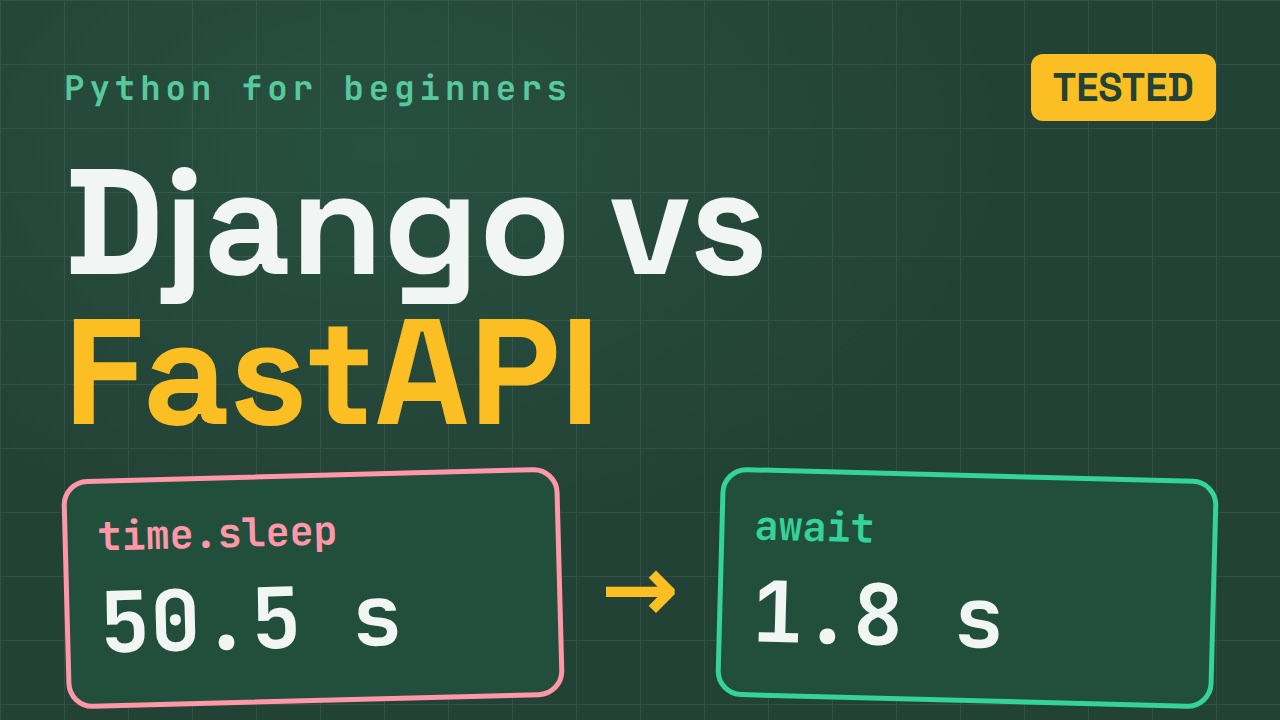
Django vs FastAPI: Which One Should You Use?
Why SQLite Is the Most Used Database in the World
How a NoSQL Database Like MongoDB Works
How to Fix Python pip error: externally-managed-environment
How to Fix MySQL Too Many Connections Database Errors
Golang Concurrency Will Finally Make Sense After This
How Amazon S3 Works
How Kubernetes Works
How Git Works
How to Fix Docker Port Already Allocated Errors
How PostgreSQL Works
How to Fix Git Merge Conflicts
How to Fix No Space Left on Device in Linux
How the Internet Works
SQL vs NoSQL: When Each One Wins
How to Fix JWT Token Expired Errors (401 Unauthorized)
Claude API vs Claude Pro: Why Your Subscription Doesn't Include It
Why AI Agent Skills Beat Giant Prompts

Linux Cron Jobs Will Finally Make Sense After This

Security Logs Will Finally Make Sense After This
How to Fix a Security Leak: An API Key Pushed to GitHub
DNS Will Finally Make Sense After This
Never Ignore a Security Update
Two-Factor Authentication Will Finally Make Sense
Never Expose a Database to the Internet
SSH Keys vs Passwords: Which Is Safer for Security?
The 5 Levels of Linux Boot: From Power On to Login
The 5 Levels of Network Firewalls
Password Security: Why Hackers Crack Weak Passwords
Why Your Linux Server Runs Out of Memory
HTTP vs HTTPS: What Actually Changes on Your Network

Every Linux File Permission You Need to Know
Linux Processes vs Threads: When Each One Wins
The OSI Model Will Finally Make Sense After This
The 7 Levels of Git
Every Network Troubleshooting Command You Need
Hashing vs Encryption in Cybersecurity: When Each One Wins
Why the Internet Ran Out of IP Addresses
Linux Package Managers: apt vs Snap vs Flatpak
Why Python Is Slow (and When It Doesn't Matter)
TCP vs UDP: When Each One Wins
Stop Running Linux as Root (Do This Instead)
Linux Users and Groups Will Finally Make Sense

Why Phishing Beats Good Security (and How to Spot It)
The 7 Levels of Docker

AI Agents Will Finally Make Sense After This
Stop Using git push --force (Use This Instead)
Agent Skills vs MCP: When Each One Wins
Networking Will Finally Make Sense After This

Every Linux Command You Actually Need
The 7 Levels of Cybersecurity
Every System Design Concept You Need, in One Diagram