How to Fix Python 'Address Already in Use' Errors
'Address already in use' (OSError: [Errno 98]) means another socket already holds the port your Python app wants. On a real Ubuntu machine we find who holds it with sudo ss -ltnp and lsof, show why Ctrl+Z leaves a paused server holding the port, pick another port when it isn't yours to stop, and fix the error that comes right after a restart (TIME-WAIT) with SO_REUSEADDR.
Port 5000 is taken
Your Python app won't start: address already in use. At a small greenhouse, Ana runs a dashboard that shows the temperature on each bench. She starts it, and Flask says port five thousand is in use by another program. Flask is polite enough not to say which one. Nothing of hers is running. So what is holding port five thousand? There are four usual reasons, and if you're on a Mac, one of them is the Mac itself. By the end you'll know which one is yours, and how to fix it.
python3 dashboard.py* Serving Flask app 'dashboard' * Debug mode: off Address already in use Port 5000 is in use by another program. Either identify and stop that program, or start the server with a different port.
One program per port
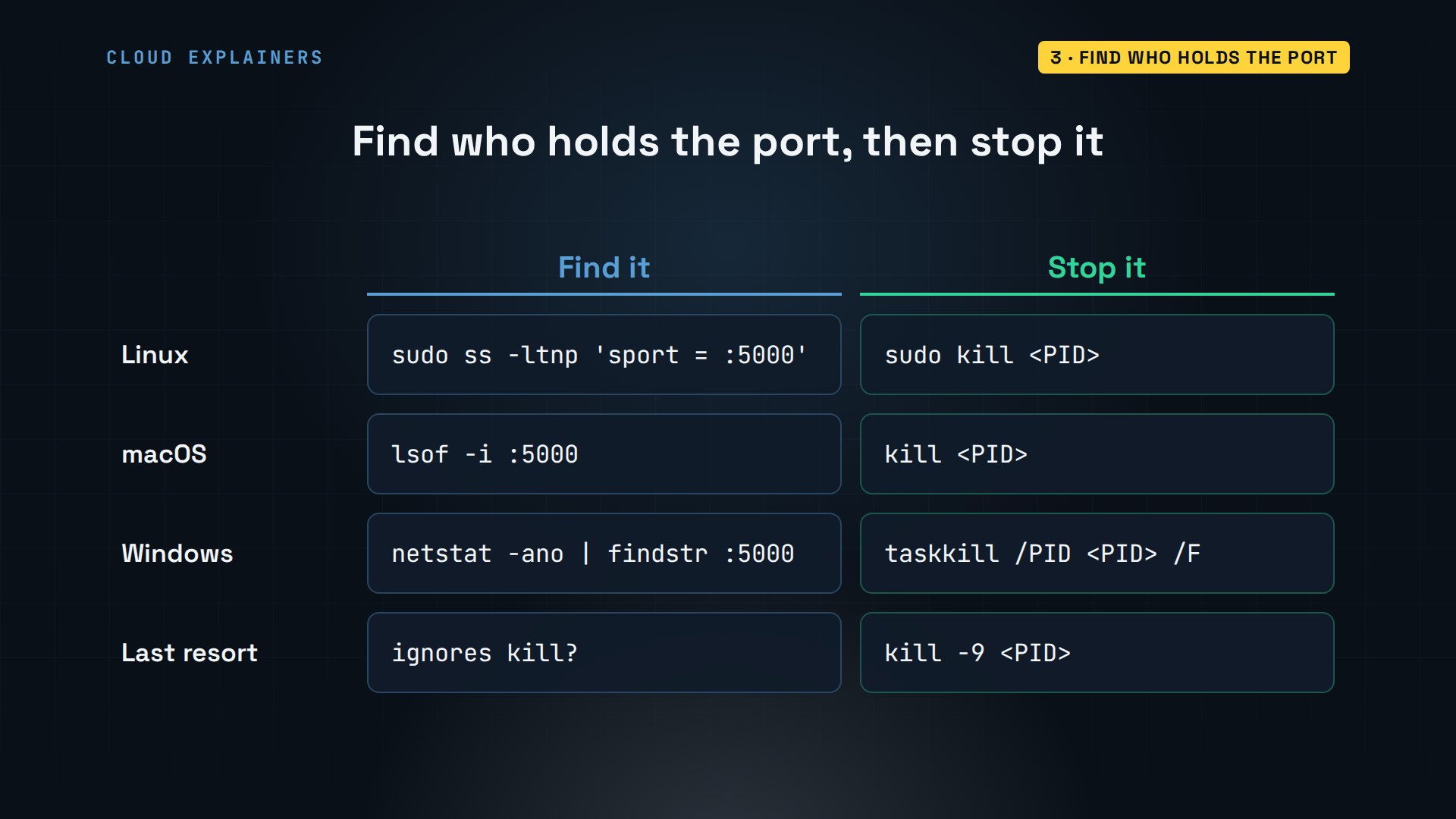
A port is a numbered way into a computer. A server claims one, and listens on it for a browser to knock. Think of a hotel room: one guest per room. When a second program asks Linux for the same number, Linux refuses, with error ninety-eight: address already in use. It says address because a server claims two things at once: the computer's network address, and the port number. So first, we find who's in the room and clear it. Then a stranger case: the same error, with nobody in the room at all.
Find who holds the port
The greenhouse computer is shared: Ben, who works there too, logs in to it as well. To find out who holds the port, Ana uses ss, a tool that lists network connections. She asks who's listening on port five thousand. The L asks for listeners, and the P asks for the program's name. It shows a listener, but no name. That's a clue: ss only names your own programs, so this one belongs to someone else. So she runs it again with sudo, as the administrator, who can see everyone's programs. Now ss names it: python three, process number 14. And ps, the tool that lists running programs, says whose it is: Ben's. He started his own copy earlier, to try a change, and left it running.
ss -ltnp 'sport = :5000'State  Recv-Q  Send-Q  Local Address:Port  Peer Address:Port  Process
LISTEN  0  128  127.0.0.1:5000  0.0.0.0:*
sudo ss -ltnp 'sport = :5000'State  Recv-Q  Send-Q  Local Address:Port  Peer Address:Port  Process
LISTEN  0  128  127.0.0.1:5000  0.0.0.0:*  users:(("python3",pid=14,fd=3))
ps -o user,pid,etime,cmd -p 14USER         PID     ELAPSED CMD
ben           14       00:07 python3 dashboard.py
Ana checks with Ben, then stops his copy with kill and that process number. It needs sudo too, because the program is Ben's, not hers. kill asks the program to stop, and a Flask server does. ss shows the port free again.
sudo kill 14
sudo ss -ltnp 'sport = :5000'State Recv-Q Send-Q Local Address:Port Peer Address:Port Process
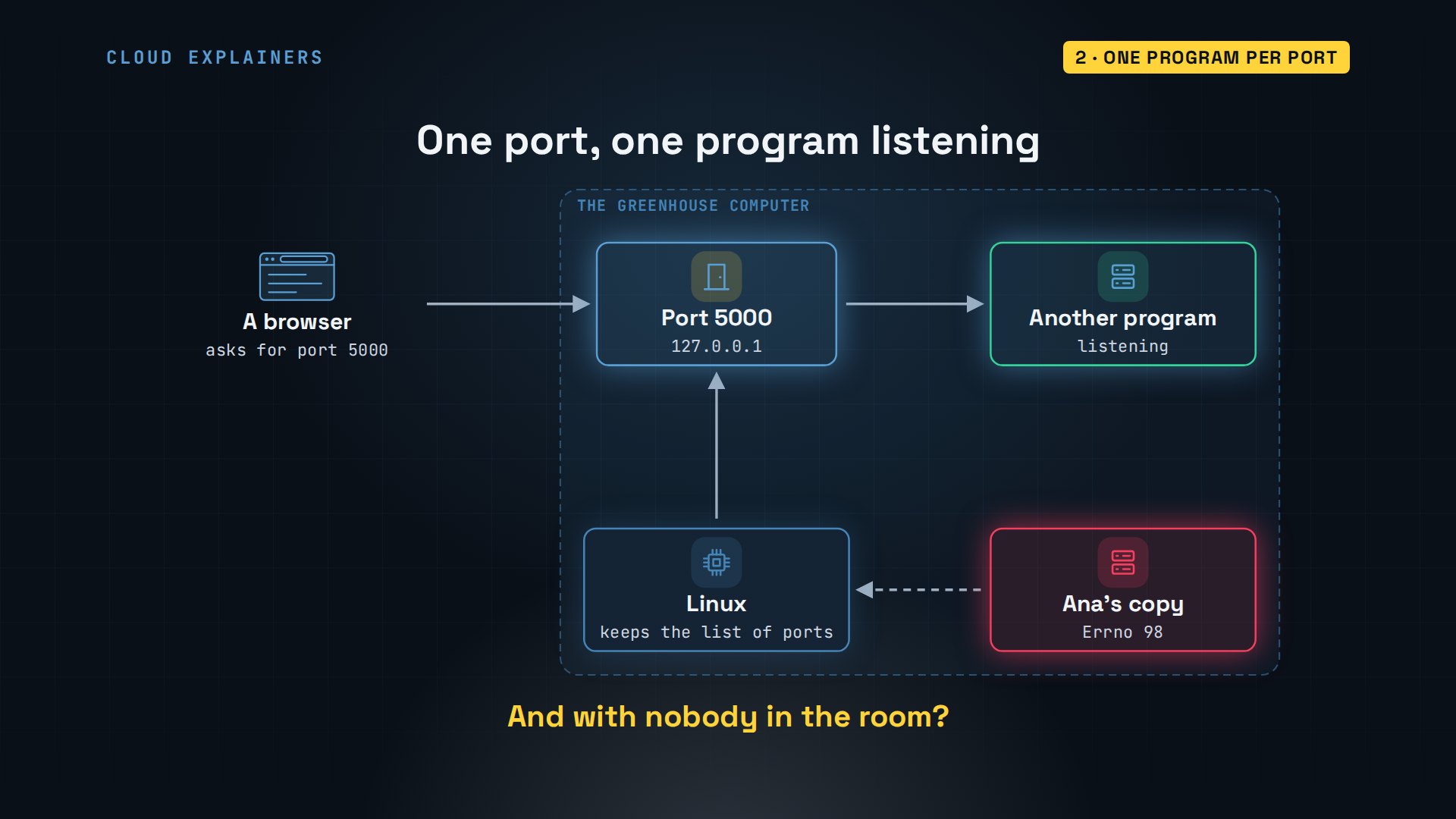
The two steps are the same everywhere: find the process number, then stop it. This table has the commands for Linux, Mac, and Windows. On a Mac, the finding tool is called lsof. Pause here if you need yours. If a program ignores a plain kill, use kill dash nine. That ends it at once, but skips its clean-up, so always try the plain kill first.
Paused is not stopped
Ana starts her dashboard, and it runs. To stop it, she presses Ctrl+Z. The terminal says: stopped, and gives her the prompt back. Guess first: is port five thousand free now? No. Starting it again gives the same error as before.
python3 dashboard.py* Serving Flask app 'dashboard' * Debug mode: off WARNING: This is a development server. Do not use it in a production deployment. Use a production WSGI server instead. * Running on http://127.0.0.1:5000 Press CTRL+C to quit ^Z [1]+ Stopped python3 dashboard.py
python3 dashboard.py* Serving Flask app 'dashboard' * Debug mode: off Address already in use Port 5000 is in use by another program. Either identify and stop that program, or start the server with a different port.
The terminal said stopped, but it really means paused. Ctrl+Z doesn't end a program. The jobs command lists it: stopped, but still there. Like a guest asleep in the room: the room is taken, and nobody answers the door. curl, which fetches a page from the terminal, knocks on the port. Nobody answers, so after three seconds it gives up. fg brings the paused program back to the front. It wakes up, answers the knock that was still waiting, and logs it, and then Ctrl+C really stops it.
jobs[1]+ Stopped python3 dashboard.py
curl -m 3 localhost:5000curl: (28) Operation timed out after 3007 milliseconds with 0 bytes received
fgpython3 dashboard.py
127.0.0.1 - - [26/Nov/2026 23:56:29] "GET / HTTP/1.1" 200 -
^C
When it's not yours to stop
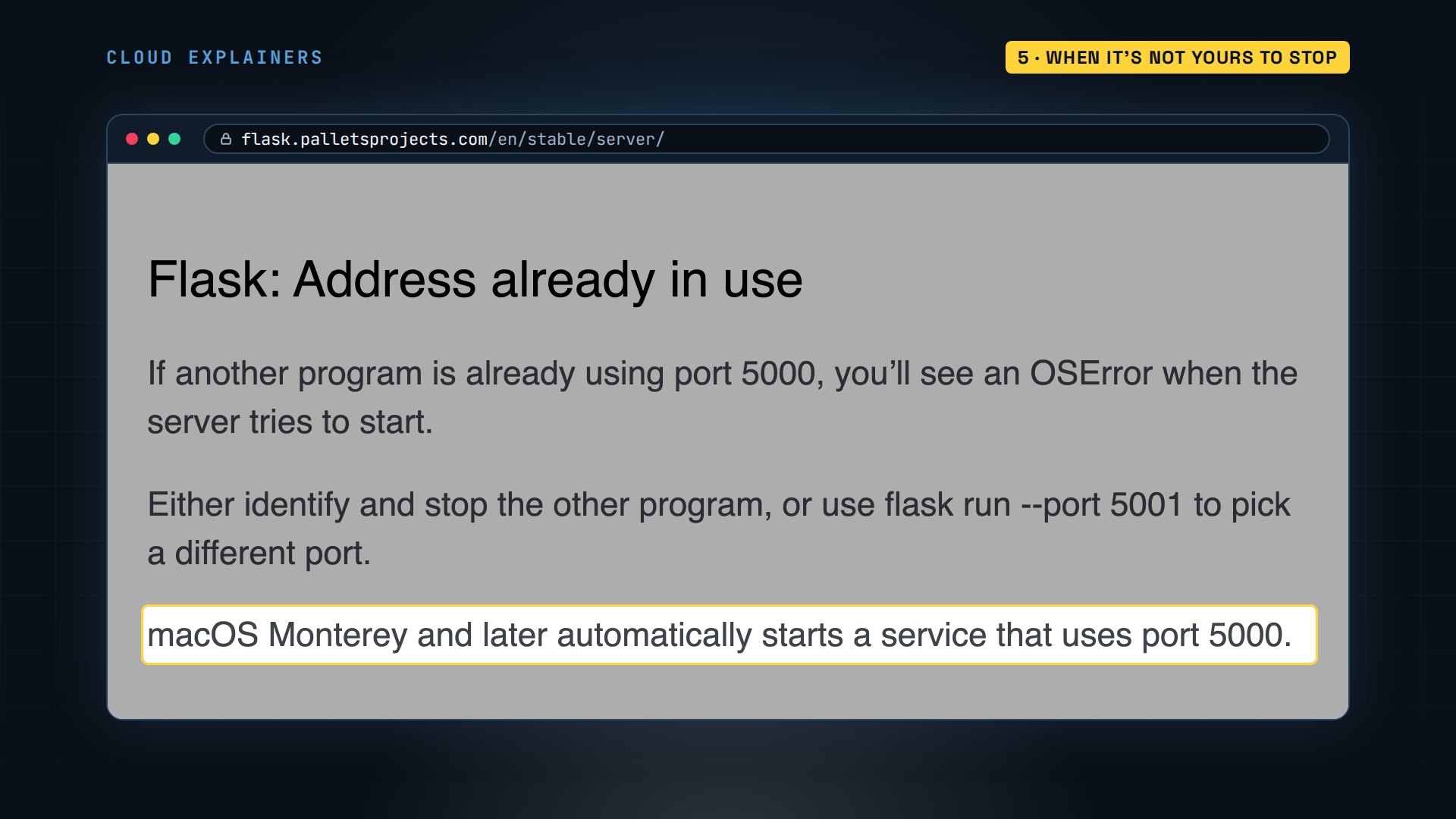
Sometimes the program on the port isn't yours to stop. Flask's own docs say what to do: stop the other program, or pick a different port. On a Mac, it's often the Mac itself: since macOS Monterey, a built-in service called AirPlay Receiver uses port five thousand. Turn it off in System Settings, or move your app to another port.
Moving is one command. Instead of python three, Ana uses Flask's own command, flask run, because it can take a port number. Dash dash app names the file, and dash dash port picks five thousand and one. It starts at once. Just remember to open it at port five thousand and one in your browser now.
flask --app dashboard run --port 5001* Serving Flask app 'dashboard' * Debug mode: off WARNING: This is a development server. Do not use it in a production deployment. Use a production WSGI server instead. * Running on http://127.0.0.1:5001 Press CTRL+C to quit ^C
It fails right after a restart
Now the strange one. The greenhouse has a second program, the collector. It's written with Python's socket module. That's the basic building block for network programs, without any of Flask's extras. It takes a reading from each bench's sensor on port nine thousand. Ana stops it properly, with Ctrl+C, and starts it again straight away. This time it's plain Python's error: error ninety-eight. And with sudo, ss finds nobody listening on port nine thousand at all.
python3 collector.pycollector listening on port 9000
bench 2: 22.5 C
bench 3: 20.9 C
bench 1: 22.4 C
bench 2: 21.5 C
bench 3: 21.4 C
^C
collector stopped
python3 collector.pyTraceback (most recent call last):
  File "/home/ana/greenhouse/collector.py", line 5, in <module>
    server.bind(("0.0.0.0", 9000))
OSError: [Errno 98] Address already in use
sudo ss -ltnp 'sport = :9000'State Recv-Q Send-Q Local Address:Port Peer Address:Port Process
Earlier, Ana asked ss only for listeners. This time she swaps the L for an A, for all connections, and adds an O, for timers. There they are: connections from the sensors, each in a state called time wait, with a timer. Guess first: how long until port nine thousand frees itself? About a minute. Ana waits, and 61 seconds after she stopped it, the port is free.
ss -tano 'sport = :9000' | head -4State  Recv-Q Send-Q Local Address:Port  Peer Address:Port Process
TIME-WAIT 0  0  192.168.40.10:9000 192.168.40.21:54072 timer:(timewait,56sec,0)
TIME-WAIT 0  0  192.168.40.10:9000 192.168.40.21:54104 timer:(timewait,59sec,0)
TIME-WAIT 0  0  192.168.40.10:9000 192.168.40.21:54074 timer:(timewait,57sec,0)
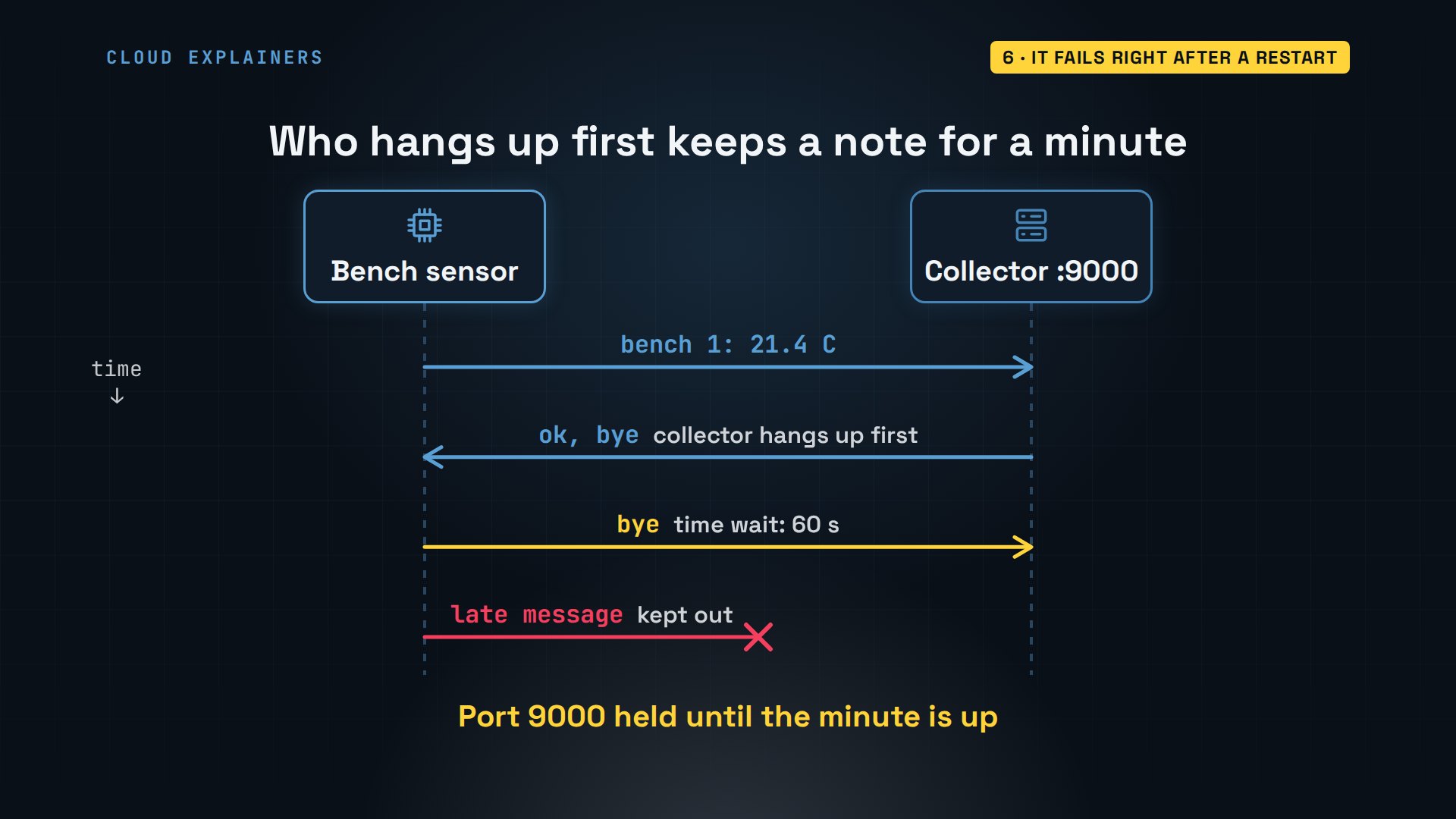
Why wait? Each sensor sends a reading, and the collector says ok and hangs up first. The side that hangs up first keeps a note of that connection for a minute, so a delayed message from it can't land in a new conversation by mistake. It's the room being cleaned after checkout: the guest is gone, but nobody gets the room for a while.
The fix for your own server
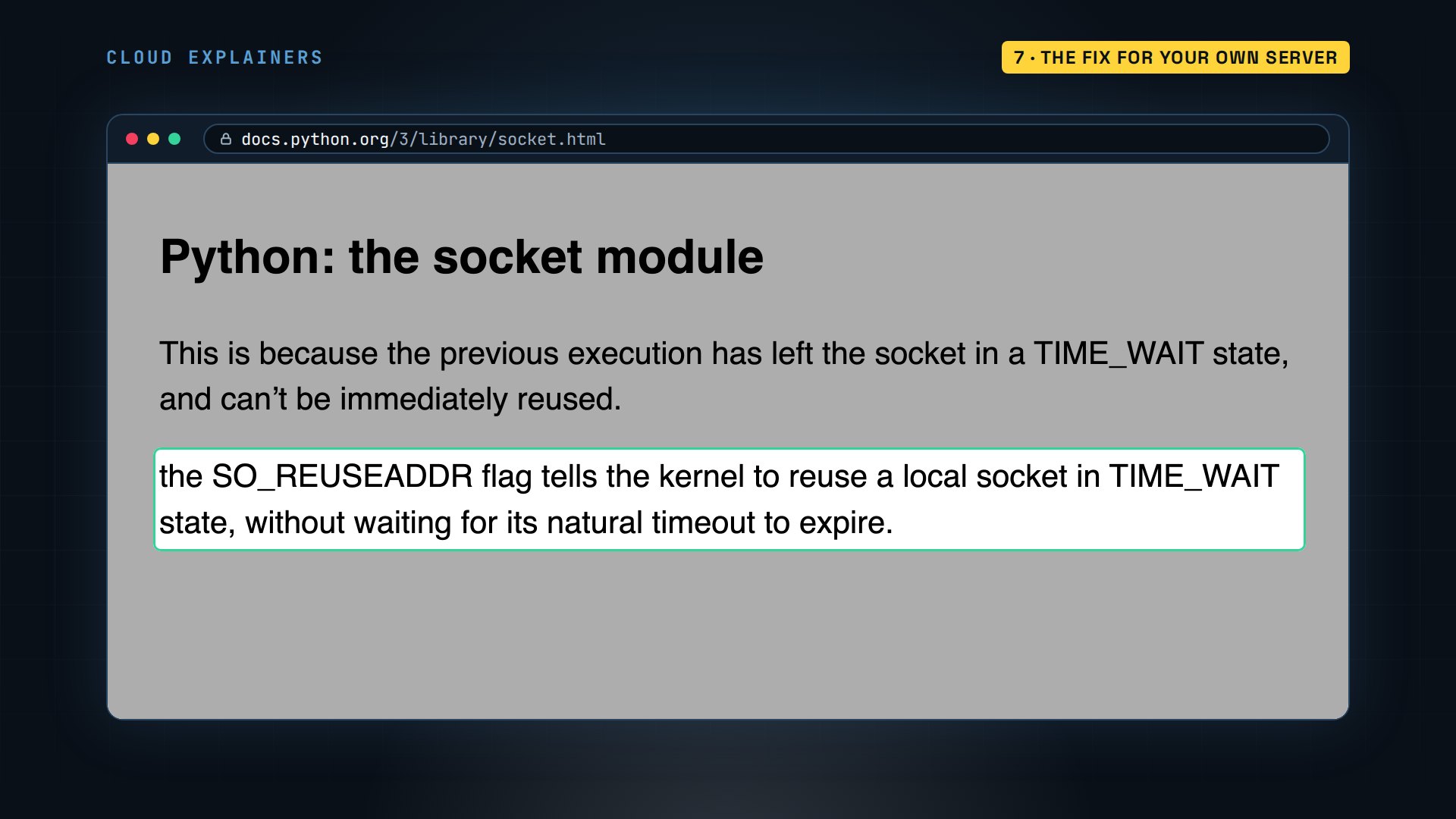
Waiting a minute after every restart gets old fast, especially while you're testing changes. Python's socket docs name this exact error, and the fix: a socket option called SO_REUSEADDR, which tells Linux it's fine to reuse a port that's only in time wait.
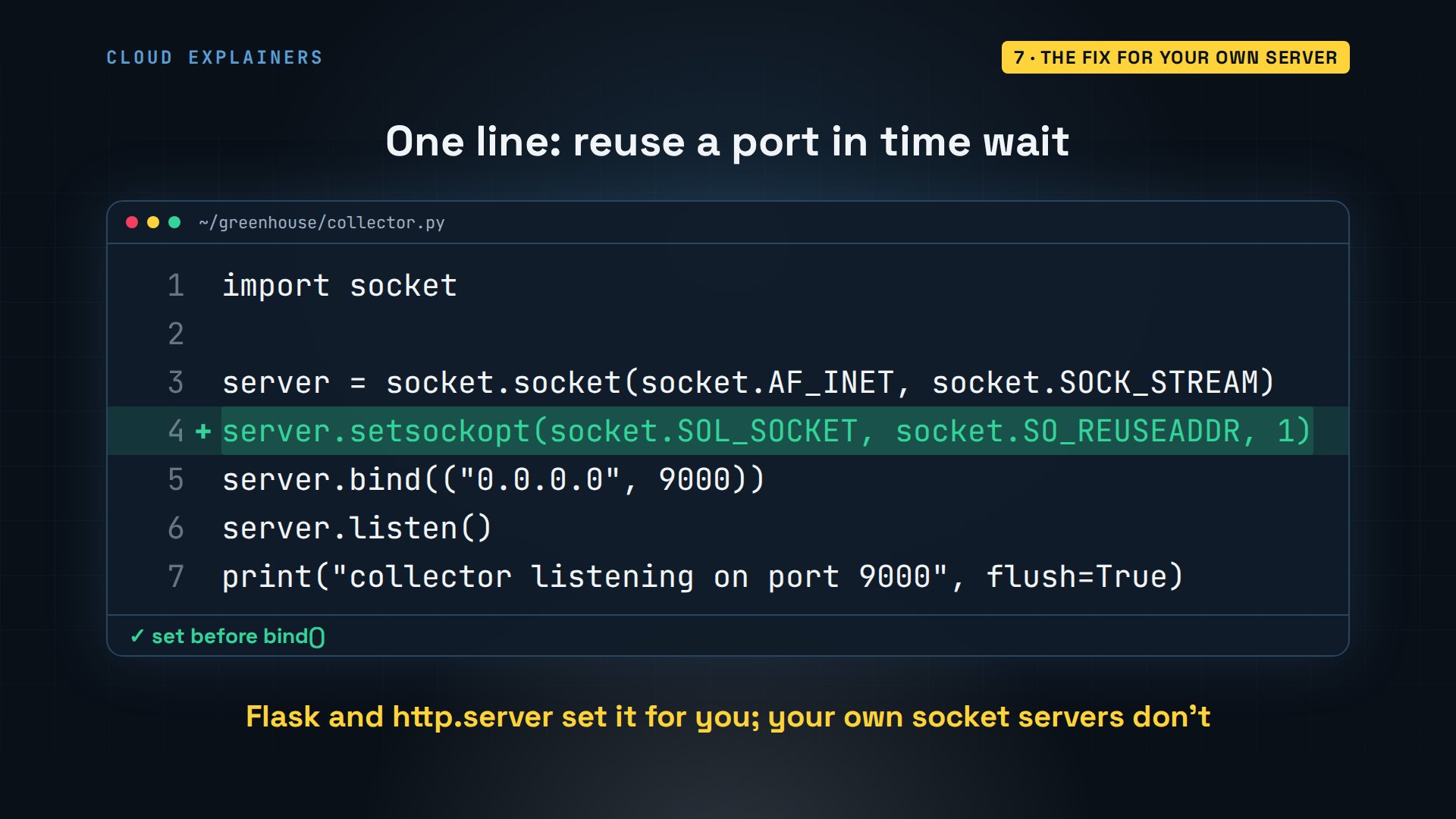
In the collector, it's one line. It goes just before bind, which is the call that claims the port. The call is setsockopt, short for set socket option, and the number one at the end turns this option on. It never lets two programs listen on one port. It only stops old connections in time wait from blocking a restart. Flask and Python's own http server already set it for you. Your own socket servers don't.
One catch: right after the change, it fails once more. The connections still waiting were made by the old version, without the option, so they block this one last start. So just this once, Ana waits out the minute, starts the new version, and stops it with Ctrl+C. From then on, she can stop the collector and restart it straight away. The time wait lines are still there, and it starts anyway.
python3 collector.pyTraceback (most recent call last):
  File "/home/ana/greenhouse/collector.py", line 5, in <module>
    server.bind(("0.0.0.0", 9000))
OSError: [Errno 98] Address already in use
python3 collector.pycollector listening on port 9000
bench 2: 21.8 C
bench 3: 22.5 C
bench 1: 21.6 C
bench 2: 22.0 C
bench 3: 22.4 C
^C
bench 1: 22.2 C
collector stopped
ss -tan 'sport = :9000' | head -3State  Recv-Q Send-Q Local Address:Port  Peer Address:Port Process
TIME-WAIT 0  0  192.168.40.10:9000 192.168.40.21:36662
TIME-WAIT 0  0  192.168.40.10:9000 192.168.40.21:36704
python3 collector.pycollector listening on port 9000
bench 2: 21.5 C
bench 3: 21.6 C
bench 1: 22.4 C
^C
bench 2: 20.8 C
collector stopped
Recap
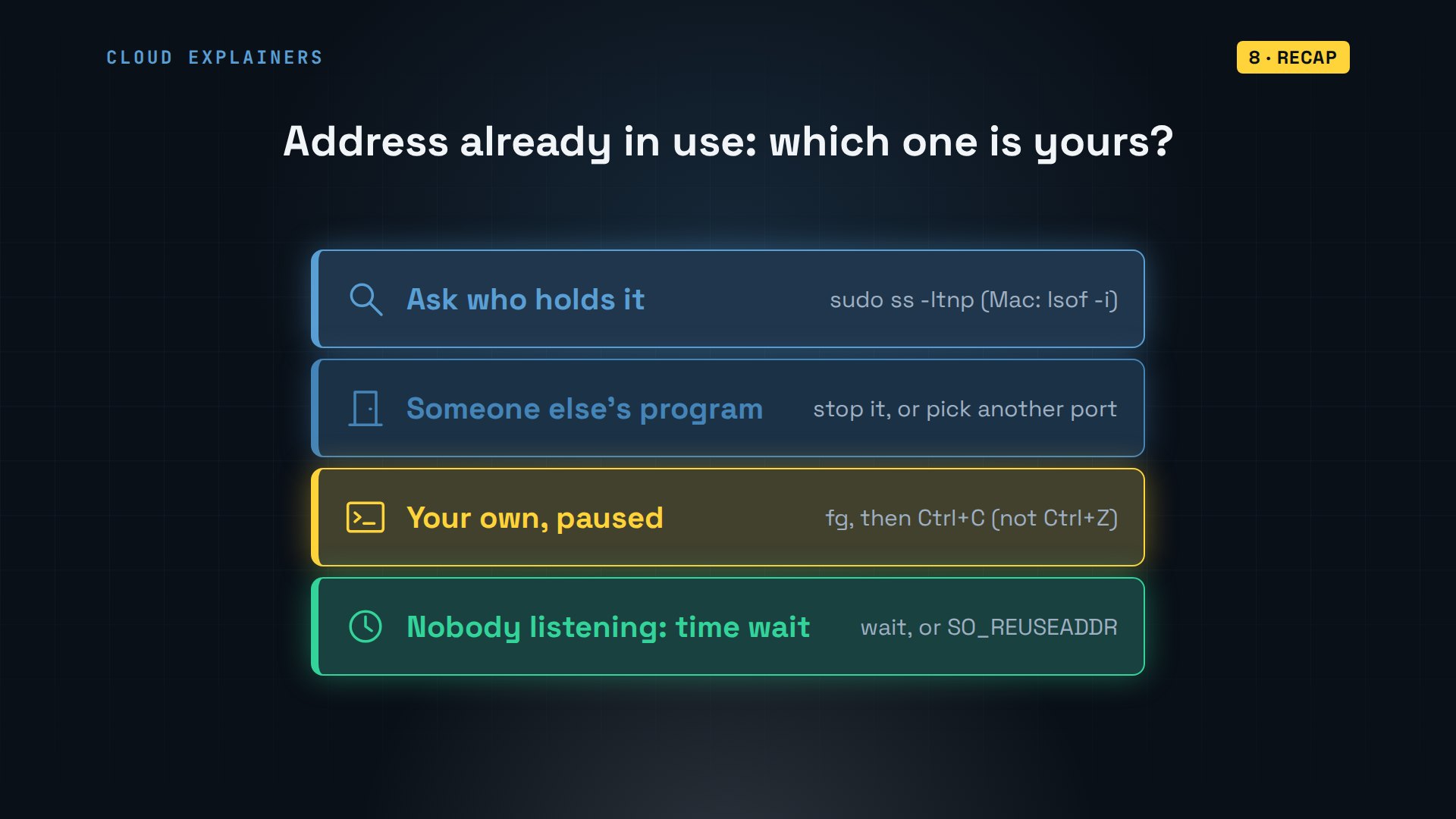
So, which one is yours? Run ss with sudo. If it names someone else's program, stop it, or move to another port. On a Mac, it may be the Mac itself: turn off AirPlay Receiver, or move ports. If it's your own paused one, use fg, then Ctrl+C. And if nobody is listening, it's time wait: wait a minute, or give your server SO_REUSEADDR before bind.
If your server starts on the first try now, a like helps YouTube show this to more beginners, and subscribing gets you the next fix, tested on a real machine.
Every error and timer in this video came from a real Ubuntu machine, and the commands and lab files are linked in the description. Thanks for watching Cloud Explainers.
Sources
- bind(2): EADDRINUSE, the given address is already in use
- socket(7): SO_REUSEADDR
- ss(8): -l listening sockets, -p the process using each socket
- Python socket docs: Errno 98 after a quick rerun is TIME_WAIT; SO_REUSEADDR
- Python socketserver: allow_reuse_address (False on TCPServer, set by http.server)
- Flask, Development Server: Address already in use, --port 5001, macOS AirPlay Receiver
- Bash manual, job control: Ctrl+Z suspends a job, jobs, fg
Demos: two containers on our own Mac standing in for a greenhouse's small computer and its bench sensors; the greenhouse and its people are made up. Every error and timer was real. Watch the full video on YouTube.
More videos
Every PostgreSQL Setting to Change After You Install It

What Happens When You Install Docker on Ubuntu
Golang Interfaces and Mocks in 5 Minutes
How to Fix Git 'Detached HEAD' State
Linux Firewall with ufw: Full Tutorial for Beginners
Golang defer Statements in 5 Minutes
How to Fix OAuth 'invalid_grant' Errors

The SQL Roadmap for Beginners
Golang make() for Slices and Maps in 5 Minutes
How to Fix Network 'No Route to Host' Errors on Linux
How to Fix Linux 'Too Many Open Files' Errors

Every Django Concept a Beginner Needs to Know
SSH on Linux: Full Tutorial for Beginners

Golang for range Loops in 5 Minutes

SQL Databases: SQLite vs PostgreSQL
The Django Roadmap for Beginners

Golang Structs in 5 Minutes

Redis: Full Tutorial for Beginners

Golang context.Context in 5 Minutes
How to Fix MySQL Database Error 1045: Access Denied for User
Golang Method Receivers in 5 Minutes
How to Fix Python SSL: CERTIFICATE_VERIFY_FAILED Errors

How to Fix Django Static Files Not Loading in Production

OpenRouter vs Direct API Keys: Which One Should You Use?
Golang if err != nil Checks in 5 Minutes

How to Fix Golang 'go.mod File Not Found' Errors

MCP Servers: Full Tutorial for Beginners

Golang Error Return Values in 5 Minutes

How to Fix Python ModuleNotFoundError: No Module Named
Golang Pointers in 5 Minutes
How to Fix a Kubernetes Pod Stuck in CrashLoopBackOff
How to Fix a Homelab ESXi Host Not Responding
PostgreSQL: Full Tutorial for Beginners
How a Load Balancer Works with HAProxy

How Python Virtual Environments Work
How to Fix Cloudflare Tunnel Errors in a Homelab
How to Fix API CORS Errors: No 'Access-Control-Allow-Origin'

How Authenticator App Login Codes Work (TOTP)
Git and GitHub: Full Tutorial for Beginners
How a Homelab Hypervisor Works (VMware ESXi)
How to Fix Kubernetes ImagePullBackOff Errors

How to Fix DNS 'Temporary Failure in Name Resolution' on Linux
How to Fix AWS CLI 'Unable to Locate Credentials'
Proxmox vs ESXi for Your Homelab: When Each One Wins
PostgreSQL UUID vs Auto Increment: Which Primary Key Should You Use?
Kubernetes: Full Tutorial for Beginners

How TCP Sockets Work

How to Fix PostgreSQL 'Could Not Connect to Server'
Claude Code Hooks Will Finally Make Sense After This
DevOps with Ansible Will Finally Make Sense After This
How SNMP Network Monitoring Works
How to Fix GitHub 'Permission Denied (publickey)' Errors
Docker: Full Tutorial for Beginners
How to Fix PostgreSQL 'Password Authentication Failed'
Why One Linux Server Handles More Users Than You Think
How to Fix Network 'Connection Refused' Errors
DevOps Pipelines: Jenkins vs GitHub Actions
Linux Nginx Reverse Proxy: Full Tutorial for Beginners
Every Networking Term a Beginner Needs in 12 Minutes
How to Fix Docker 'Permission Denied' on docker.sock
How to Fix Git 'Updates Were Rejected' When You Push
How to Fix nginx 502 Bad Gateway Errors on Linux
How to Fix Linux apt 'Could Not Get Lock' Errors (Ubuntu)

How Email Works on the Internet (SMTP) in 10 Minutes
The Python Roadmap for Beginners

Golang REST API with Gin: Full Tutorial for Beginners
How a WireGuard VPN Network Works

Linux Makefiles Will Finally Make Sense After This

SAML vs OAuth vs OpenID Connect: What's the Difference?
How to Fix Python cron Jobs That Never Run
Linux Bash Scripting: Full Tutorial for Beginners
How PXE Network Boot Works
How Active Directory Works

How to Fix a Linux systemd Service That Won't Start
Linux Logs: syslog vs journald
JWT vs Session Cookies: Which One Should You Use?
Docker vs Docker Compose: Which One Should You Use?
How to Fix Docker Compose Containers That Can't Talk to Each Other
Django Full Tutorial for Beginners

How Linux systemd Works

How to Fix 'Windows Cannot Access' Network Share Errors (SMB)
REST vs gRPC: Which One Should You Use?
How to Fix SSL Certificate Chain Errors (Missing Intermediate)
Every Python Concept for Beginners in 10 Minutes
Every SQL Join Type in 10 Minutes
Why OpenRouter Free Models Hit Their Limit So Fast
Why Your Gemini API Free Tier Runs Out So Fast

OpenRouter Will Finally Make Sense After This
How Redis Caching Works
Gemini API vs Vertex AI: Which One Should You Use?
How to Fix a Leaked Gemini API Key
Why Golang Uses Goroutines Instead of Threads
How to Fix Gemini API Error 429: Resource Exhausted
Claude Token Pricing Will Finally Make Sense After This
Why Python Web Scraping Returns Nothing (and the Fix)
Python uv vs pip: Which One Should You Use?

Python Automation: Full Tutorial for Beginners
How OAuth Login Works

Google AI Studio Will Finally Make Sense After This
What Happens When You Run a Docker Container
How to Fix Claude Code Billing Your API Key Instead of Your Plan
Why Passkeys Can't Be Phished Like Passwords
PowerShell vs Bash: Which One Should You Learn?
The Linux Roadmap for Beginners
Django vs FastAPI: Which One Should You Use?

Why SQLite Is the Most Used Database in the World
How a NoSQL Database Like MongoDB Works
How to Fix Python pip error: externally-managed-environment
How to Fix MySQL Too Many Connections Database Errors
Golang Concurrency Will Finally Make Sense After This
How Amazon S3 Works
How Kubernetes Works
How Git Works
How to Fix Docker Port Already Allocated Errors
How PostgreSQL Works
How to Fix Git Merge Conflicts

How to Fix No Space Left on Device in Linux
How the Internet Works
SQL vs NoSQL: When Each One Wins
How to Fix JWT Token Expired Errors (401 Unauthorized)
Claude API vs Claude Pro: Why Your Subscription Doesn't Include It

Why AI Agent Skills Beat Giant Prompts

Linux Cron Jobs Will Finally Make Sense After This

Security Logs Will Finally Make Sense After This
How to Fix a Security Leak: An API Key Pushed to GitHub
DNS Will Finally Make Sense After This
Never Ignore a Security Update
Two-Factor Authentication Will Finally Make Sense
Never Expose a Database to the Internet
SSH Keys vs Passwords: Which Is Safer for Security?
The 5 Levels of Linux Boot: From Power On to Login
The 5 Levels of Network Firewalls
Password Security: Why Hackers Crack Weak Passwords
Why Your Linux Server Runs Out of Memory
HTTP vs HTTPS: What Actually Changes on Your Network

Every Linux File Permission You Need to Know
Linux Processes vs Threads: When Each One Wins
The OSI Model Will Finally Make Sense After This
The 7 Levels of Git
Every Network Troubleshooting Command You Need
Hashing vs Encryption in Cybersecurity: When Each One Wins
Why the Internet Ran Out of IP Addresses
Linux Package Managers: apt vs Snap vs Flatpak

Why Python Is Slow (and When It Doesn't Matter)
TCP vs UDP: When Each One Wins
Stop Running Linux as Root (Do This Instead)
Linux Users and Groups Will Finally Make Sense

Why Phishing Beats Good Security (and How to Spot It)

The 7 Levels of Docker

AI Agents Will Finally Make Sense After This
Stop Using git push --force (Use This Instead)
Agent Skills vs MCP: When Each One Wins

Networking Will Finally Make Sense After This

Every Linux Command You Actually Need
The 7 Levels of Cybersecurity
Every System Design Concept You Need, in One Diagram