REST vs gRPC: Which One Should You Use?
REST and gRPC are two ways for one program to ask another for something. We built one tea-shop stock service with both doors and measured them for real: answer size, speed over 10,000 calls, streaming, what happens when a field is renamed or renumbered, and why browsers need gRPC-Web. Then which one to pick.
Two ways to ask one question
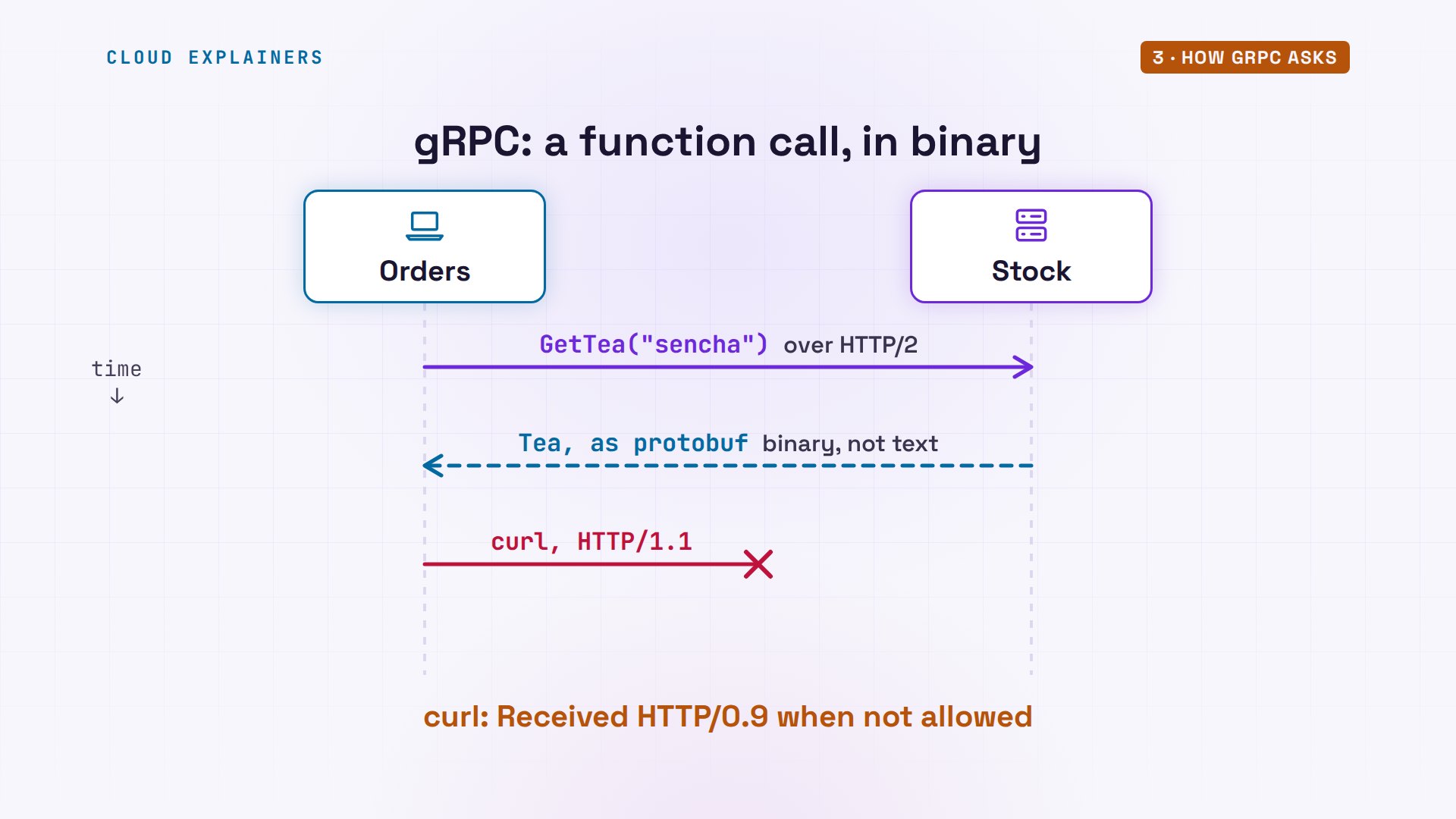
Your app needs to ask another service a question, and someone says: use gRPC, it's faster than REST. Here's Ana's tea shop, asking its stock service how much Sencha is left. Over REST: a plain address, and an answer you can read. The same question to the gRPC port, with the same curl: an error.
(.venv) ana@laptop:~/order-service$ curl -s stock:8000/teas/sencha{"name":"Sencha","stock":12,"cents":650}
(.venv) ana@laptop:~/order-service$ curl -sS stock:50051/teas/senchacurl: (1) Received HTTP/0.9 when not allowed
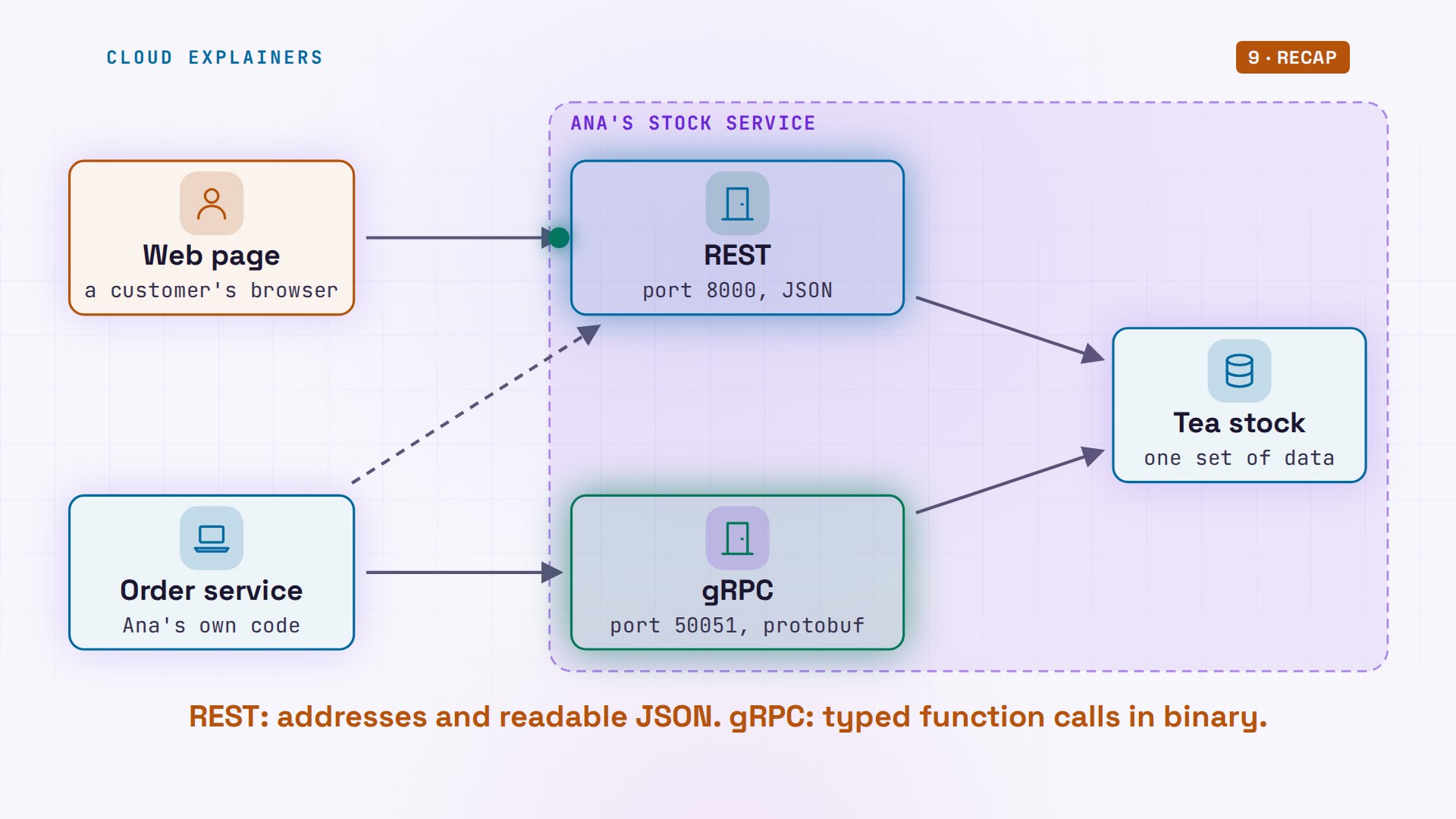
Both are ways for one program to ask another for something. REST sends a request to an address and gets text back. gRPC calls a function on the other machine, using a contract both sides share. By the end you'll know which one to use, how much faster gRPC really was in our test, and why one tiny edit made it report zero tea in stock.
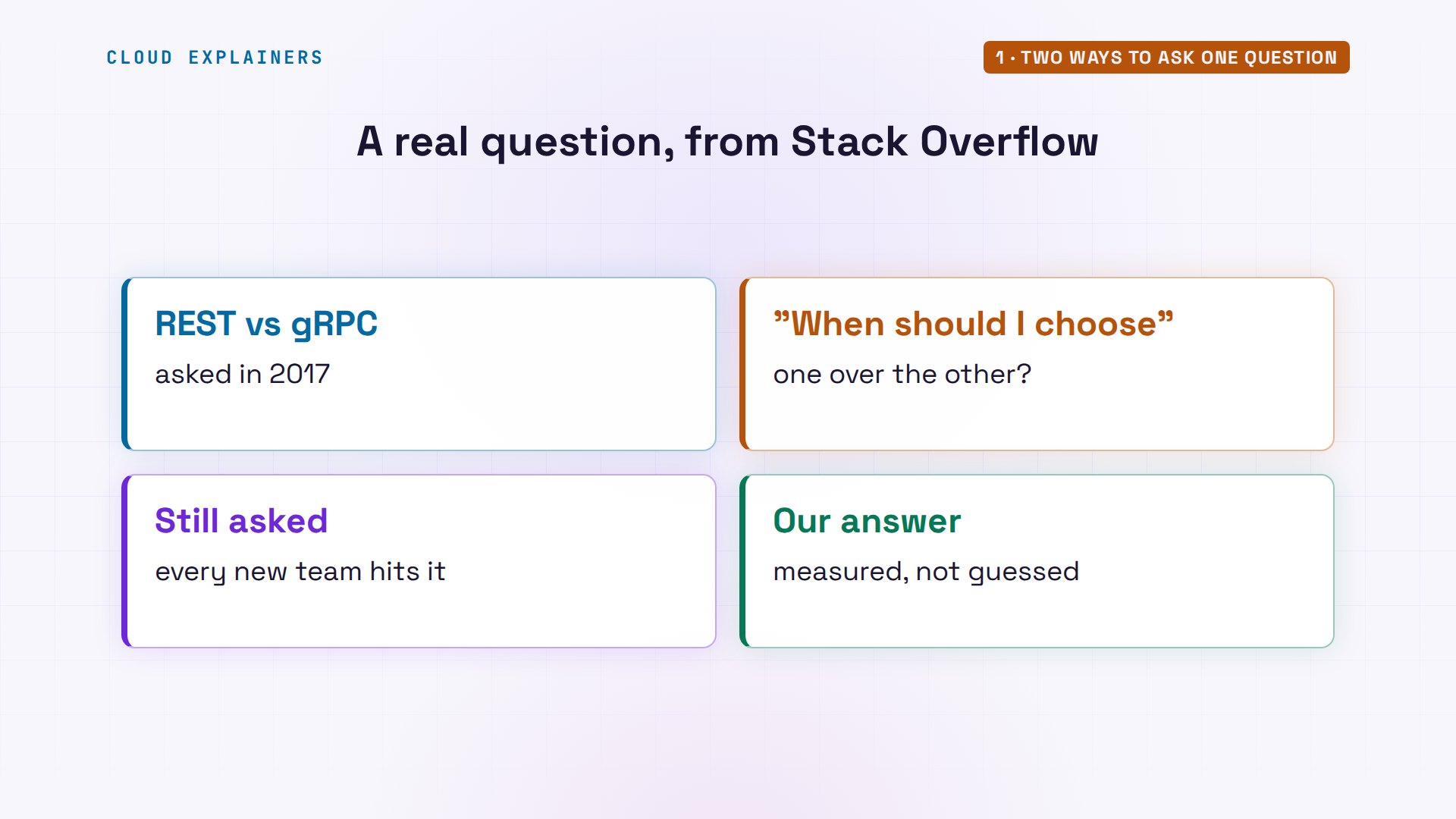
Someone asked exactly this on Stack Overflow in 2017: REST versus gRPC, when should I choose one over the other? People still ask it, so let's answer it with a real run, one question at a time.
How REST asks
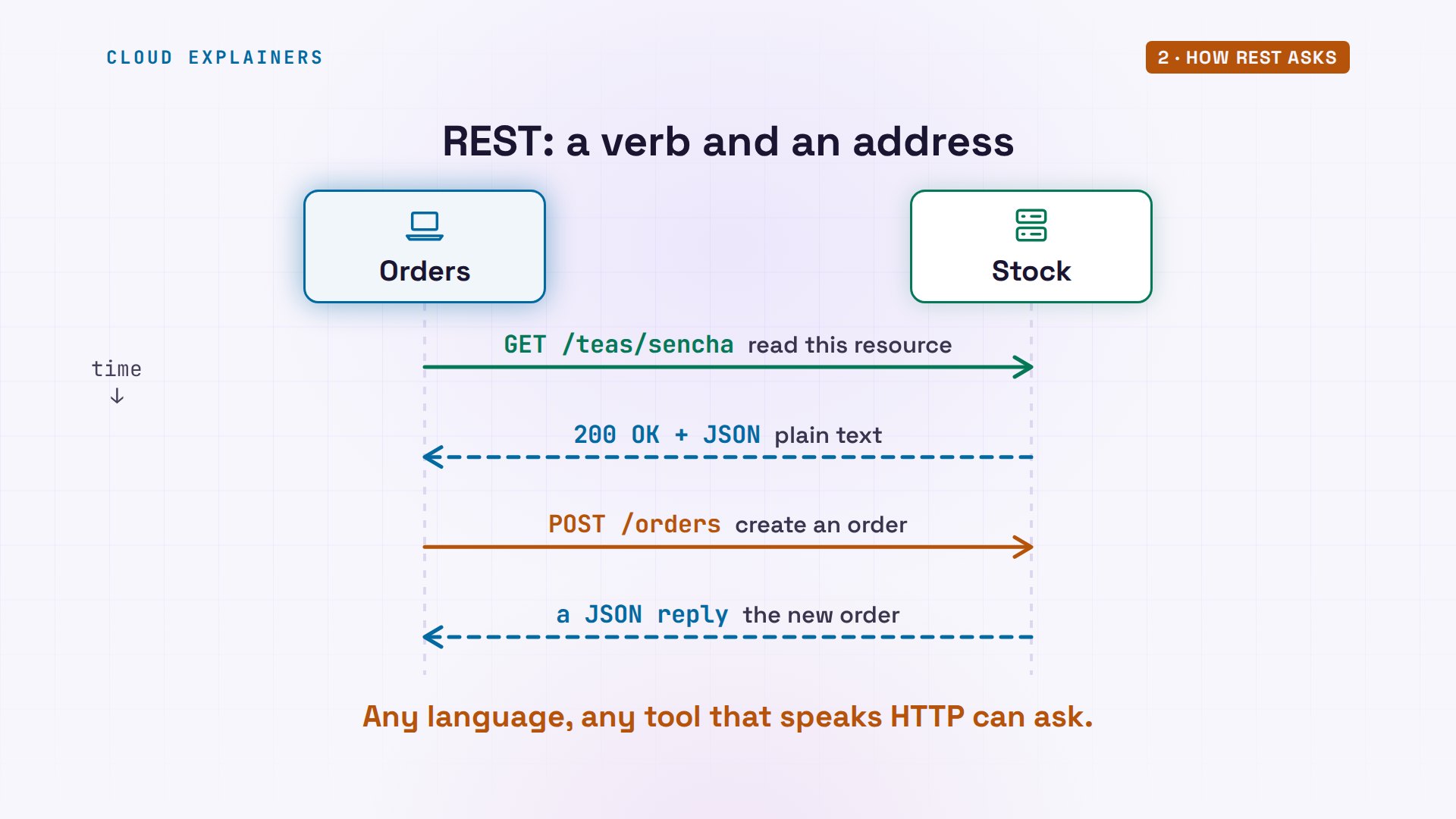
What does REST actually do? It treats each thing as a resource with an address: this tea lives at slash teas slash sencha. You ask with an HTTP verb, GET to read, POST to create, and the answer usually comes back as JSON, plain text.
In Ana's order service that's three lines of Python: get the address, read the JSON, print the stock. Twelve in stock.
(.venv) ana@laptop:~/order-service$ cat check_rest.py# Ana's order service asks the stock service over REST: a plain HTTP GET that answers JSON.
import httpx

tea = httpx.get("http://stock:8000/teas/sencha").json()
print(f"{tea['name']}: {tea['stock']} in stock")
(.venv) ana@laptop:~/order-service$ python3 check_rest.pySencha: 12 in stock
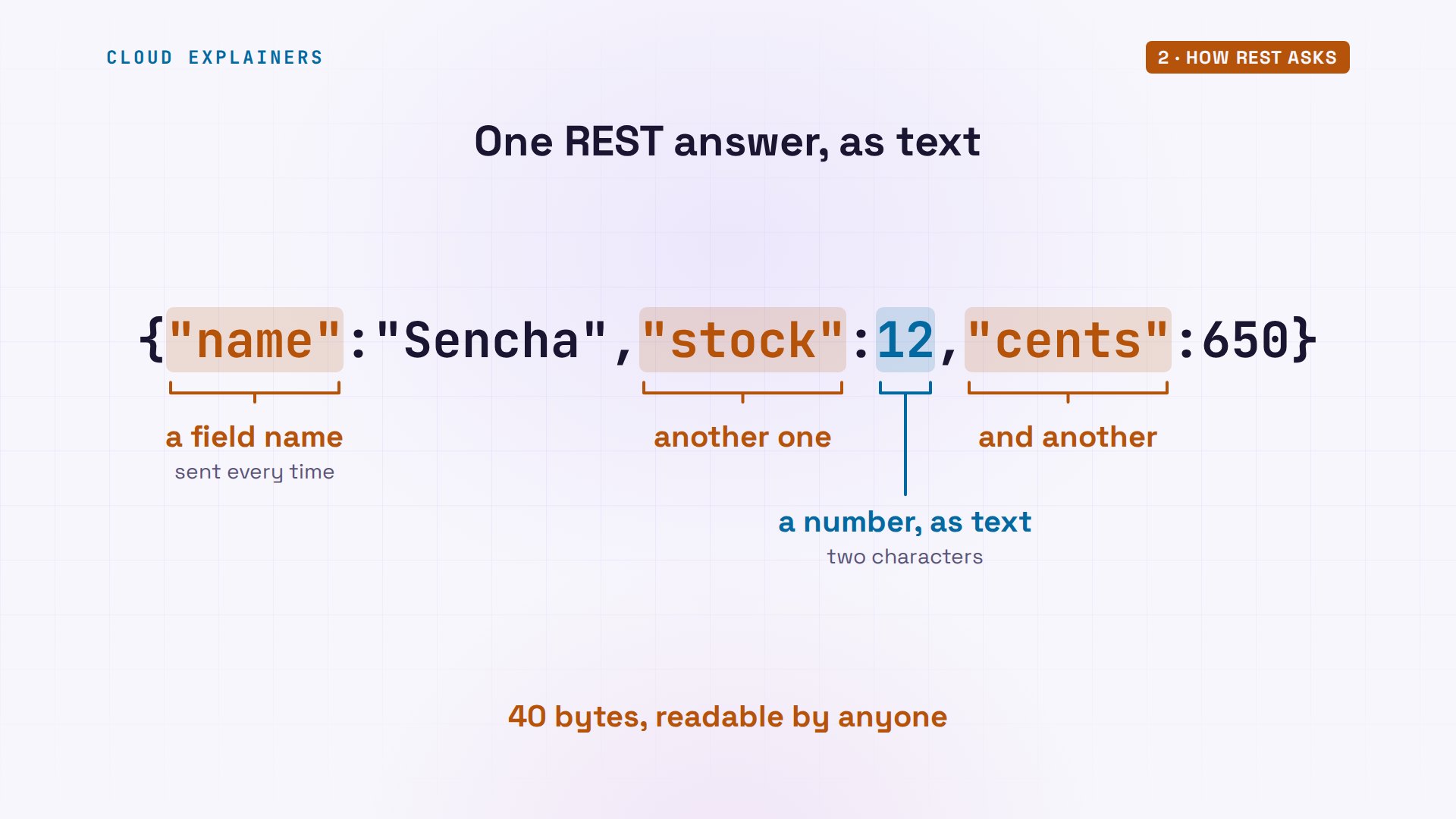
Look at what came back. Every answer spells out its field names: name, stock, cents, every single time. Even the twelve travels as two text characters. That's why JSON is easy to read, and it's where the bytes go.
How gRPC asks
gRPC starts somewhere else: a contract. A file, stock.proto, lists the functions the stock service offers, GetTea and WatchStock, and the exact shape of every message they send.
(.venv) ana@laptop:~/order-service$ cat stock.protosyntax = "proto3";

service Stock {
  rpc GetTea (TeaRequest) returns (Tea);
  rpc WatchStock (TeaRequest) returns (stream Tea);
}

message TeaRequest {
  string name = 1;
}

message Tea {
  string name = 1;
  int32 stock = 2;
  int32 cents = 3;
}
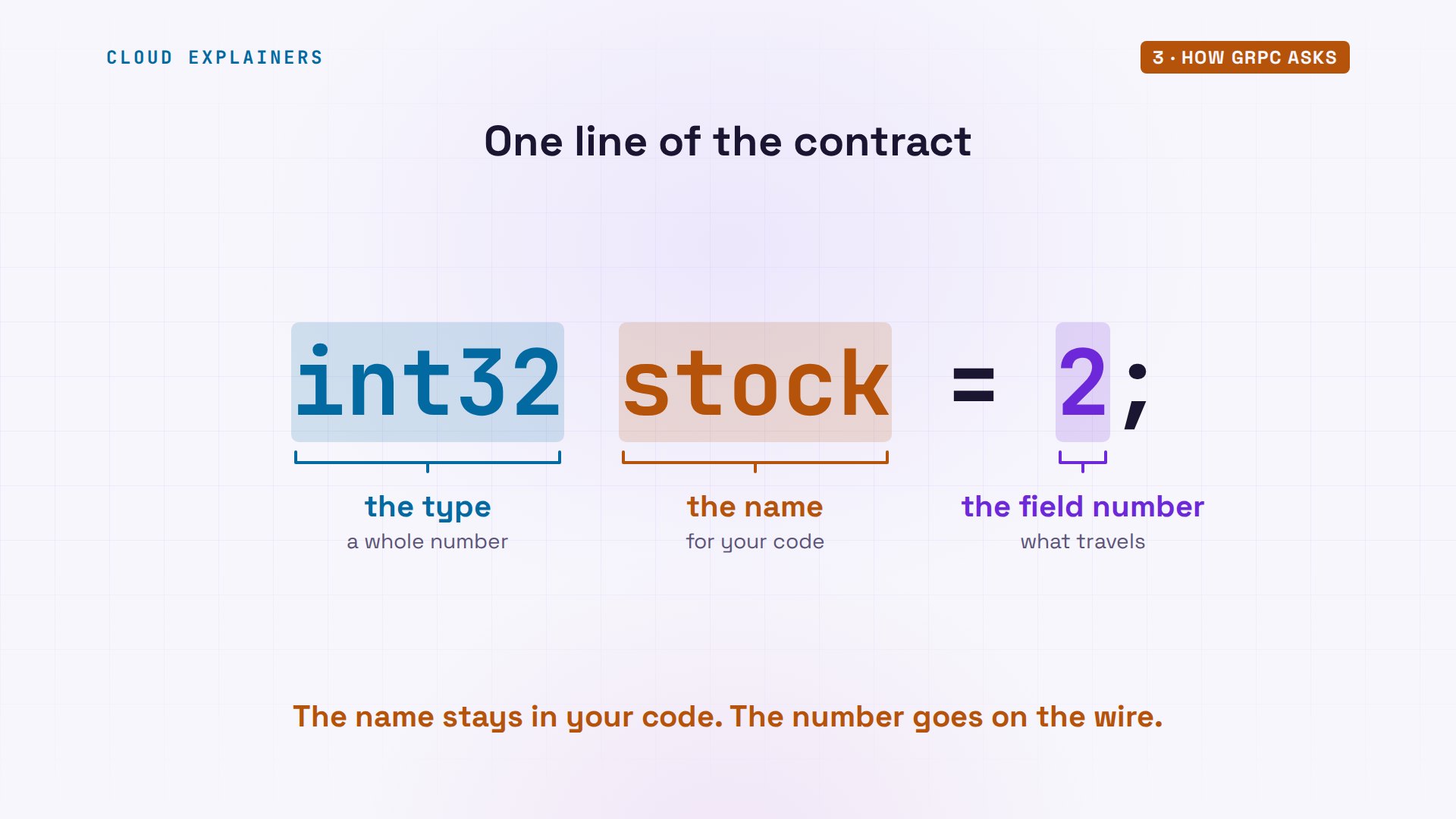
Each field in that contract has three parts. A type: here, a whole number. A name, which your code uses. And a number, two. That equals sign doesn't set the stock to two: two is the field's number. Remember it, because it's the part that actually travels between the machines.
Then a tool reads the contract and writes code for you: two new Python files. One holds the message shapes; the other holds a stub, a ready-made client. Ana's script calls GetTea on that stub like a normal function, and gets the same answer: twelve.
(.venv) ana@laptop:~/order-service$ python -m grpc_tools.protoc -I. --python_out=. --grpc_python_out=. stock.proto
(.venv) ana@laptop:~/order-service$ lsbench.py check_grpc.py check_rest.py sizes.py stock.proto stock_pb2.py stock_pb2_grpc.py
(.venv) ana@laptop:~/order-service$ cat check_grpc.py# The same question over gRPC: call GetTea like a function, with code generated from stock.proto.
import grpc
import stock_pb2
import stock_pb2_grpc

stub = stock_pb2_grpc.StockStub(grpc.insecure_channel("stock:50051"))
tea = stub.GetTea(stock_pb2.TeaRequest(name="sencha"))
print(f"{tea.name}: {tea.stock} in stock")
(.venv) ana@laptop:~/order-service$ python3 check_grpc.pySencha: 12 in stock
Underneath, gRPC sends that call as an HTTP/2 request, the newer version of the web's protocol, and the message as protobuf: compact binary, not text. That's why plain curl failed at the start. It spoke the older HTTP/1.1, and got back bytes it couldn't read as an HTTP reply.
To try a gRPC service by hand, you need a tool that knows the contract, like grpcurl. Give it the proto file, and it shows the answer as JSON, for humans. And the reply's content type? Application slash g r p c.
(.venv) ana@laptop:~/order-service$ grpcurl -plaintext -proto stock.proto -d '{"name": "sencha"}' stock:50051 Stock/GetTea{
  "name": "Sencha",
  "stock": 12,
  "cents": 650
}
(.venv) ana@laptop:~/order-service$ grpcurl -v -plaintext -proto stock.proto -d '{"name": "sencha"}' stock:50051 Stock/GetTea | grep content-typecontent-type: application/grpc
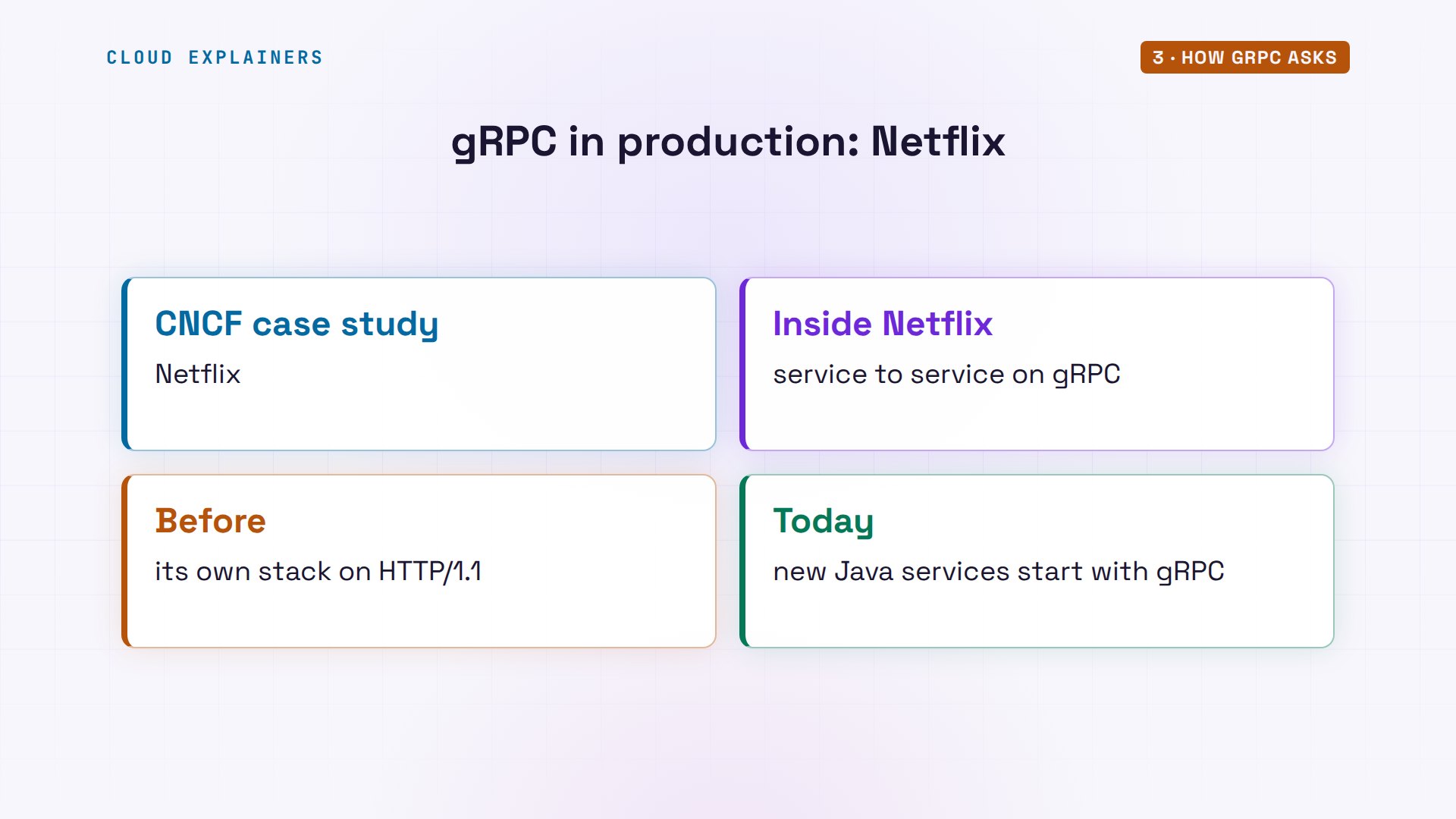
This isn't only for small shops. The Cloud Native Computing Foundation's Netflix case study says a huge part of Netflix's internal service-to-service traffic runs on gRPC. Before that, Netflix ran its own stack on HTTP/1.1, and today all new Java development there starts with gRPC.
Smaller and faster, by how much?
So is it really smaller? Ana's script asks both doors for the same Sencha and counts the bytes. JSON: 40 bytes. Protobuf: 13, about a third.
(.venv) ana@laptop:~/order-service$ python3 sizes.pyJSON:     40 bytes  {"name":"Sencha","stock":12,"cents":650}
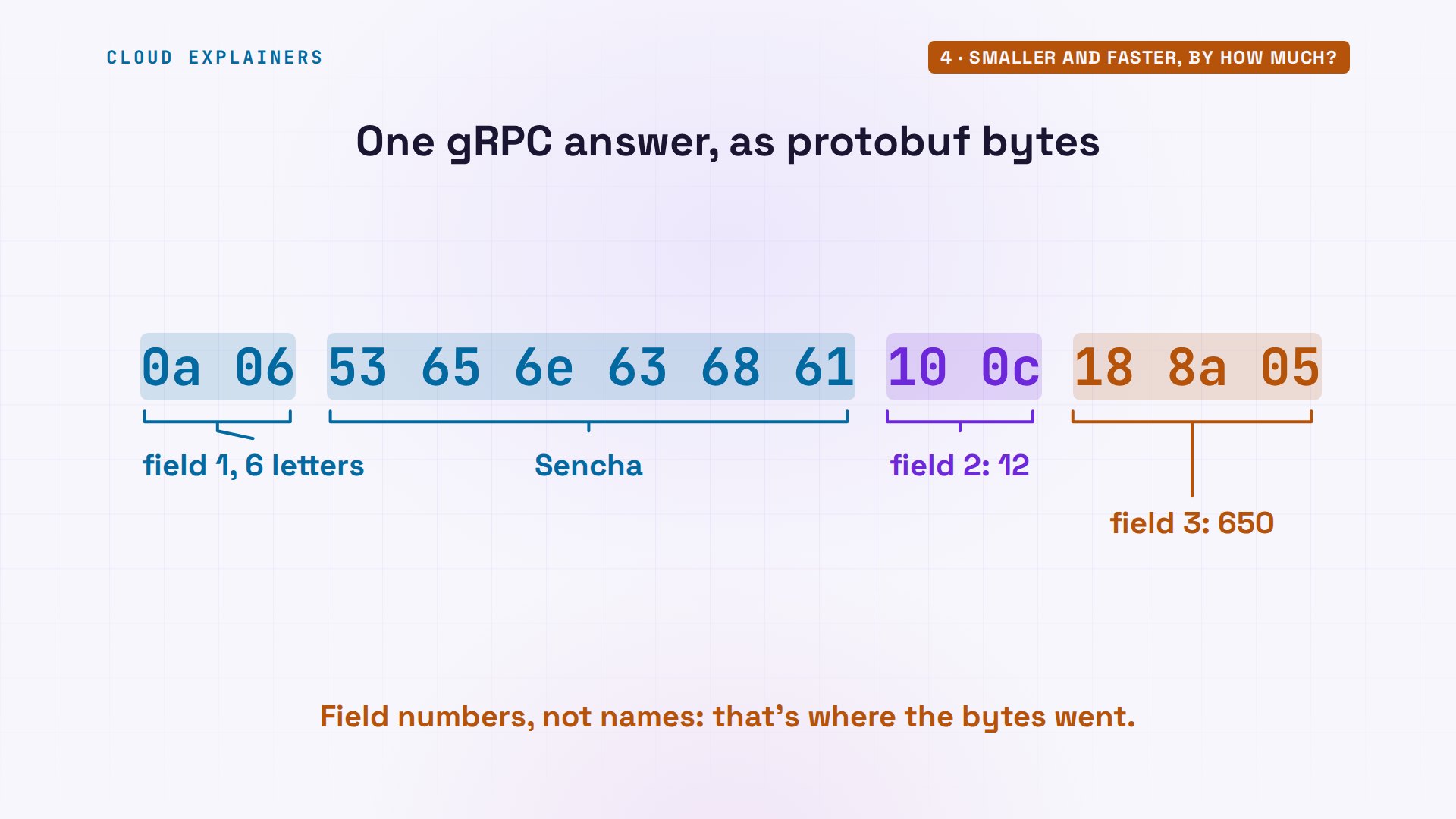
protobuf: 13 bytes  0a 06 53 65 6e 63 68 61 10 0c 18 8a 05
Here are those 13 bytes. The first says field one, text, and the next says six letters follow: Sencha. Then field two: twelve. Then field three: six hundred and fifty. No field names at all, just the numbers from the contract.
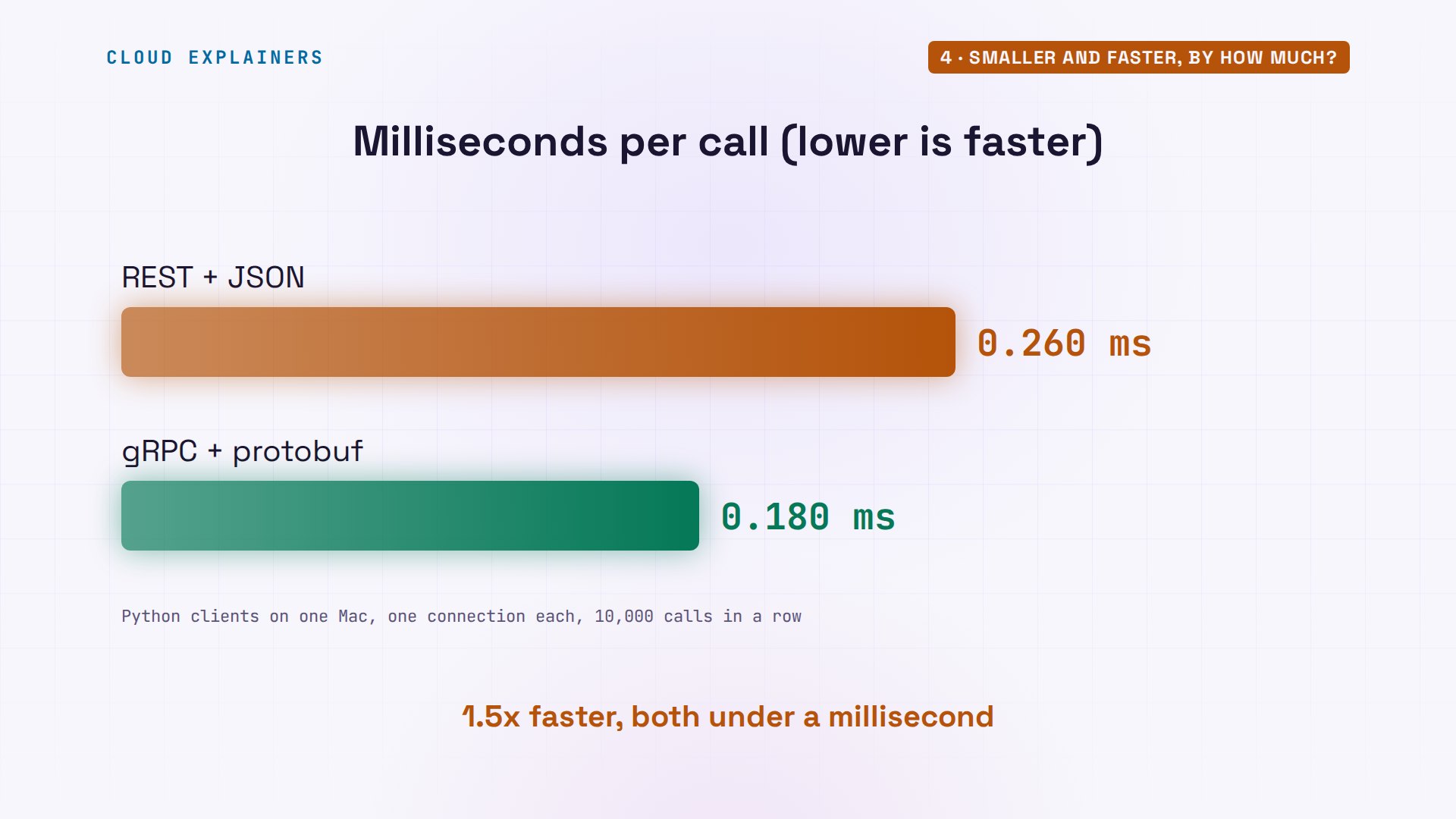
Smaller, but is it faster? Ana's script asks each door ten thousand times in a row. Guess first: how much faster is gRPC? About one and a half times. REST took 2.58 seconds, gRPC 1.75.
(.venv) ana@laptop:~/order-service$ python3 bench.py 10000REST: 10,000 calls in 2.58 s  (0.26 ms each)
gRPC: 10,000 calls in 1.75 s  (0.18 ms each)
Per call, that's 0.26 milliseconds against 0.18. Real, but small: across a real network, the trip itself often takes longer than either.
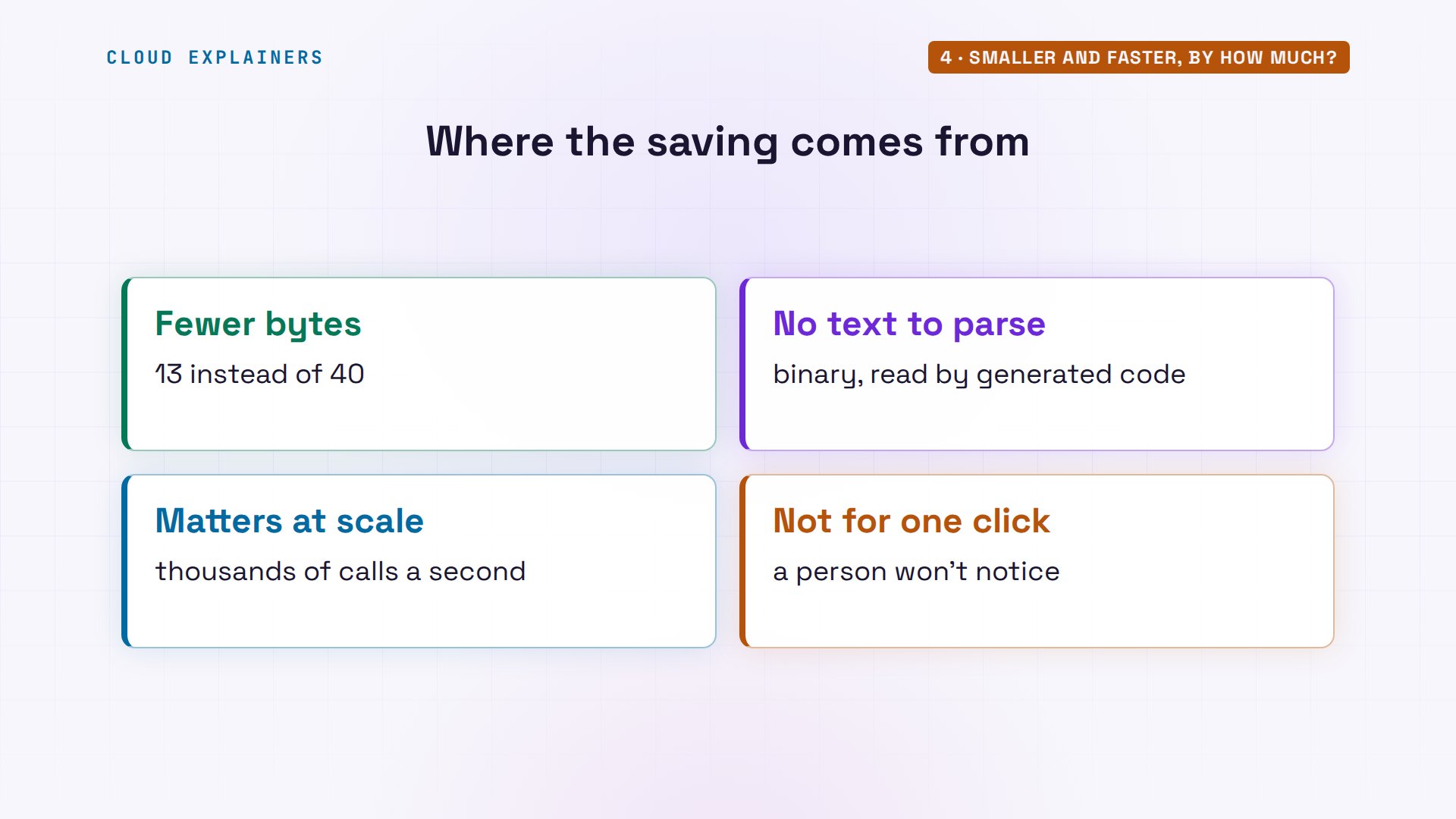
So where does the saving come from? Fewer bytes to send. No text to turn back into numbers: the generated code reads the binary directly. It adds up when services call each other thousands of times a second, and hardly matters for a page a person clicks once.
When the answer keeps changing
Now a harder question: Ana wants to know the moment Sencha runs low. With plain REST you ask again and again, and mostly hear the same answer. gRPC can stream: one call, and the server keeps sending each change.
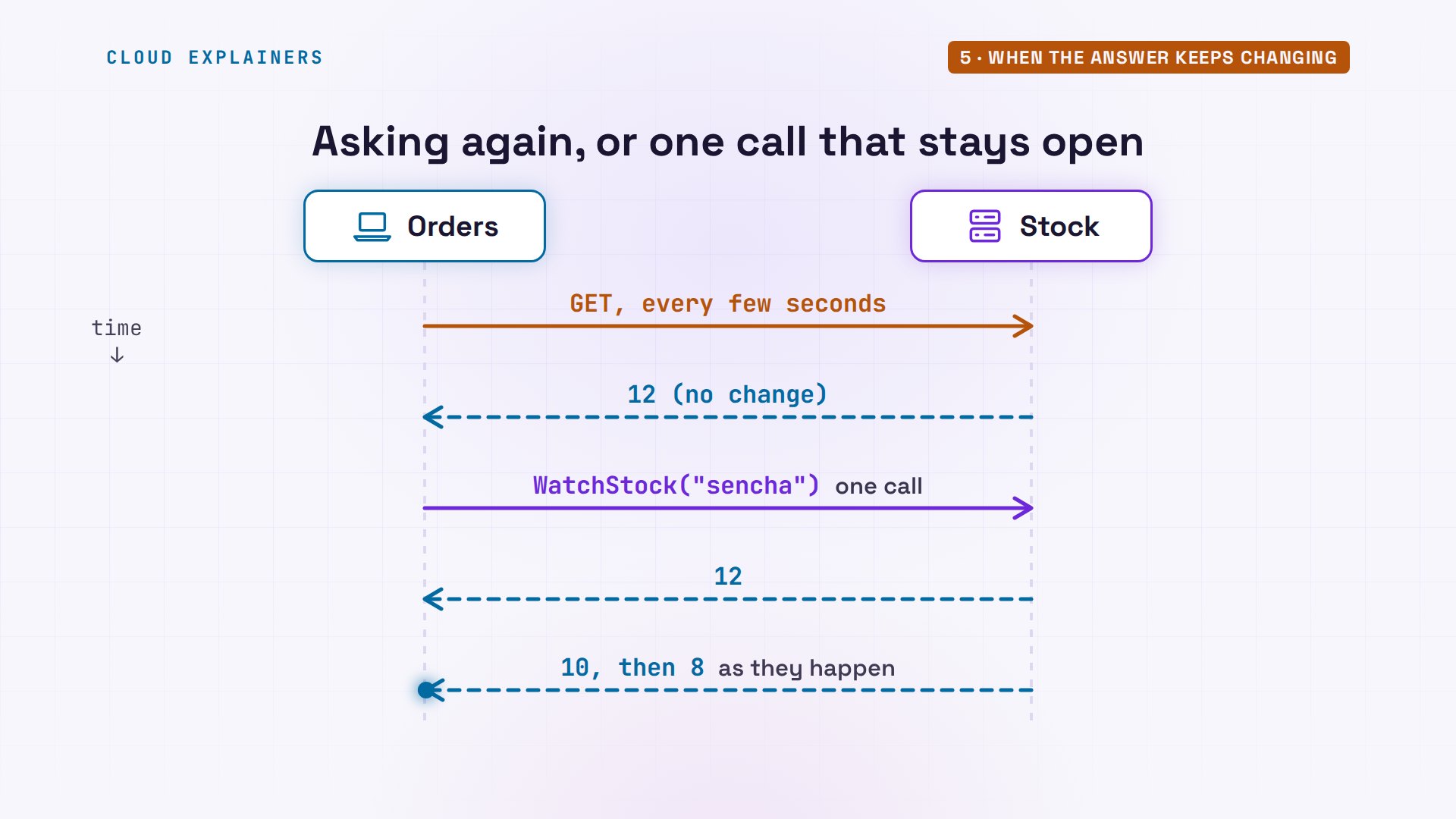
In a second window, Ana starts WatchStock. The first message arrives at once: twelve. And the call stays open.
(.venv) ana@laptop:~/order-service$ grpcurl -plaintext -proto stock.proto -d '{"name": "sencha"}' stock:50051 Stock/WatchStock{
  "name": "Sencha",
  "stock": 12,
  "cents": 650
}
Back in her first window, two customers each buy two packs of Sencha, through the REST door. Ten left, then eight.
(.venv) ana@laptop:~/order-service$ curl -s stock:8000/orders -H "Content-Type: application/json" -d '{"tea": "sencha", "qty": 2}'{"ok":true,"tea":"Sencha","left":10}
(.venv) ana@laptop:~/order-service$ curl -s stock:8000/orders -H "Content-Type: application/json" -d '{"tea": "sencha", "qty": 2}'{"ok":true,"tea":"Sencha","left":8}
And the watching window? It got both changes, ten and eight, the moment they happened, without asking again.
(.venv) ana@laptop:~/order-service$ grpcurl -plaintext -proto stock.proto -d '{"name": "sencha"}' stock:50051 Stock/WatchStock{
  "name": "Sencha",
  "stock": 12,
  "cents": 650
}
{
  "name": "Sencha",
  "stock": 10,
  "cents": 650
}
{
  "name": "Sencha",
  "stock": 8,
  "cents": 650
}
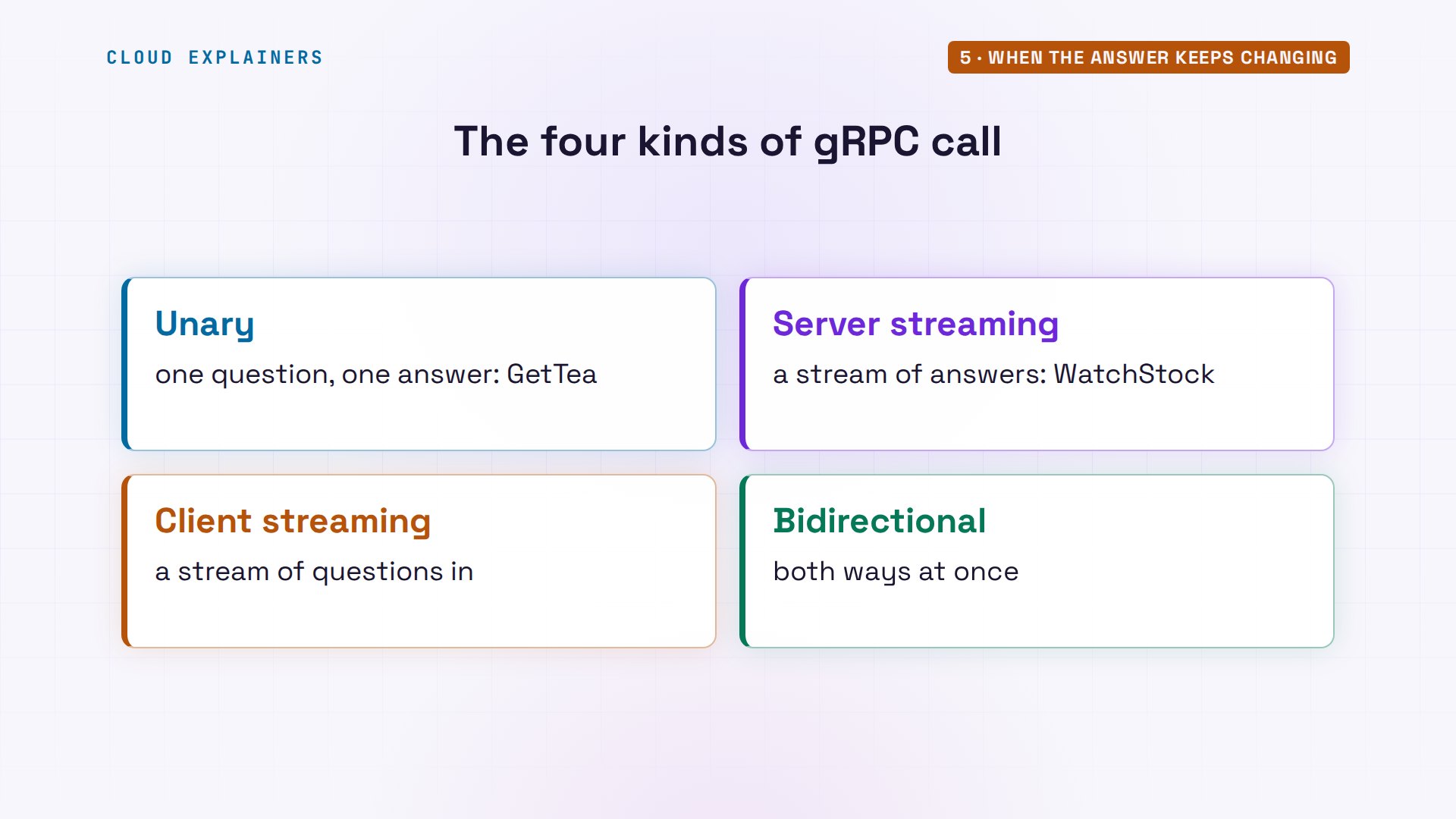
That stream is one of four kinds of call a gRPC contract can have. One question, one answer, like GetTea. One question, and a stream of answers, like WatchStock. A stream of questions in, say a phone uploading readings. Or streams both ways at once, like a chat.
When the API changes
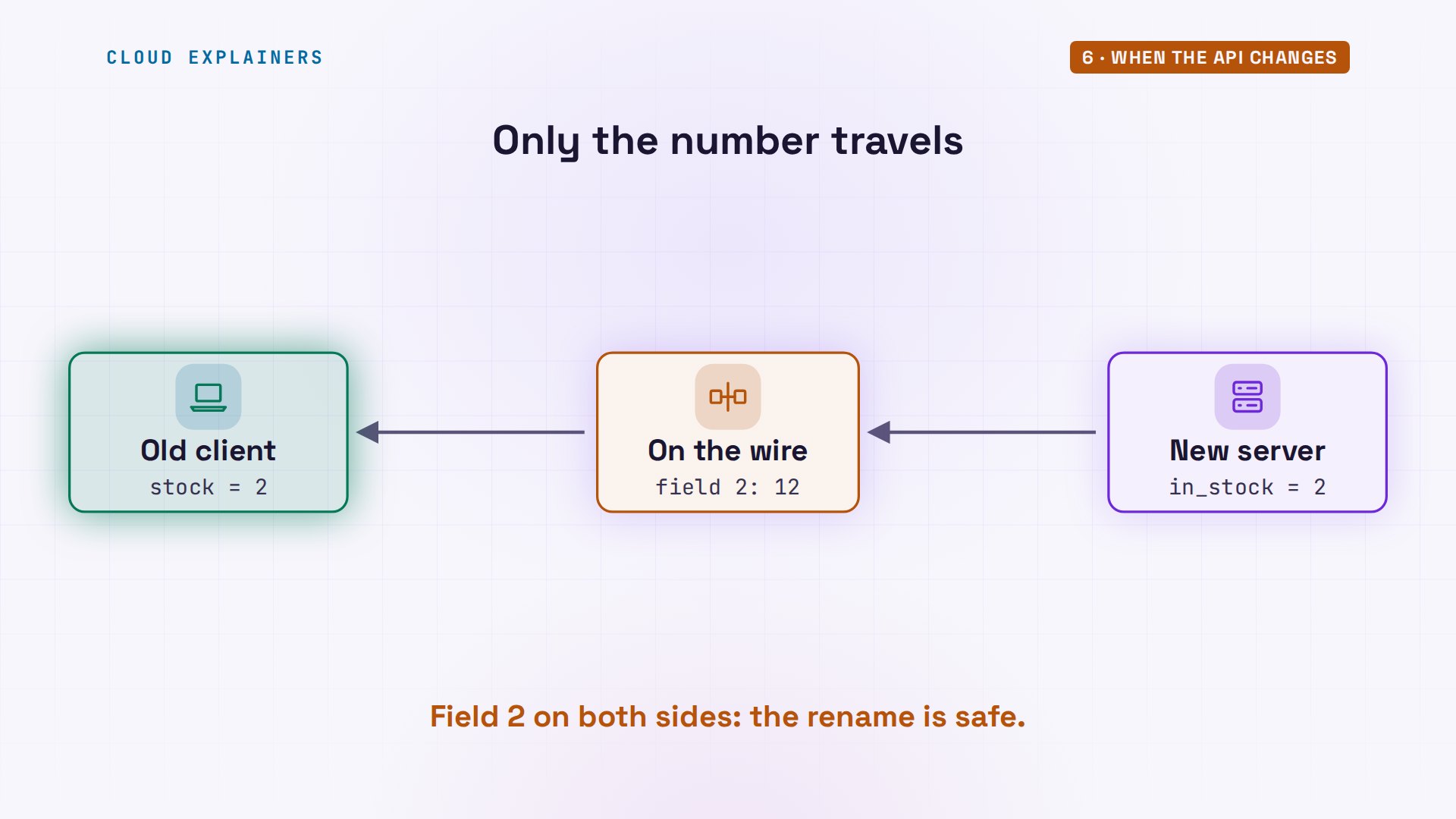
Every API changes. Ana's team renames the stock field to in stock, on both doors. The field number stays two. But the order service still runs its old code.
(.venv) ana@stock:~/stock-service$ diff stock.proto v2/stock.proto14c14
<   int32 stock = 2;
---
>   int32 in_stock = 2;
(.venv) ana@stock:~/stock-service$ python3 shop_server.py --v2stock service v2 ready: REST on port 8000, gRPC on port 50051
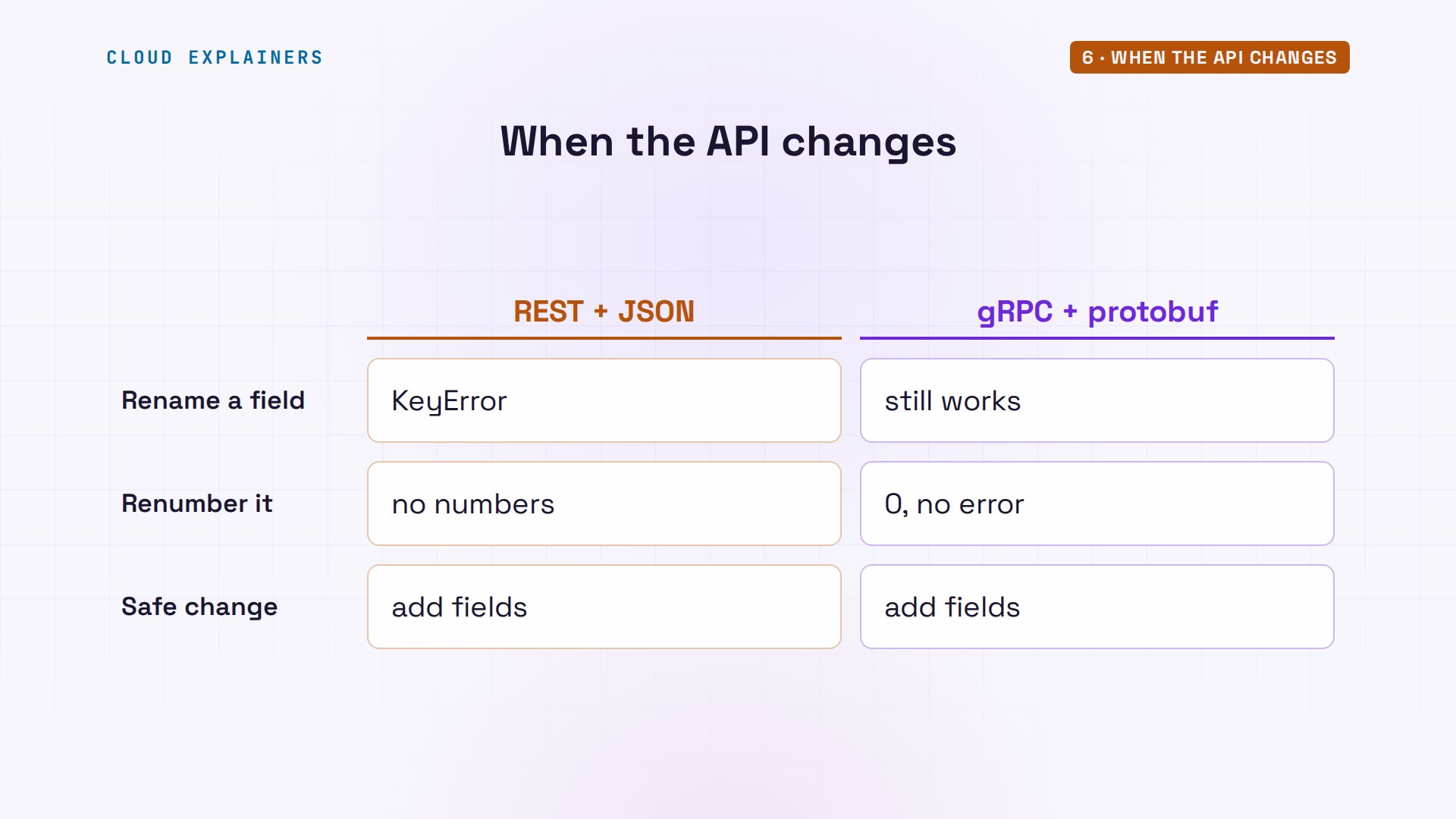
The REST answer now says in stock. Guess first: old clients, new server. Which one still works? Not REST: the JSON says in stock, and Ana's old script asks for stock: a KeyError, and the order service stops.
(.venv) ana@laptop:~/order-service$ curl -s stock:8000/teas/sencha{"name":"Sencha","in_stock":12,"cents":650}
(.venv) ana@laptop:~/order-service$ python3 check_rest.pyTraceback (most recent call last):
  File "/home/ana/order-service/check_rest.py", line 5, in <module>
    print(f"{tea['name']}: {tea['stock']} in stock")
                            ~~~^^^^^^^^^
KeyError: 'stock'
The gRPC client doesn't notice. Twelve in stock, with its old code.
(.venv) ana@laptop:~/order-service$ python3 check_grpc.pySencha: 12 in stock
Why? The old client's contract says stock is field two. The new server's says in stock is field two. The bytes on the wire only say: field two, twelve. The name never travels, so both sides still agree.
So what made gRPC say zero? Change the number instead, from two to four, and run the same old client.
(.venv) ana@stock:~/stock-service$ diff stock.proto v3/stock.proto14c14
<   int32 stock = 2;
---
>   int32 in_stock = 4;
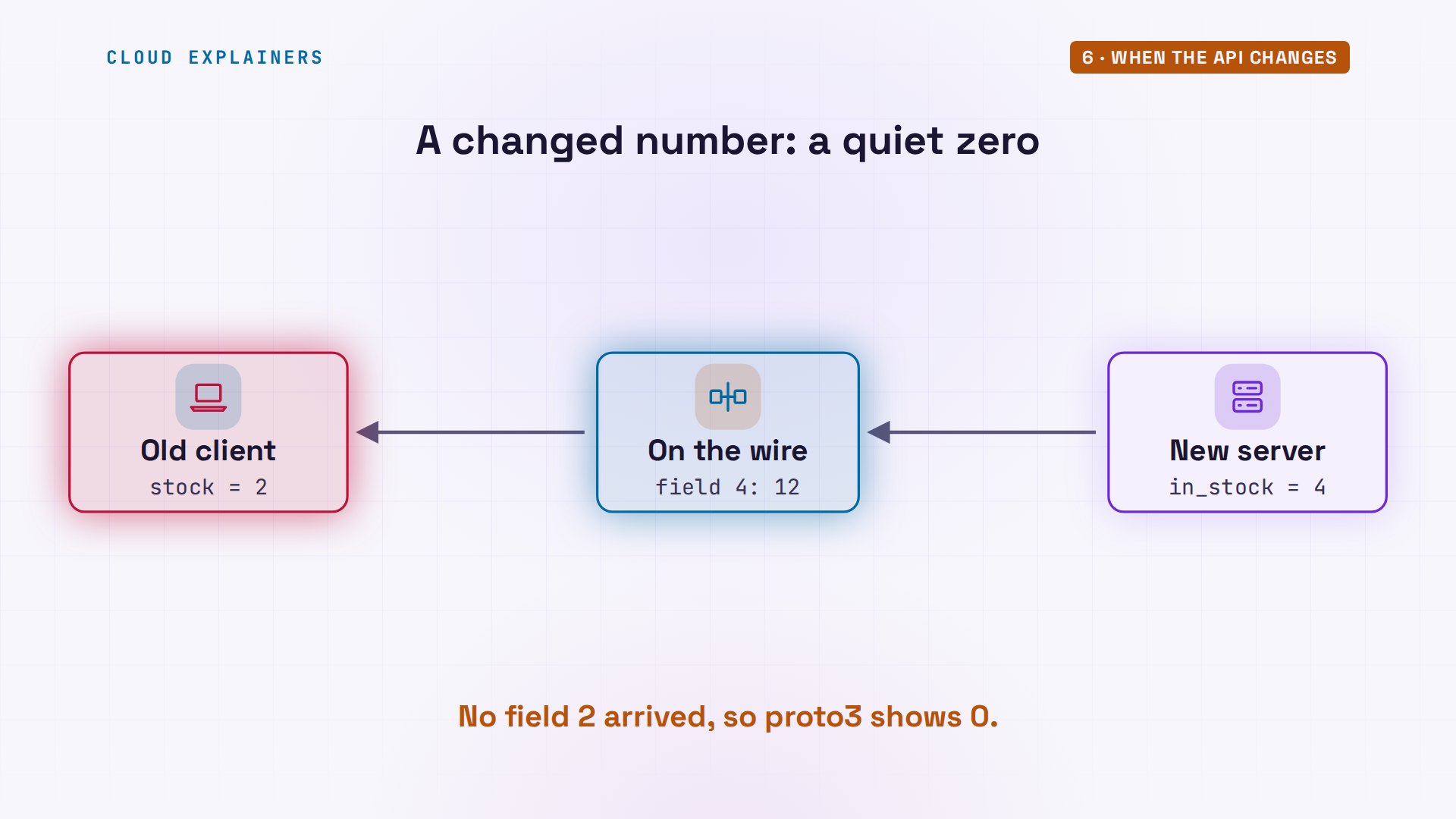
Sencha: zero in stock. No error, no warning, just a wrong number that looks right.
(.venv) ana@laptop:~/order-service$ python3 check_grpc.pySencha: 0 in stock
The server now sends field four. The old client looks for field two, finds nothing, and proto3 fills in the default for a missing number: zero. That's why the protobuf guide says a field number can't change once it's in use.
So the two fail differently. REST breaks loudly when a name changes. gRPC survives a rename, but a changed number gives quiet, wrong answers. With either one, add new fields and keep the old ones.
Where gRPC is harder
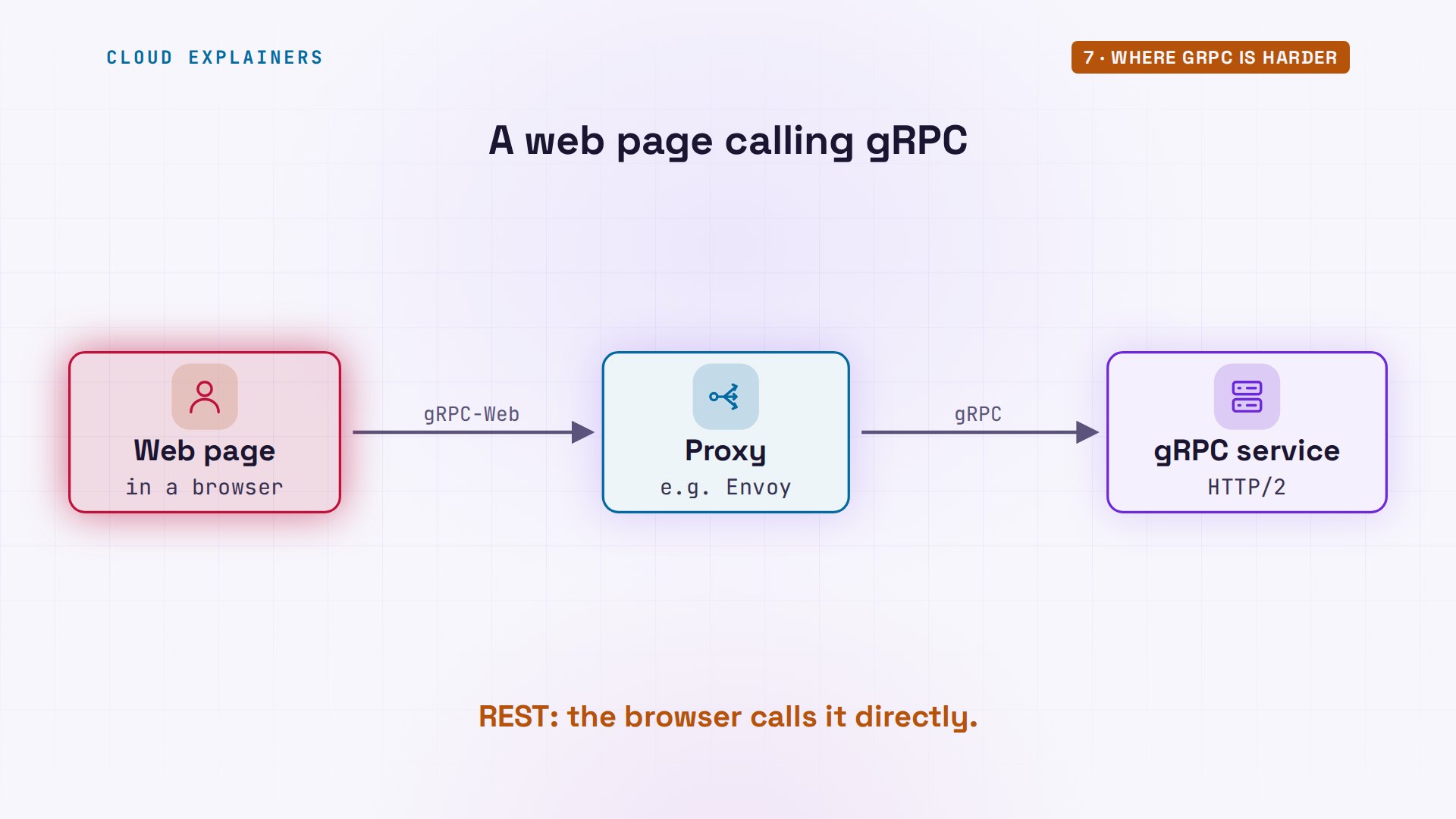
So why not use gRPC everywhere? The browser. Page code can't reach the raw HTTP/2 frames gRPC needs, so a web page uses gRPC-Web, and a proxy such as Envoy translates in between. REST needs none of that: the browser already speaks it.
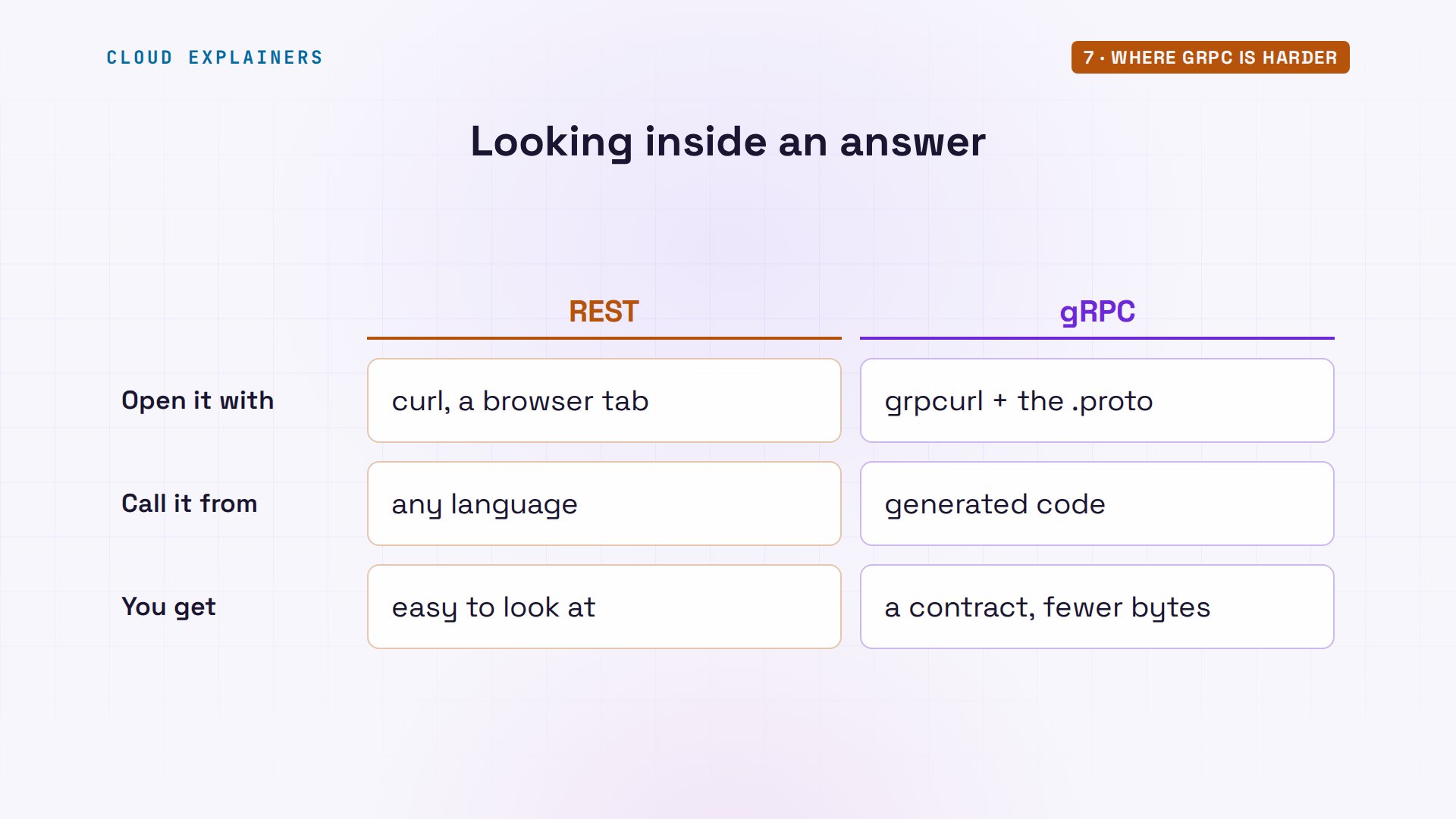
It's also harder to look at. A REST answer opens in curl, a browser tab, or any language. A gRPC answer needs the proto file, generated code, or a tool like grpcurl. That's the price of the contract.
Which one to pick
So which one should you use? REST talks in readable JSON, works in every browser, and needs no contract. gRPC talks in compact binary, needs a proto file, and streams out of the box. In one line: REST is addresses and readable JSON; gRPC is typed function calls in binary.
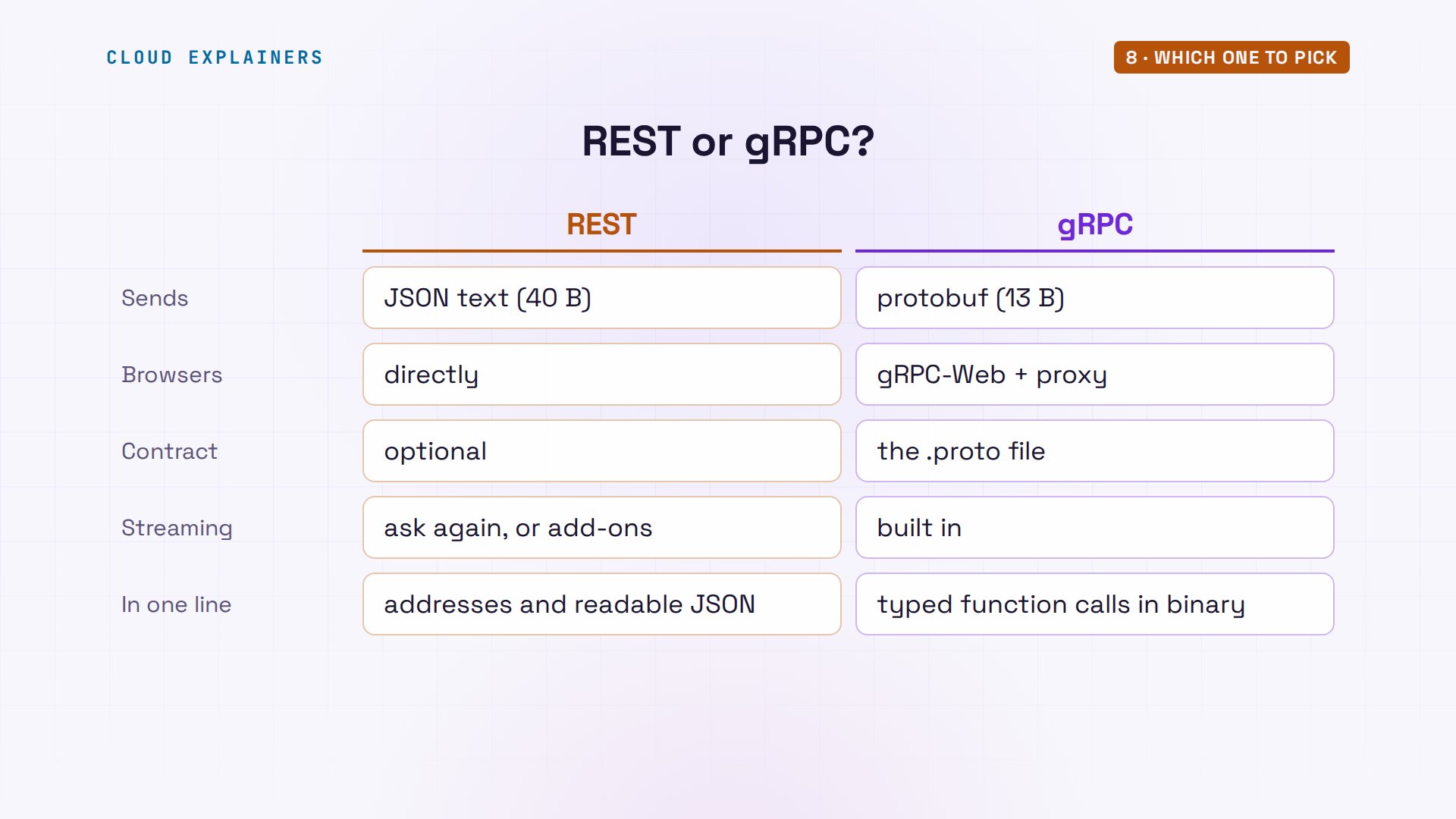
Use REST for anything public: web pages, partners, an API people try with curl. Use gRPC between your own services, when they talk a lot, need streaming, or are written in different languages that share one contract. Many teams run both, like Ana's stock service: REST at the edge, gRPC inside.
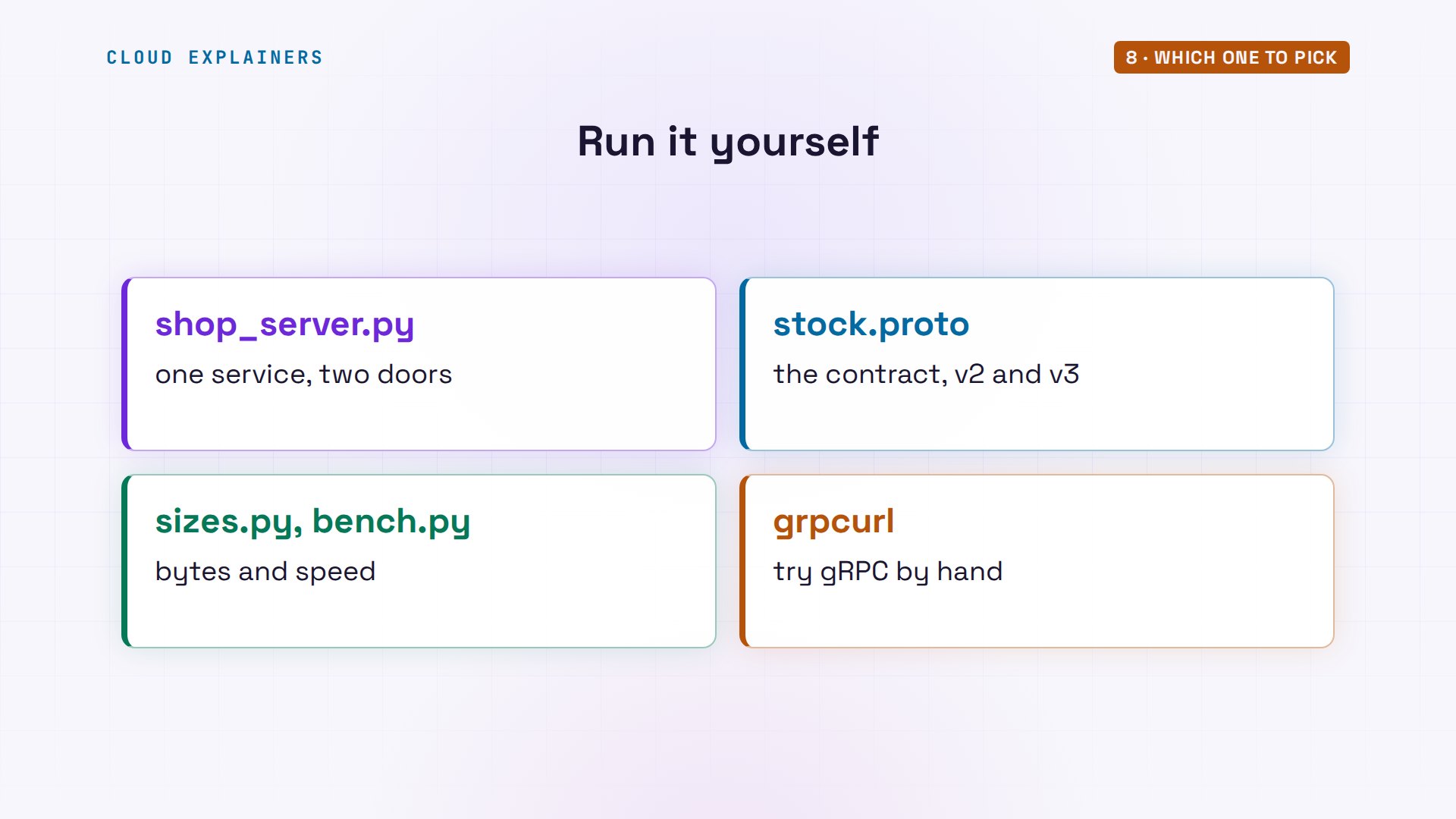
Every command and the lab files are linked in the description, so you can run both doors yourself.
Recap
So: JSON was 40 bytes, protobuf 13. gRPC was about 1.5 times faster, it streams, and it needs a contract you never renumber. REST stays the door for browsers.
If this settled the argument for your team, a like helps YouTube show it to more beginners, and subscribing brings the next one to you.
Every request here ran for real between two small Linux machines. Thanks for watching Cloud Explainers.
Sources
- CNCF case study, Netflix ("a huge part of the internal service-to-service communication at Netflix runs on gRPC"; the earlier HTTP/1.1 stack; new Java development starts with gRPC)
- gRPC, Core concepts (unary, server streaming, client streaming and bidirectional streaming RPCs)
- gRPC over HTTP/2, the protocol spec
- gRPC blog, The state of gRPC in the browser (raw HTTP/2 frames are inaccessible in browsers; gRPC-Web and a proxy such as Envoy)
- Protocol Buffers, proto3 language guide (field numbers identify fields in the wire format and can't change once in use; default values)
- Stack Overflow, REST vs gRPC: when should I choose one over the other? (2017)
Demos: two containers on our own Mac standing in for Ana's stock service and order service; the tea shop is made up. Watch the full video on YouTube.
More videos

Linux Makefiles Will Finally Make Sense After This

SAML vs OAuth vs OpenID Connect: What's the Difference?
How to Fix Python cron Jobs That Never Run
Linux Bash Scripting: Full Tutorial for Beginners
How PXE Network Boot Works
How Active Directory Works
How to Fix a Linux systemd Service That Won't Start
Linux Logs: syslog vs journald
JWT vs Session Cookies: Which One Should You Use?
Docker vs Docker Compose: Which One Should You Use?
How to Fix Docker Compose Containers That Can't Talk to Each Other

Django Full Tutorial for Beginners

How Linux systemd Works

How to Fix 'Windows Cannot Access' Network Share Errors (SMB)
How to Fix SSL Certificate Chain Errors (Missing Intermediate)

Every Python Concept for Beginners in 10 Minutes
Every SQL Join Type in 10 Minutes

Why OpenRouter Free Models Hit Their Limit So Fast
Why Your Gemini API Free Tier Runs Out So Fast
OpenRouter Will Finally Make Sense After This
How Redis Caching Works
Gemini API vs Vertex AI: Which One Should You Use?
How to Fix a Leaked Gemini API Key
Why Golang Uses Goroutines Instead of Threads
How to Fix Gemini API Error 429: Resource Exhausted
Claude Token Pricing Will Finally Make Sense After This
Why Python Web Scraping Returns Nothing (and the Fix)
Python uv vs pip: Which One Should You Use?

Python Automation: Full Tutorial for Beginners
How OAuth Login Works

Google AI Studio Will Finally Make Sense After This
What Happens When You Run a Docker Container
How to Fix Claude Code Billing Your API Key Instead of Your Plan
Why Passkeys Can't Be Phished Like Passwords
PowerShell vs Bash: Which One Should You Learn?
The Linux Roadmap for Beginners
Django vs FastAPI: Which One Should You Use?
Why SQLite Is the Most Used Database in the World
How a NoSQL Database Like MongoDB Works
How to Fix Python pip error: externally-managed-environment
How to Fix MySQL Too Many Connections Database Errors
Golang Concurrency Will Finally Make Sense After This
How Amazon S3 Works
How Kubernetes Works
How Git Works
How to Fix Docker Port Already Allocated Errors
How PostgreSQL Works
How to Fix Git Merge Conflicts
How to Fix No Space Left on Device in Linux
How the Internet Works
SQL vs NoSQL: When Each One Wins
How to Fix JWT Token Expired Errors (401 Unauthorized)
Claude API vs Claude Pro: Why Your Subscription Doesn't Include It

Why AI Agent Skills Beat Giant Prompts

Linux Cron Jobs Will Finally Make Sense After This

Security Logs Will Finally Make Sense After This
How to Fix a Security Leak: An API Key Pushed to GitHub
DNS Will Finally Make Sense After This
Never Ignore a Security Update
Two-Factor Authentication Will Finally Make Sense
Never Expose a Database to the Internet
SSH Keys vs Passwords: Which Is Safer for Security?
The 5 Levels of Linux Boot: From Power On to Login
The 5 Levels of Network Firewalls
Password Security: Why Hackers Crack Weak Passwords
Why Your Linux Server Runs Out of Memory
HTTP vs HTTPS: What Actually Changes on Your Network

Every Linux File Permission You Need to Know
Linux Processes vs Threads: When Each One Wins
The OSI Model Will Finally Make Sense After This

The 7 Levels of Git
Every Network Troubleshooting Command You Need
Hashing vs Encryption in Cybersecurity: When Each One Wins
Why the Internet Ran Out of IP Addresses
Linux Package Managers: apt vs Snap vs Flatpak

Why Python Is Slow (and When It Doesn't Matter)
TCP vs UDP: When Each One Wins

Stop Running Linux as Root (Do This Instead)

Linux Users and Groups Will Finally Make Sense

Why Phishing Beats Good Security (and How to Spot It)

The 7 Levels of Docker

AI Agents Will Finally Make Sense After This

Stop Using git push --force (Use This Instead)
Agent Skills vs MCP: When Each One Wins
Networking Will Finally Make Sense After This

Every Linux Command You Actually Need
The 7 Levels of Cybersecurity
Every System Design Concept You Need, in One Diagram