The Django Roadmap for Beginners
A Django roadmap for beginners: eight stages in the order that keeps each one from surprising you, from Python and a virtual environment to URLs and views, templates, models and migrations, the admin, forms and CSRF, tests, and the real-world settings most tutorials skip. We build one small potluck sign-up site through all eight on Ubuntu, with every error real.
Works on the laptop, not for real
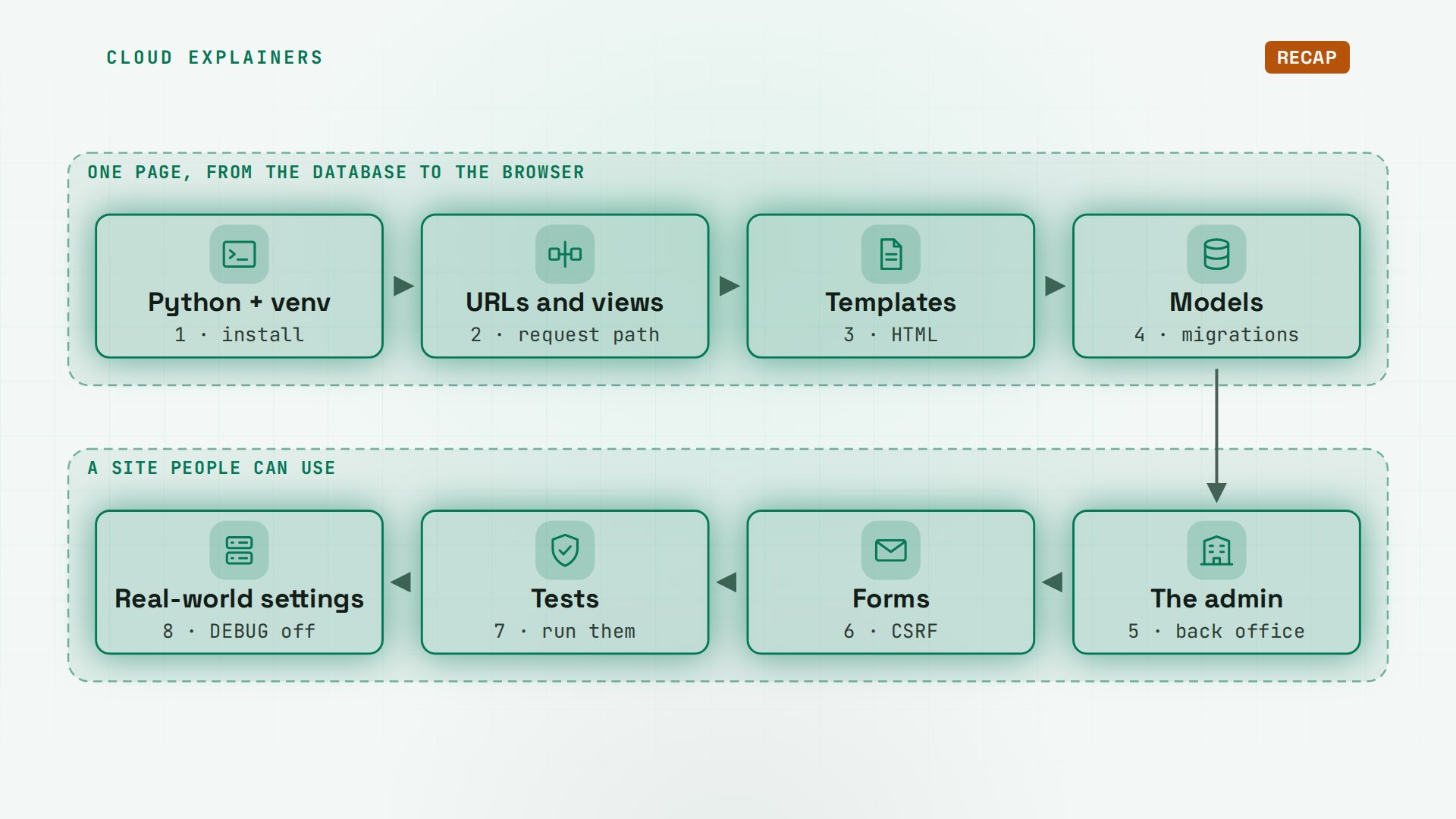
You finished a Django tutorial, and your site works on your laptop. Dave's does too. It's the sign-up page for his church potluck, nicely styled, with Beth's lasagna and an apple pie already on the list.
Then he gets it ready to go online for the church. He turns off DEBUG, the setting that shows detailed error pages. And the server won't even start: you must set ALLOWED_HOSTS if DEBUG is False. By the end, Dave's server starts with DEBUG off, and you'll have an order for learning Django where no stage surprises you like that.
(.venv) dave@laptop:~/potluck$ grep -n '^DEBUG\|^ALLOWED_HOSTS' potluck/settings.py26:DEBUG = False
28:ALLOWED_HOSTS = []
(.venv) dave@laptop:~/potluck$ python manage.py runserverCommandError: You must set settings.ALLOWED_HOSTS if DEBUG is False.
The order
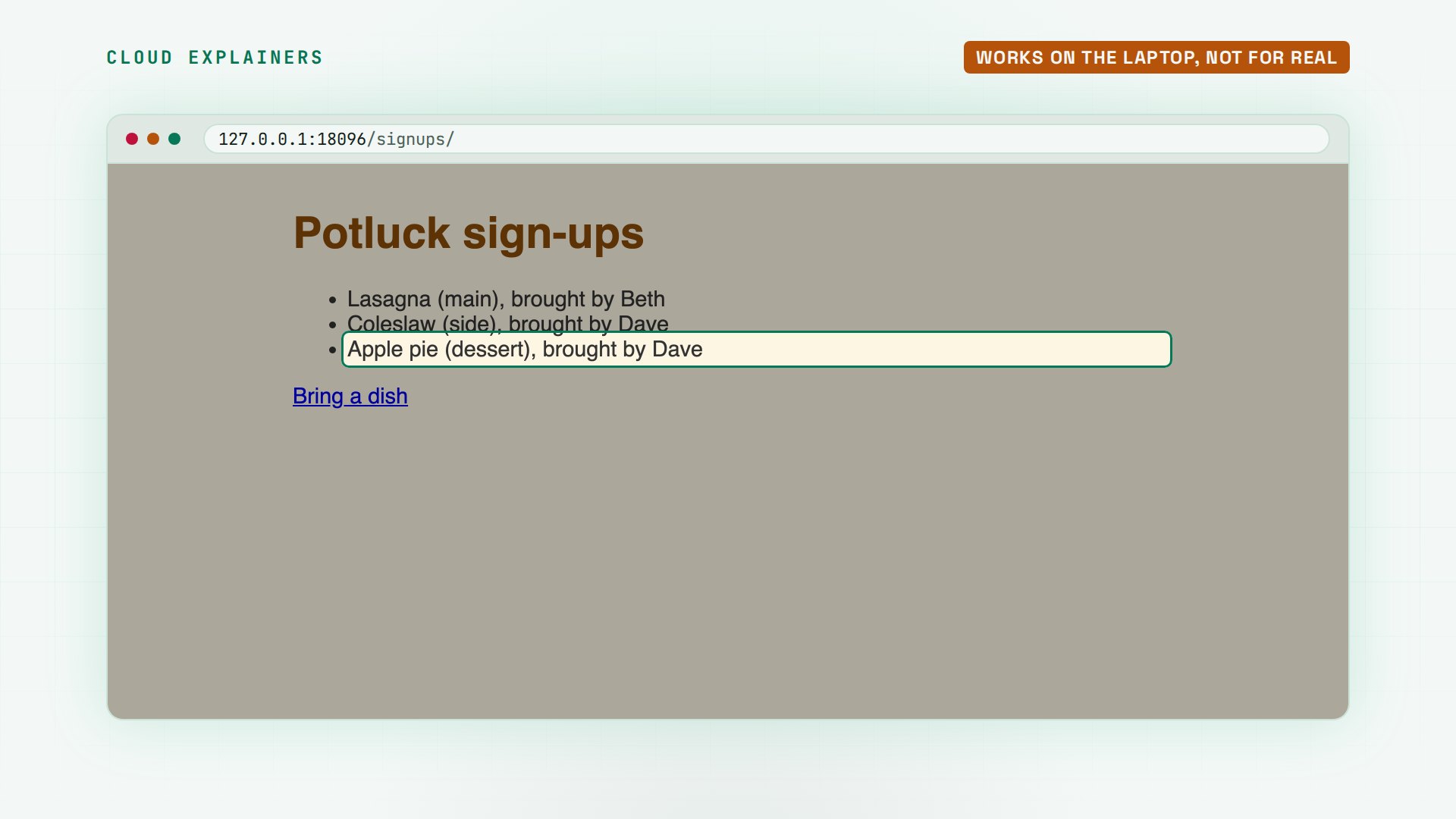
Here's an order that works, in eight stages. Think of flat-pack furniture: the instructions go frame, then shelves, then doors, because each part screws into the one before. Django is the same. The first four stages get one page from the database to the browser. The next four make it a site people can use. We'll build Dave's potluck site again from an empty folder, through all eight, including the stage most tutorials skip.
Stage 1: Python and a venv
Stage one is Python itself. If functions, lists and dictionaries are new, start with our Python roadmap first: Django code is ordinary Python. Then give the project its own virtual environment. That's a private folder of packages, so this site's Django can't clash with anything else on the laptop. Dave makes one called dot venv, switches it on, and installs Django with pip install django.
python3 -m venv .venv
source .venv/bin/activate
(.venv) dave@laptop:~/potluck$ pip install djangoCollecting django
  Downloading django-6.1.3-py3-none-any.whl.metadata (3.9 kB)
Collecting asgiref>=3.9.1 (from django)
  Downloading asgiref-3.13.0-py3-none-any.whl.metadata (12 kB)
Collecting sqlparse>=0.5.0 (from django)
  Downloading sqlparse-0.6.1-py3-none-any.whl.metadata (6.9 kB)
Downloading django-6.1.3-py3-none-any.whl (8.4 MB)
   ━━━━━━━━━━━━━━━━━━━━━━━━━━━━━━━━━━━━━━━━ 8.4/8.4 MB 57.9 MB/s eta 0:00:00
Downloading asgiref-3.13.0-py3-none-any.whl (27 kB)
Downloading sqlparse-0.6.1-py3-none-any.whl (51 kB)
   ━━━━━━━━━━━━━━━━━━━━━━━━━━━━━━━━━━━━━━━━ 51.2/51.2 kB 16.7 MB/s eta 0:00:00
Installing collected packages: sqlparse, asgiref, django
Successfully installed asgiref-3.13.0 django-6.1.3 sqlparse-0.6.1
django-admin startproject makes the project. The dot at the end puts it right in the folder he's in. He gets manage.py, the command you'll run for everything, and a folder of settings. runserver starts Django's development server. Two lines to notice. Eighteen unapplied migrations: we'll meet those in stage four. And a warning that this server is for development only.
(.venv) dave@laptop:~/potluck$ django-admin startproject potluck .
(.venv) dave@laptop:~/potluck$ lsmanage.py potluck
(.venv) dave@laptop:~/potluck$ python manage.py runserverWatching for file changes with StatReloader
Performing system checks...

System check identified no issues (0 silenced).

You have 18 unapplied migration(s). Your project may not work properly until you apply the migrations for app(s): admin, auth, contenttypes, sessions.
Run 'python manage.py migrate' to apply them.
November 24, 2026 - 15:00:15
Django version 6.1.3, using settings 'potluck.settings'
Starting WSGI development server at http://127.0.0.1:8000/
Quit the server with CONTROL-C.

WARNING: This is a development server. Do not use it in a production setting. Use a production WSGI or ASGI server instead.
For more information on production servers see: https://docs.djangoproject.com/en/6.1/howto/deployment/
[24/Nov/2026 15:00:15] "GET / HTTP/1.1" 200 12149
[24/Nov/2026 15:00:15] "GET / HTTP/1.1" 200 12149
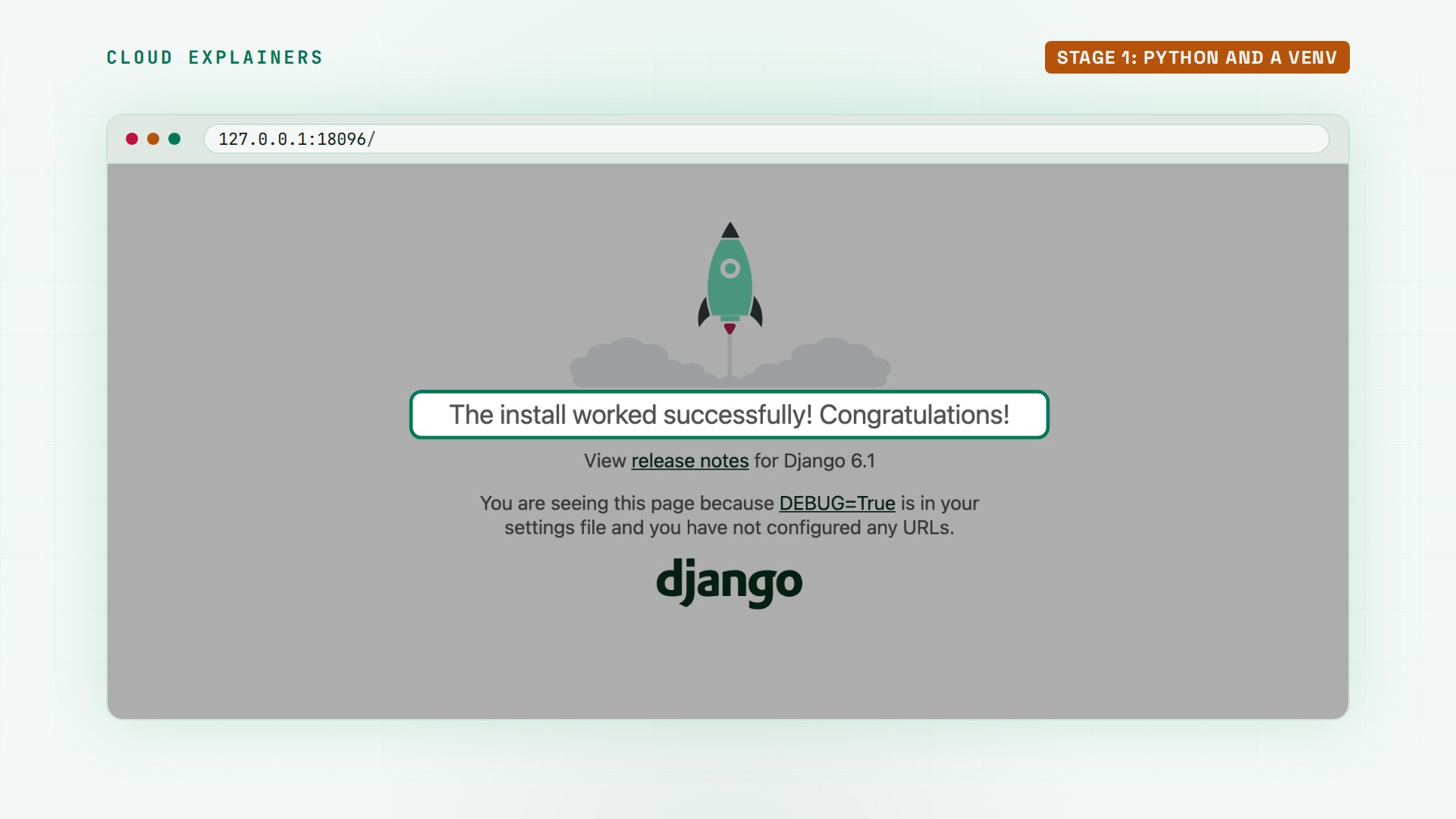
And in the browser, there's Django's rocket page. The install worked.
Stage 2: URLs and views
The rocket page is Django's, not Dave's. So how does Django decide what to show for an address? Stage two is the path every request takes. Django reads the address, finds the matching pattern in urls.py, and calls that pattern's view: a Python function that takes the request and returns a response. Templates and models come later, and they plug into the view.
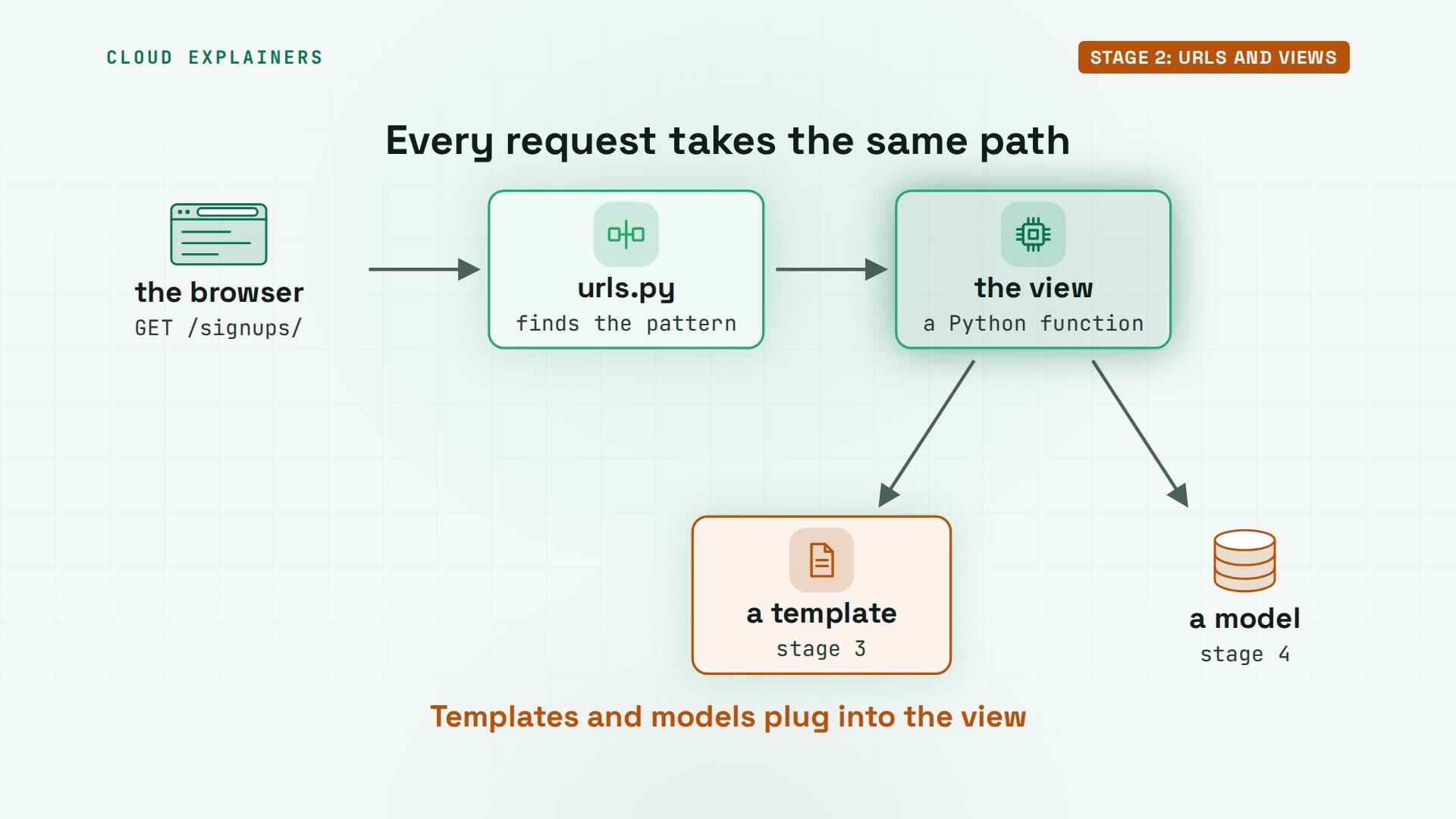
A project is split into apps, one folder for each part of the site, and Dave makes one called signups. His view is a function that returns one line of text, and there are now two urls.py files. The project's file sends any address starting with signups to the app, and the app's file points what's left, nothing, at the view. curl, a browser for the terminal, fetches the page: no dishes yet. Then he asks for signup, without the s, and curl shows just the status code: 404, Not Found.
(.venv) dave@laptop:~/potluck$ python manage.py startapp signups
(.venv) dave@laptop:~/potluck$ cat signups/views.pyfrom django.http import HttpResponse


def dish_list(request):
    return HttpResponse("Potluck sign-ups: no dishes yet")
(.venv) dave@laptop:~/potluck$ cat signups/urls.pyfrom django.urls import path

from . import views

urlpatterns = [
    path("", views.dish_list),
]
(.venv) dave@laptop:~/potluck$ curl -s localhost:8000/signups/Potluck sign-ups: no dishes yet
(.venv) dave@laptop:~/potluck$ curl -s -o /dev/null -w '%{http_code}\n' localhost:8000/signup/404
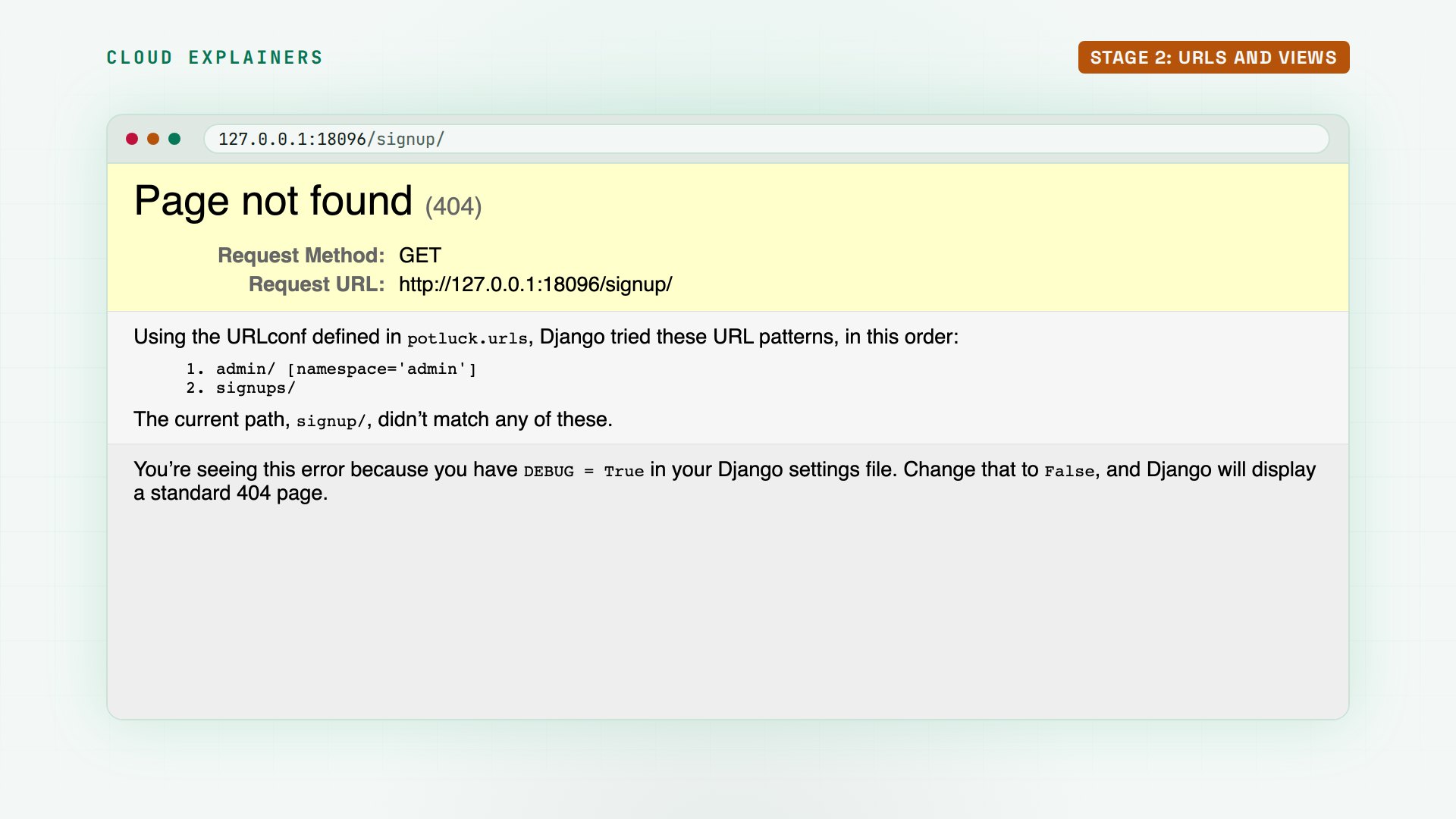
With DEBUG on, Django's 404 page lists every pattern it tried, in order: admin, then signups. When a page won't load, that list is the first place to look.
Stage 3: templates
One line of text won't make a sign-up sheet. Stage three is templates: HTML files with gaps that Django fills in, like a loop that writes one line per dish. Dave's view now renders signups slash list.html, which means it fills in that template and sends it back. The file lives at signups, templates, signups, list.html. The second signups folder keeps its name from clashing with another app's. Guess first: will the page load? No. It's a 500, a server error. The log says: TemplateDoesNotExist.
(.venv) dave@laptop:~/potluck$ cat signups/templates/signups/list.html<h1>Potluck sign-ups</h1>
<ul>
{% for dish in dishes %}
  <li>{{ dish.name }} ({{ dish.kind }}), brought by {{ dish.person }}</li>
{% empty %}
  <li>No dishes yet</li>
{% endfor %}
</ul>
(.venv) dave@laptop:~/potluck$ curl -s -o /dev/null -w '%{http_code}\n' localhost:8000/signups/500
(.venv) dave@laptop:~/potluck$ python manage.py runserverWatching for file changes with StatReloader
Performing system checks...

System check identified no issues (0 silenced).

You have 18 unapplied migration(s). Your project may not work properly until you apply the migrations for app(s): admin, auth, contenttypes, sessions.
Run 'python manage.py migrate' to apply them.
November 24, 2026 - 15:00:17
Django version 6.1.3, using settings 'potluck.settings'
Starting WSGI development server at http://127.0.0.1:8000/
Quit the server with CONTROL-C.

WARNING: This is a development server. Do not use it in a production setting. Use a production WSGI or ASGI server instead.
For more information on production servers see: https://docs.djangoproject.com/en/6.1/howto/deployment/
Internal Server Error: /signups/
Traceback (most recent call last):
  File "/home/dave/potluck/.venv/lib/python3.12/site-packages/django/core/handlers/exception.py", line 56, in inner
    response = get_response(request)
               ^^^^^^^^^^^^^^^^^^^^^
  File "/home/dave/potluck/.venv/lib/python3.12/site-packages/django/core/handlers/base.py", line 199, in _get_response
    response = wrapped_callback(request, *callback_args, **callback_kwargs)
               ^^^^^^^^^^^^^^^^^^^^^^^^^^^^^^^^^^^^^^^^^^^^^^^^^^^^^^^^^^^^
  File "/home/dave/potluck/signups/views.py", line 5, in dish_list
    return render(request, "signups/list.html", {"dishes": []})
           ^^^^^^^^^^^^^^^^^^^^^^^^^^^^^^^^^^^^^^^^^^^^^^^^^^^^
  File "/home/dave/potluck/.venv/lib/python3.12/site-packages/django/shortcuts.py", line 27, in render
    content = loader.render_to_string(template_name, context, request, using=using)
              ^^^^^^^^^^^^^^^^^^^^^^^^^^^^^^^^^^^^^^^^^^^^^^^^^^^^^^^^^^^^^^^^^^^^^
  File "/home/dave/potluck/.venv/lib/python3.12/site-packages/django/template/loader.py", line 61, in render_to_string
    template = get_template(template_name, using=using)
               ^^^^^^^^^^^^^^^^^^^^^^^^^^^^^^^^^^^^^^^^
  File "/home/dave/potluck/.venv/lib/python3.12/site-packages/django/template/loader.py", line 19, in get_template
    raise TemplateDoesNotExist(template_name, chain=chain)
django.template.exceptions.TemplateDoesNotExist: signups/list.html
[24/Nov/2026 15:00:17] "GET /signups/ HTTP/1.1" 500 69339
Django only looks for templates inside apps it knows about, and nobody told it about signups. In settings.py there's a list called INSTALLED_APPS: the apps Django knows about. Add signups to it, and the page renders. Every new app goes in that list.
(.venv) dave@laptop:~/potluck$ grep -A8 '^INSTALLED_APPS' potluck/settings.pyINSTALLED_APPS = [
    'django.contrib.admin',
    'django.contrib.auth',
    'django.contrib.contenttypes',
    'django.contrib.sessions',
    'django.contrib.messages',
    'django.contrib.staticfiles',
    'signups',
]
(.venv) dave@laptop:~/potluck$ curl -s localhost:8000/signups/<h1>Potluck sign-ups</h1>
<ul>

  <li>No dishes yet</li>

</ul>
Stage 4: models
Right now the page can only say no dishes yet: there's nowhere to keep them. Stage four is the database, the last piece of the frame. A database keeps data in tables, a bit like spreadsheets. A model is a Python class that describes one table, and each field becomes a column: the dish, who brings it, and the kind: main, side or dessert. The dish name must be unique, so nobody brings the same thing twice. makemigrations writes the change down as a migration file, a small Python file that says create this table.
(.venv) dave@laptop:~/potluck$ sed -n '4,9p' signups/models.pyclass Dish(models.Model):
    KINDS = [("main", "main"), ("side", "side"), ("dessert", "dessert")]
    name = models.CharField(max_length=60, unique=True)
    person = models.CharField(max_length=60)
    kind = models.CharField(max_length=10, choices=KINDS)
(.venv) dave@laptop:~/potluck$ python manage.py makemigrationsMigrations for 'signups':
  signups/migrations/0001_initial.py
    + Create model Dish
Then Dave changes his view to fetch every dish from the database, and hand them to the template, and the page fails again: no such table, signups_dish. A migration file doesn't change the database by itself.
(.venv) dave@laptop:~/potluck$ curl -s -o /dev/null -w '%{http_code}\n' localhost:8000/signups/500
(.venv) dave@laptop:~/potluck$ python manage.py runserverWatching for file changes with StatReloader
Performing system checks...

System check identified no issues (0 silenced).

You have 19 unapplied migration(s). Your project may not work properly until you apply the migrations for app(s): admin, auth, contenttypes, sessions, signups.
Run 'python manage.py migrate' to apply them.
November 24, 2026 - 15:00:18
Django version 6.1.3, using settings 'potluck.settings'
Starting WSGI development server at http://127.0.0.1:8000/
Quit the server with CONTROL-C.

WARNING: This is a development server. Do not use it in a production setting. Use a production WSGI or ASGI server instead.
For more information on production servers see: https://docs.djangoproject.com/en/6.1/howto/deployment/
Internal Server Error: /signups/
Traceback (most recent call last):
  File "/home/dave/potluck/.venv/lib/python3.12/site-packages/django/db/backends/utils.py", line 105, in _execute
    return self.cursor.execute(sql, params)
           ^^^^^^^^^^^^^^^^^^^^^^^^^^^^^^^^
  File "/home/dave/potluck/.venv/lib/python3.12/site-packages/django/db/backends/sqlite3/base.py", line 359, in execute
    return super().execute(query, params)
           ^^^^^^^^^^^^^^^^^^^^^^^^^^^^^^
sqlite3.OperationalError: no such table: signups_dish

The above exception was the direct cause of the following exception:

Traceback (most recent call last):
  File "/home/dave/potluck/.venv/lib/python3.12/site-packages/django/core/handlers/exception.py", line 56, in inner
    response = get_response(request)
               ^^^^^^^^^^^^^^^^^^^^^
  File "/home/dave/potluck/.venv/lib/python3.12/site-packages/django/core/handlers/base.py", line 199, in _get_response
    response = wrapped_callback(request, *callback_args, **callback_kwargs)
               ^^^^^^^^^^^^^^^^^^^^^^^^^^^^^^^^^^^^^^^^^^^^^^^^^^^^^^^^^^^^
  File "/home/dave/potluck/signups/views.py", line 7, in dish_list
    return render(request, "signups/list.html", {"dishes": Dish.objects.all()})
           ^^^^^^^^^^^^^^^^^^^^^^^^^^^^^^^^^^^^^^^^^^^^^^^^^^^^^^^^^^^^^^^^^^^^
  File "/home/dave/potluck/.venv/lib/python3.12/site-packages/django/shortcuts.py", line 27, in render
    content = loader.render_to_string(template_name, context, request, using=using)
              ^^^^^^^^^^^^^^^^^^^^^^^^^^^^^^^^^^^^^^^^^^^^^^^^^^^^^^^^^^^^^^^^^^^^^
  File "/home/dave/potluck/.venv/lib/python3.12/site-packages/django/template/loader.py", line 62, in render_to_string
    return template.render(context, request)
           ^^^^^^^^^^^^^^^^^^^^^^^^^^^^^^^^^
  File "/home/dave/potluck/.venv/lib/python3.12/site-packages/django/template/backends/django.py", line 107, in render
    return self.template.render(context)
           ^^^^^^^^^^^^^^^^^^^^^^^^^^^^^
  File "/home/dave/potluck/.venv/lib/python3.12/site-packages/django/template/base.py", line 174, in render
    return self._render(context)
           ^^^^^^^^^^^^^^^^^^^^^
  File "/home/dave/potluck/.venv/lib/python3.12/site-packages/django/template/base.py", line 166, in _render
    return self.nodelist.render(context)
           ^^^^^^^^^^^^^^^^^^^^^^^^^^^^^
  File "/home/dave/potluck/.venv/lib/python3.12/site-packages/django/template/base.py", line 1107, in render
    return SafeString("".join([node.render_annotated(context) for node in self]))
                               ^^^^^^^^^^^^^^^^^^^^^^^^^^^^^^
  File "/home/dave/potluck/.venv/lib/python3.12/site-packages/django/template/base.py", line 1068, in render_annotated
    return self.render(context)
           ^^^^^^^^^^^^^^^^^^^^
  File "/home/dave/potluck/.venv/lib/python3.12/site-packages/django/template/defaulttags.py", line 202, in render
    len_values = len(values)
                 ^^^^^^^^^^^
  File "/home/dave/potluck/.venv/lib/python3.12/site-packages/django/db/models/query.py", line 455, in __len__
    self._fetch_all()
  File "/home/dave/potluck/.venv/lib/python3.12/site-packages/django/db/models/query.py", line 2287, in _fetch_all
    self._result_cache = list(self._iterable_class(self))
                         ^^^^^^^^^^^^^^^^^^^^^^^^^^^^^^^^
  File "/home/dave/potluck/.venv/lib/python3.12/site-packages/django/db/models/query.py", line 131, in __iter__
    results = compiler.execute_sql(
              ^^^^^^^^^^^^^^^^^^^^^
  File "/home/dave/potluck/.venv/lib/python3.12/site-packages/django/db/models/sql/compiler.py", line 1643, in execute_sql
    cursor.execute(sql, params)
  File "/home/dave/potluck/.venv/lib/python3.12/site-packages/django/db/backends/utils.py", line 122, in execute
    return super().execute(sql, params)
           ^^^^^^^^^^^^^^^^^^^^^^^^^^^^
  File "/home/dave/potluck/.venv/lib/python3.12/site-packages/django/db/backends/utils.py", line 79, in execute
    return self._execute_with_wrappers(
           ^^^^^^^^^^^^^^^^^^^^^^^^^^^^
  File "/home/dave/potluck/.venv/lib/python3.12/site-packages/django/db/backends/utils.py", line 92, in _execute_with_wrappers
    return executor(sql, params, many, context)
           ^^^^^^^^^^^^^^^^^^^^^^^^^^^^^^^^^^^^
  File "/home/dave/potluck/.venv/lib/python3.12/site-packages/django/db/backends/utils.py", line 100, in _execute
    with self.db.wrap_database_errors:
  File "/home/dave/potluck/.venv/lib/python3.12/site-packages/django/db/utils.py", line 94, in __exit__
    raise dj_exc_value.with_traceback(traceback) from exc_value
  File "/home/dave/potluck/.venv/lib/python3.12/site-packages/django/db/backends/utils.py", line 105, in _execute
    return self.cursor.execute(sql, params)
           ^^^^^^^^^^^^^^^^^^^^^^^^^^^^^^^^
  File "/home/dave/potluck/.venv/lib/python3.12/site-packages/django/db/backends/sqlite3/base.py", line 359, in execute
    return super().execute(query, params)
           ^^^^^^^^^^^^^^^^^^^^^^^^^^^^^^
django.db.utils.OperationalError: no such table: signups_dish
[24/Nov/2026 15:00:18] "GET /signups/ HTTP/1.1" 500 152426
migrate applies it, along with Django's own eighteen. Now Dave opens manage.py shell, which runs Python inside the project, and uses the ORM: Django's way of reading and writing the database in plain Python. He adds Beth's lasagna and his own coleslaw, then asks for only the mains, and gets back the lasagna.
(.venv) dave@laptop:~/potluck$ python manage.py migrateOperations to perform:
  Apply all migrations: admin, auth, contenttypes, sessions, signups
Running migrations:
  Applying contenttypes.0001_initial... OK
  Applying auth.0001_initial... OK
  Applying admin.0001_initial... OK
  Applying admin.0002_logentry_remove_auto_add... OK
  Applying admin.0003_logentry_add_action_flag_choices... OK
  Applying contenttypes.0002_remove_content_type_name... OK
  Applying auth.0002_alter_permission_name_max_length... OK
  Applying auth.0003_alter_user_email_max_length... OK
  Applying auth.0004_alter_user_username_opts... OK
  Applying auth.0005_alter_user_last_login_null... OK
  Applying auth.0006_require_contenttypes_0002... OK
  Applying auth.0007_alter_validators_add_error_messages... OK
  Applying auth.0008_alter_user_username_max_length... OK
  Applying auth.0009_alter_user_last_name_max_length... OK
  Applying auth.0010_alter_group_name_max_length... OK
  Applying auth.0011_update_proxy_permissions... OK
  Applying auth.0012_alter_user_first_name_max_length... OK
  Applying sessions.0001_initial... OK
  Applying signups.0001_initial... OK
(.venv) dave@laptop:~/potluck$ python manage.py shell -c "from signups.models import Dish; Dish.objects.create(name='Lasagna', person='Beth', kind='main'); Dish.objects.create(name='Coleslaw', person='Dave', kind='side'); print(Dish.objects.count(), 'dishes')"13 objects imported automatically (use -v 2 for details).

2 dishes
(.venv) dave@laptop:~/potluck$ python manage.py shell -c "from signups.models import Dish; print(Dish.objects.filter(kind='main'))"13 objects imported automatically (use -v 2 for details).

<QuerySet [<Dish: Lasagna>]>
Stage 5: the admin
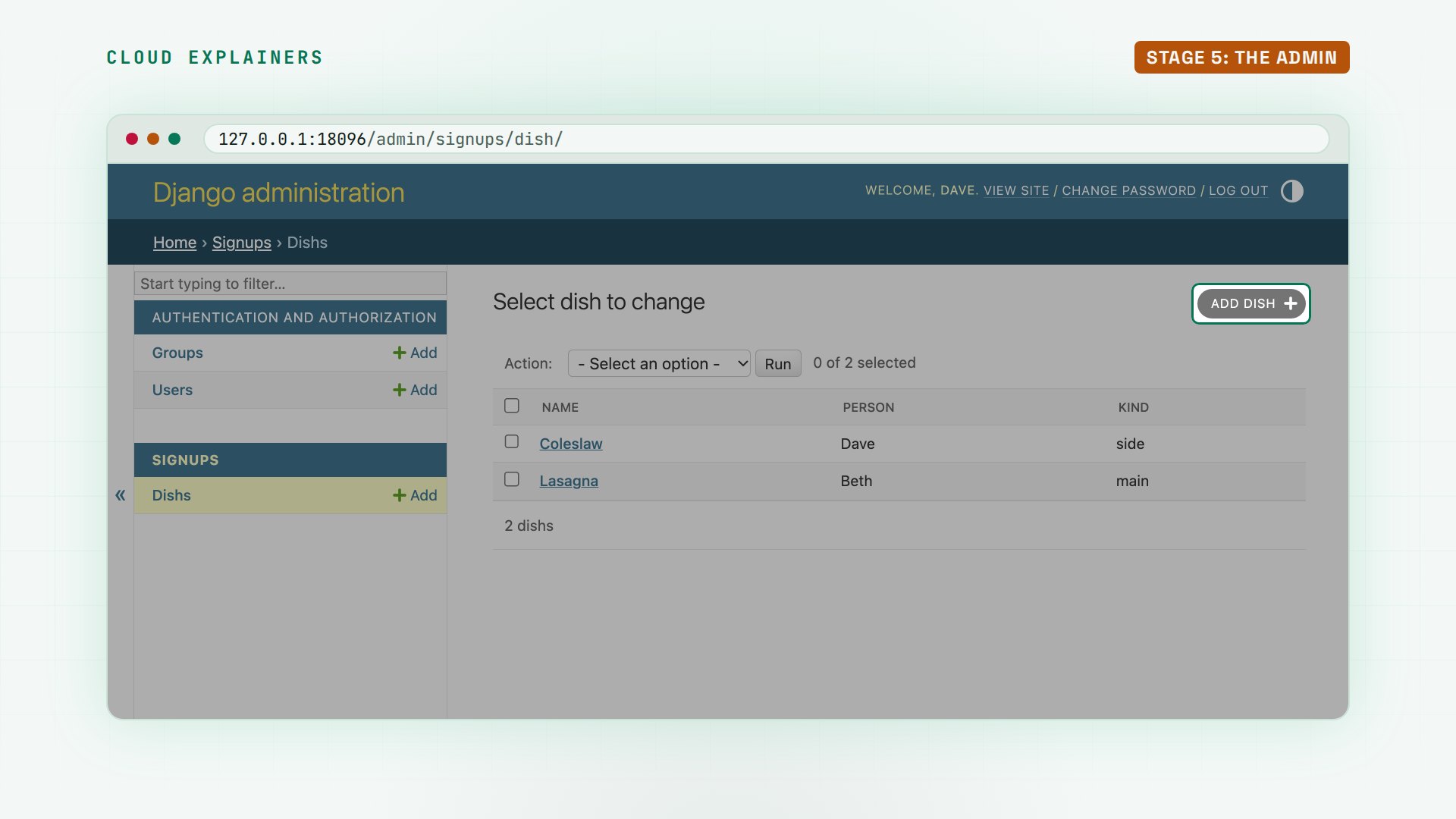
Typing dishes into a Python shell won't work for Beth. Stage five gives her a screen, and it's nearly free. Register the model in admin.py, and create a superuser. That's an account allowed into the admin. Now Django's admin site lists every dish, with a button to add more, and forms to change or delete them. For a small site, it can be the whole back office. But the admin is only for people you trust, like Beth, who runs the potluck. Everyone else needs a page of their own, and that's stage six.
Stage 6: forms
Stage six is that page. A browser asks for the empty form with a GET request, and sends it back filled in with a POST. A ModelForm builds the form from the model, and checks what people type. Every form that sends data also needs one extra line in its template, the CSRF token. It proves the post came from your own page, not someone else's. The token comes with a cookie. Dave's curl request has no cookie, so Django refuses it: 403, CSRF cookie not set.
(.venv) dave@laptop:~/potluck$ grep -n 'form\|csrf' signups/templates/signups/new.html4:<form method="post">
5:  {% csrf_token %}
6:  {{ form.as_p }}
8:</form>
(.venv) dave@laptop:~/potluck$ curl -s -o /dev/null -w '%{http_code}\n' -X POST -d 'name=Chili&person=Dave&kind=main' localhost:8000/signups/new/403
(.venv) dave@laptop:~/potluck$ python manage.py runserverWatching for file changes with StatReloader
Performing system checks...

System check identified no issues (0 silenced).
November 24, 2026 - 15:00:21
Django version 6.1.3, using settings 'potluck.settings'
Starting WSGI development server at http://127.0.0.1:8000/
Quit the server with CONTROL-C.

WARNING: This is a development server. Do not use it in a production setting. Use a production WSGI or ASGI server instead.
For more information on production servers see: https://docs.djangoproject.com/en/6.1/howto/deployment/
Forbidden (CSRF cookie not set.): /signups/new/
[24/Nov/2026 15:00:21] "POST /signups/new/ HTTP/1.1" 403 2908
[24/Nov/2026 15:00:21] "GET /signups/new/ HTTP/1.1" 200 870
[24/Nov/2026 15:00:21] "GET /static/signups/style.css HTTP/1.1" 200 157
[24/Nov/2026 15:00:21] "POST /signups/new/ HTTP/1.1" 200 1045
[24/Nov/2026 15:00:21] "GET /static/signups/style.css HTTP/1.1" 304 0
[24/Nov/2026 15:00:22] "POST /signups/new/ HTTP/1.1" 302 0
[24/Nov/2026 15:00:22] "GET /signups/ HTTP/1.1" 200 275
[24/Nov/2026 15:00:22] "GET /static/signups/style.css HTTP/1.1" 304 0
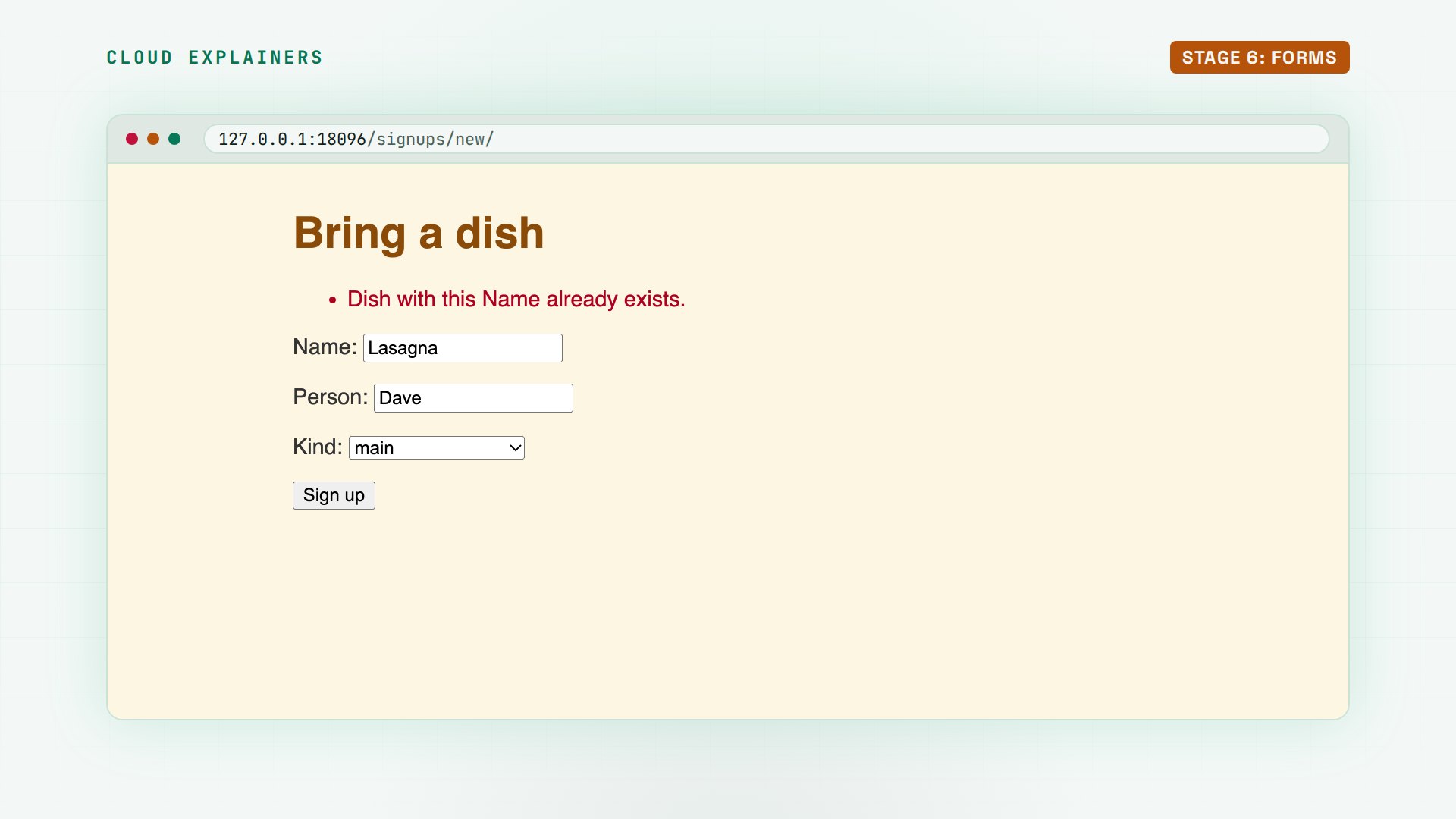
And the model's rules come along for free. A dish name must be unique, so when Dave signs up a second lasagna, the form says: Dish with this Name already exists. No double lasagna at the potluck.
Stage 7: tests
Every time Dave changes something, how does he know sign-ups still work, without clicking through the whole site? Stage seven is tests: small functions that use your site the way a visitor would, and check what comes back. Django's test runner builds a fresh, empty database for every run. Dave writes two tests: the list shows a dish, and the same dish twice is refused. Ran 2 tests: OK. Now he can change anything and know within a second whether he broke it.
(.venv) dave@laptop:~/potluck$ sed -n '7,10p' signups/tests.pydef test_list_shows_dish(self): Dish.objects.create(name="Lasagna", person="Beth", kind="main") page = self.client.get("/signups/") self.assertContains(page, "Lasagna")
(.venv) dave@laptop:~/potluck$ python manage.py testFound 2 test(s).
Creating test database for alias 'default'...
System check identified no issues (0 silenced).
..
----------------------------------------------------------------------
Ran 2 tests in 0.006s

OK
Destroying test database for alias 'default'...
Stage 8: real-world settings
Stage eight is the one most tutorials skip, and the one that stopped Dave's server. DEBUG shows those detailed error pages to anyone who asks, with your code, your settings and your URL list, so it must be off on a real site. With DEBUG off, Django wants a list of the addresses your site answers to, and it turns away a request sent to any other. Dave lists them, and the server starts.
(.venv) dave@laptop:~/potluck$ grep -n '^DEBUG\|^ALLOWED_HOSTS' potluck/settings.py26:DEBUG = False
28:ALLOWED_HOSTS = ['localhost', '127.0.0.1']
(.venv) dave@laptop:~/potluck$ curl -s -o /dev/null -w '%{http_code}\n' localhost:8000/signups/200
The page loads, but bare: the stylesheet comes back 404, Not Found. Static files are your CSS, images and scripts. Django's development server only serves them while DEBUG is on, as a convenience. On a real server, a web server like nginx serves them, and our video on Django static files shows exactly how. It's the kind of surprise this stage is for: nothing is broken in your code, the setting changed the rules.
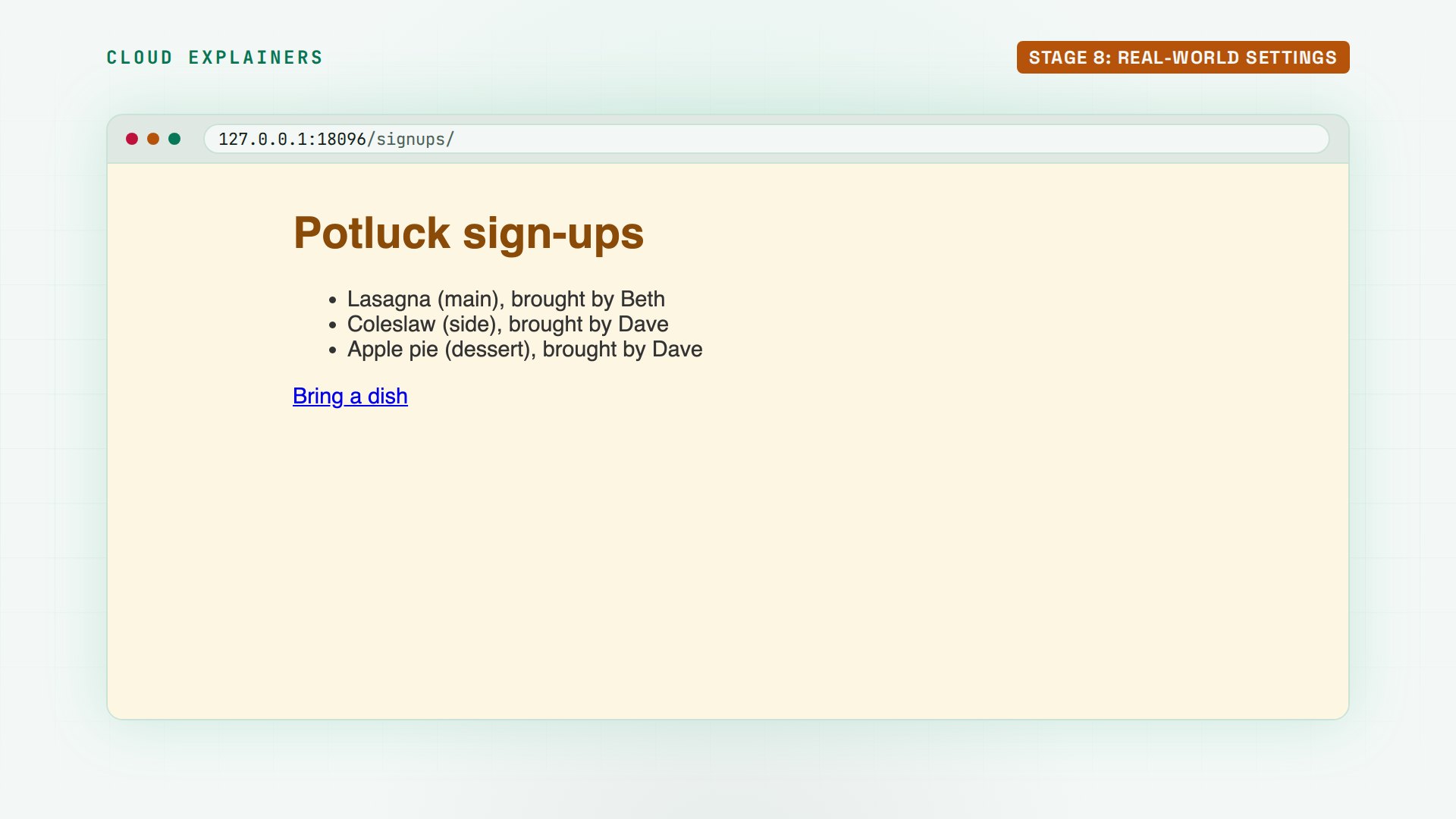
Last, manage.py check --deploy lists what's still missing. Six issues on Dave's site. Three of them: the secret key Django made for development, cookies not marked secure, and an email setting that only prints to the console. Work through that list before anyone else sees your site.
(.venv) dave@laptop:~/potluck$ python manage.py check --deploySystemCheckError: System check identified some issues:

ERRORS:
?: (mail.E001) Your MAILERS setting uses a development-only email backend in the 'default' entry (django.core.mail.backends.console.EmailBackend).
    HINT: Use a production-ready email backend, such as the SMTP backend, otherwise email will not be sent.

WARNINGS:
?: (security.W004) You have not set a value for the SECURE_HSTS_SECONDS setting. If your entire site is served only over SSL, you may want to consider setting a value and enabling HTTP Strict Transport Security. Be sure to read the documentation first; enabling HSTS carelessly can cause serious, irreversible problems.
?: (security.W008) Your SECURE_SSL_REDIRECT setting is not set to True. Unless your site should be available over both SSL and non-SSL connections, you may want to either set this setting True or configure a load balancer or reverse-proxy server to redirect all connections to HTTPS.
?: (security.W009) Your SECRET_KEY has less than 50 characters, less than 5 unique characters, or it's prefixed with 'django-insecure-' indicating that it was generated automatically by Django. Please generate a long and random value, otherwise many of Django's security-critical features will be vulnerable to attack.
?: (security.W012) SESSION_COOKIE_SECURE is not set to True. Using a secure-only session cookie makes it more difficult for network traffic sniffers to hijack user sessions.
?: (security.W016) You have 'django.middleware.csrf.CsrfViewMiddleware' in your MIDDLEWARE, but you have not set CSRF_COOKIE_SECURE to True. Using a secure-only CSRF cookie makes it more difficult for network traffic sniffers to steal the CSRF token.

System check identified 6 issues (0 silenced).
What can wait
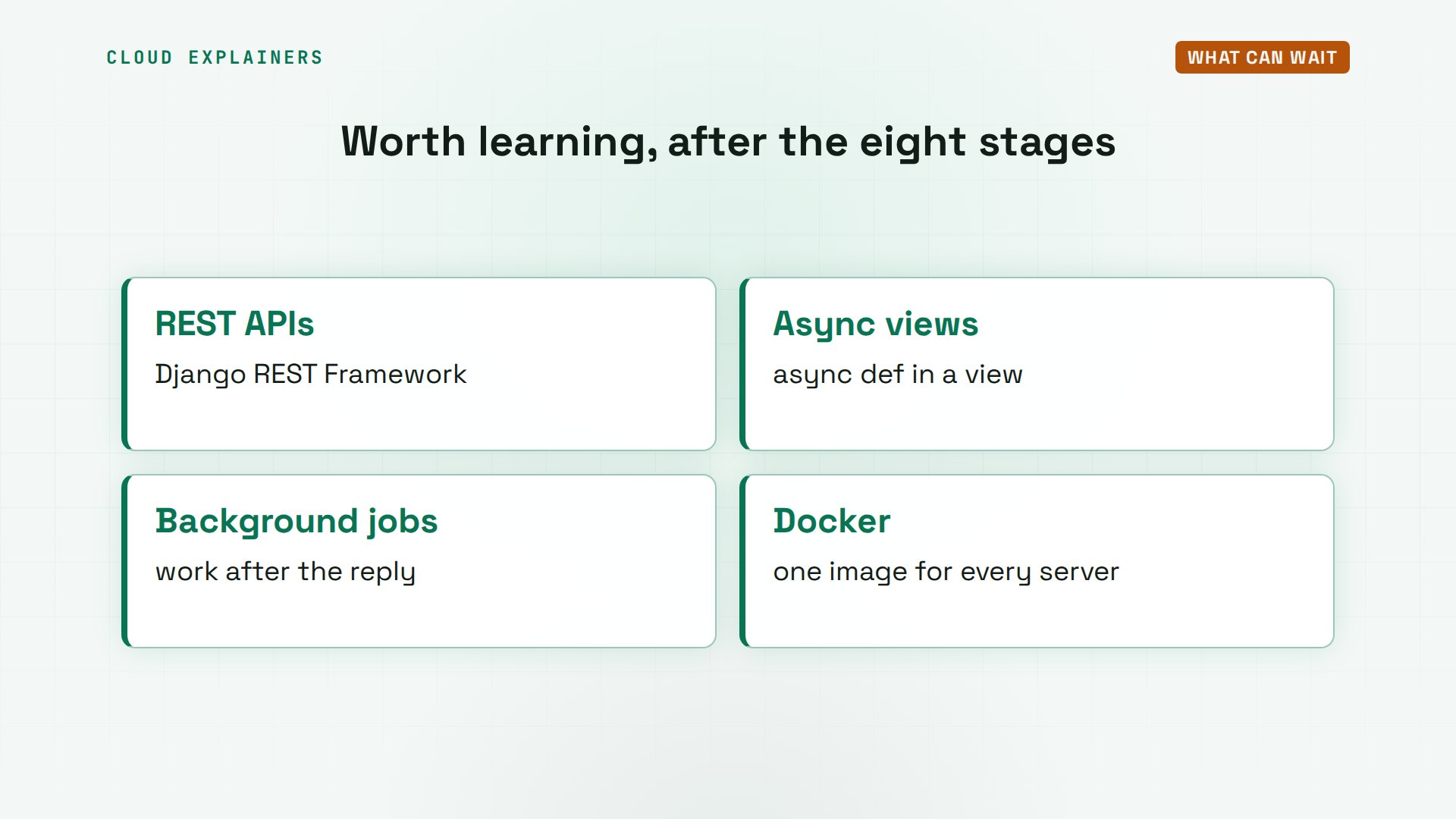
And what can wait? APIs with Django REST Framework, async views, background jobs, and Docker. They're all worth learning, and they all sit on top of these eight stages. An API is still URLs, views and models. An async view is still a view. Learn each one when your site needs it, not before.
Can you change the order? A little. Tests can start as soon as you have one view, and the earlier the better. And the admin only needs a model, so you can open it the day you write one. But stages one to four hold each other up, like the frame and the shelves. And stage eight always comes before anyone else uses your site.
Recap
Eight stages: one page from the database to the browser, then an admin, forms, tests, and settings for the real world.
If this gave your Django learning an order, a like helps YouTube show it to more beginners, and subscribing brings each stage's next episode your way.
All the lab files and commands are linked in the description. Thanks for watching Cloud Explainers.
Sources
- Django documentation, Writing your first Django app (parts 1-5)
- Django documentation, URL dispatcher
- Django documentation, Templates (the app directories loader)
- Django documentation, Migrations
- Django documentation, The Django admin site
- Django documentation, Cross Site Request Forgery protection
- Django documentation, Testing tools
- Django documentation, Deployment checklist
- Django documentation, ALLOWED_HOSTS and DEBUG
- Python documentation, venv
Demos: a container on our own Mac standing in for a laptop; the potluck is made up. Django was downloaded from PyPI during the run. Every command, error and number was real. Watch the full video on YouTube.
More videos
Every PostgreSQL Setting to Change After You Install It

What Happens When You Install Docker on Ubuntu

How to Fix Python 'Address Already in Use' Errors
Golang Interfaces and Mocks in 5 Minutes
How to Fix Git 'Detached HEAD' State
Linux Firewall with ufw: Full Tutorial for Beginners
Golang defer Statements in 5 Minutes
How to Fix OAuth 'invalid_grant' Errors
The SQL Roadmap for Beginners
Golang make() for Slices and Maps in 5 Minutes
How to Fix Network 'No Route to Host' Errors on Linux
How to Fix Linux 'Too Many Open Files' Errors

Every Django Concept a Beginner Needs to Know
SSH on Linux: Full Tutorial for Beginners

Golang for range Loops in 5 Minutes
SQL Databases: SQLite vs PostgreSQL
Golang Structs in 5 Minutes

Redis: Full Tutorial for Beginners

Golang context.Context in 5 Minutes
How to Fix MySQL Database Error 1045: Access Denied for User
Golang Method Receivers in 5 Minutes
How to Fix Python SSL: CERTIFICATE_VERIFY_FAILED Errors

How to Fix Django Static Files Not Loading in Production

OpenRouter vs Direct API Keys: Which One Should You Use?
Golang if err != nil Checks in 5 Minutes

How to Fix Golang 'go.mod File Not Found' Errors

MCP Servers: Full Tutorial for Beginners
Golang Error Return Values in 5 Minutes
How to Fix Python ModuleNotFoundError: No Module Named
Golang Pointers in 5 Minutes
How to Fix a Kubernetes Pod Stuck in CrashLoopBackOff
How to Fix a Homelab ESXi Host Not Responding
PostgreSQL: Full Tutorial for Beginners
How a Load Balancer Works with HAProxy

How Python Virtual Environments Work
How to Fix Cloudflare Tunnel Errors in a Homelab
How to Fix API CORS Errors: No 'Access-Control-Allow-Origin'

How Authenticator App Login Codes Work (TOTP)
Git and GitHub: Full Tutorial for Beginners

How a Homelab Hypervisor Works (VMware ESXi)
How to Fix Kubernetes ImagePullBackOff Errors
How to Fix DNS 'Temporary Failure in Name Resolution' on Linux
How to Fix AWS CLI 'Unable to Locate Credentials'
Proxmox vs ESXi for Your Homelab: When Each One Wins
PostgreSQL UUID vs Auto Increment: Which Primary Key Should You Use?
Kubernetes: Full Tutorial for Beginners

How TCP Sockets Work

How to Fix PostgreSQL 'Could Not Connect to Server'
Claude Code Hooks Will Finally Make Sense After This
DevOps with Ansible Will Finally Make Sense After This
How SNMP Network Monitoring Works
How to Fix GitHub 'Permission Denied (publickey)' Errors
Docker: Full Tutorial for Beginners
How to Fix PostgreSQL 'Password Authentication Failed'
Why One Linux Server Handles More Users Than You Think
How to Fix Network 'Connection Refused' Errors
DevOps Pipelines: Jenkins vs GitHub Actions
Linux Nginx Reverse Proxy: Full Tutorial for Beginners
Every Networking Term a Beginner Needs in 12 Minutes
How to Fix Docker 'Permission Denied' on docker.sock
How to Fix Git 'Updates Were Rejected' When You Push
How to Fix nginx 502 Bad Gateway Errors on Linux
How to Fix Linux apt 'Could Not Get Lock' Errors (Ubuntu)

How Email Works on the Internet (SMTP) in 10 Minutes
The Python Roadmap for Beginners

Golang REST API with Gin: Full Tutorial for Beginners
How a WireGuard VPN Network Works

Linux Makefiles Will Finally Make Sense After This

SAML vs OAuth vs OpenID Connect: What's the Difference?
How to Fix Python cron Jobs That Never Run
Linux Bash Scripting: Full Tutorial for Beginners
How PXE Network Boot Works
How Active Directory Works

How to Fix a Linux systemd Service That Won't Start
Linux Logs: syslog vs journald
JWT vs Session Cookies: Which One Should You Use?
Docker vs Docker Compose: Which One Should You Use?
How to Fix Docker Compose Containers That Can't Talk to Each Other
Django Full Tutorial for Beginners
How Linux systemd Works

How to Fix 'Windows Cannot Access' Network Share Errors (SMB)
REST vs gRPC: Which One Should You Use?
How to Fix SSL Certificate Chain Errors (Missing Intermediate)
Every Python Concept for Beginners in 10 Minutes
Every SQL Join Type in 10 Minutes
Why OpenRouter Free Models Hit Their Limit So Fast
Why Your Gemini API Free Tier Runs Out So Fast
OpenRouter Will Finally Make Sense After This
How Redis Caching Works
Gemini API vs Vertex AI: Which One Should You Use?
How to Fix a Leaked Gemini API Key
Why Golang Uses Goroutines Instead of Threads
How to Fix Gemini API Error 429: Resource Exhausted
Claude Token Pricing Will Finally Make Sense After This
Why Python Web Scraping Returns Nothing (and the Fix)
Python uv vs pip: Which One Should You Use?
Python Automation: Full Tutorial for Beginners
How OAuth Login Works

Google AI Studio Will Finally Make Sense After This
What Happens When You Run a Docker Container
How to Fix Claude Code Billing Your API Key Instead of Your Plan
Why Passkeys Can't Be Phished Like Passwords
PowerShell vs Bash: Which One Should You Learn?
The Linux Roadmap for Beginners
Django vs FastAPI: Which One Should You Use?
Why SQLite Is the Most Used Database in the World
How a NoSQL Database Like MongoDB Works
How to Fix Python pip error: externally-managed-environment
How to Fix MySQL Too Many Connections Database Errors
Golang Concurrency Will Finally Make Sense After This
How Amazon S3 Works
How Kubernetes Works
How Git Works
How to Fix Docker Port Already Allocated Errors
How PostgreSQL Works
How to Fix Git Merge Conflicts

How to Fix No Space Left on Device in Linux
How the Internet Works
SQL vs NoSQL: When Each One Wins
How to Fix JWT Token Expired Errors (401 Unauthorized)
Claude API vs Claude Pro: Why Your Subscription Doesn't Include It
Why AI Agent Skills Beat Giant Prompts

Linux Cron Jobs Will Finally Make Sense After This

Security Logs Will Finally Make Sense After This
How to Fix a Security Leak: An API Key Pushed to GitHub
DNS Will Finally Make Sense After This
Never Ignore a Security Update
Two-Factor Authentication Will Finally Make Sense
Never Expose a Database to the Internet
SSH Keys vs Passwords: Which Is Safer for Security?
The 5 Levels of Linux Boot: From Power On to Login
The 5 Levels of Network Firewalls
Password Security: Why Hackers Crack Weak Passwords
Why Your Linux Server Runs Out of Memory
HTTP vs HTTPS: What Actually Changes on Your Network

Every Linux File Permission You Need to Know
Linux Processes vs Threads: When Each One Wins
The OSI Model Will Finally Make Sense After This
The 7 Levels of Git
Every Network Troubleshooting Command You Need
Hashing vs Encryption in Cybersecurity: When Each One Wins
Why the Internet Ran Out of IP Addresses
Linux Package Managers: apt vs Snap vs Flatpak
Why Python Is Slow (and When It Doesn't Matter)
TCP vs UDP: When Each One Wins
Stop Running Linux as Root (Do This Instead)
Linux Users and Groups Will Finally Make Sense

Why Phishing Beats Good Security (and How to Spot It)

The 7 Levels of Docker

AI Agents Will Finally Make Sense After This
Stop Using git push --force (Use This Instead)
Agent Skills vs MCP: When Each One Wins

Networking Will Finally Make Sense After This

Every Linux Command You Actually Need
The 7 Levels of Cybersecurity
Every System Design Concept You Need, in One Diagram