
Homelab & self-hosting for Beginners
Every Homelab & self-hosting explainer for beginners: 4 videos, each with its commands, real output and diagrams.
Videos
How to Fix a Homelab ESXi Host Not Responding
Your ESXi host answers ping but its web page won't load, or it stops answering altogether. We broke a real ESXi 8 host five ways and fixed each: a frozen host agent (status still says running; restarting hostd brought the page back in about 17 seconds while the VMs kept running), a stopped agent ('no healthy upstream'), a new DHCP address after a power cut, an unplugged management cable, and a purple screen that took the VMs down with it.
How to Fix Cloudflare Tunnel Errors in a Homelab
Cloudflare Tunnel errors on a home server, fixed on real tunnels: a 502 Bad Gateway because cloudflared in Docker points at localhost, a 502 when the app is stopped (no such host), error 1033 when no cloudflared is connected (an old quick-tunnel address, no restart policy), a tunnel that runs but gives 1033 for almost two minutes because UDP 7844 is blocked, an x509 error from a NAS's self-signed certificate, and a named tunnel's missing catch-all rule.
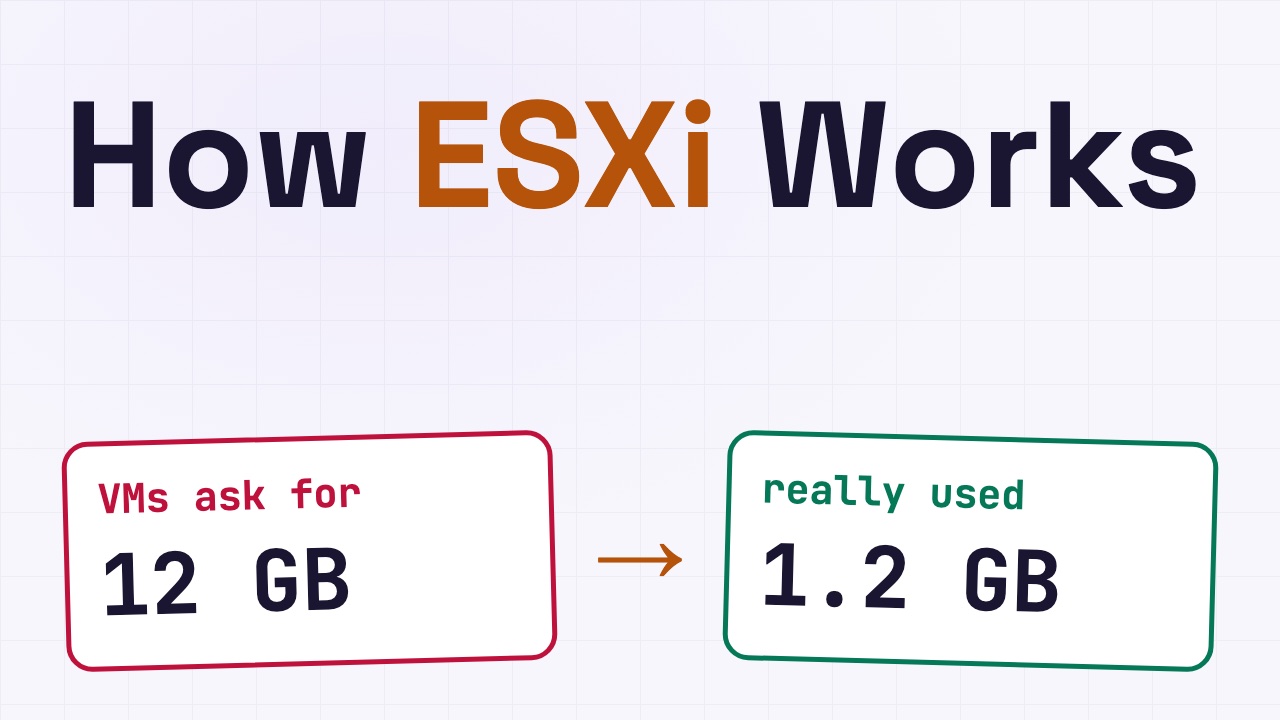
How a Homelab Hypervisor Works (VMware ESXi)
How does ESXi run 12 GB of virtual machines on an 8 GB server? We ran three VMs on a real ESXi 8 host and looked inside: a VM is a folder of files, a running VM is a process that takes turns on the real cores (three busy VMs on two cores each waited about 35% of the time), memory is handed out only when it's touched, and a memory reservation is the setting that makes ESXi say no.
Proxmox vs ESXi for Your Homelab: When Each One Wins
Proxmox or ESXi for a homelab? We installed both on the same small server and ran the same steps: ESXi's installer stopped on a network card Proxmox drives fine, ESXi kept a 40 GB disk all to itself while Proxmox left 12 GB for VMs, a Proxmox container started in under three seconds, and the free ESXi refused to create a VM through its API. Then when each one wins.